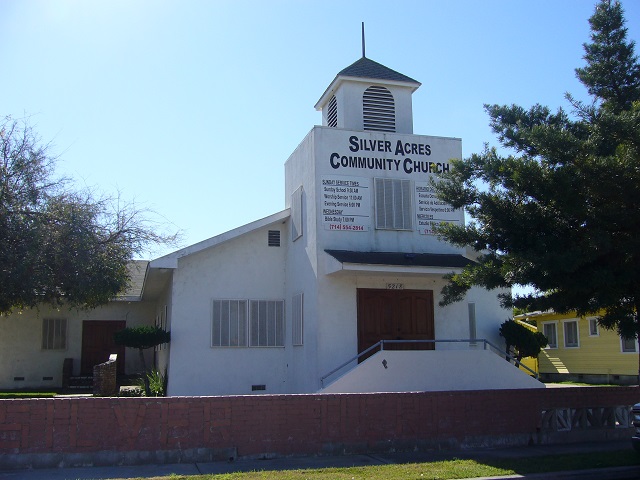
Mrs. Wallace’s Sunday school class met in a small outbuilding at Silver Acres, a community church which stood on a sandy lot at the west edge of Santa Ana, California. We sat on wooden, child-sized chairs arranged in a circle on a linoleum-covered floor that was not completely level. Mrs. Wallace, a woman in her fifties with her brown hair rolled up on the sides, always wore a darker print dress and black shoes. She would set up a flannelgraph board on an easel to display flannel-backed cardboard cutouts of Moses, David, Daniel, Joseph, Mary, miscellaneous angels and of course Jesus. We learned to sing “Jesus Loves Me,” “Rolled away” (as in, my sins are rolled away) and “The B.I.B.L.E.” (“yes; that’s the book for me!”). Fundamentalists were big on the Bible and Silver Acres believed in the Bible―infallible, inerrant, trustworthy, a book to build your life upon. Mrs. Wallace’s class formed me and Silver Acres became my guiding north star in my childhood.
In the break between Sunday School and church we would eat mulberries. In the northeast corner if the Silver Acres lot stood a forty-foot-tall mulberry tree that branched out its shade over the hot, sandy soil and produced amazing, dark blue mulberries. The older kids would reach and pick them off the lower branches or shake the branches to make the berries fall off. We gathered them up, brushed the sand off and bit them, letting the sweet dark juice flow over our tongues. Then we walked into church with blue lips and hands. No one scolded us. I felt enfolded, accepted by the people at Silver Acres and felt known by our pastor, Brother Cantrell.
People came dressed up for church—Dad wore a brown suit with a little Christian Endeavor button pinned to his lapel. Mother wore a dress and black hat, sometimes with a veil. My three sisters wore flowered dresses. I wore a collar shirt, slacks and brown leather shoes. Sundays were special and you dressed up.
In church we never celebrated “high church” events (Lent, Advent, Pentecost, Ascension Day). Instead, we had Easter, Mother’s Day (when they pinned a red rose on each mother and gave you a white rose if your mother had died), Father’s Day (not as big of a deal), Fourth of July, Boy Scout Sunday, a kickoff in the fall when you graduated to the next grade level—and Christmas, always Christmas. Our huge fragrant Christmas tree extended her branches that held ribbons, glass balls and colored metal pendants. Tied on the boughs were small sacks of candy. We couldn’t wait for the Christmas Eve service when they would pass out the little boxes to all the children―boxes that contained plastic prizes, candies and cookies. It was the highlight of the year.
The church women would always direct a Christmas play with the usual suspects—shepherds, the three wise men, an angel or two, Mary and Joseph, and baby Jesus who lay in a wooden trough lined with hay. The mothers would create bright-colored robes, cloth sashes, and kerchiefs for head coverings. Fake beards and wooden staffs for the boys. White dresses and wings for the girls. The storage room behind the church platform transformed into a dressing room. I remember the director bursting into that room yelling “Shepherds! Shepherds!” When I was older, Dad confessed to me that he had loved the early Christmas plays at Silver Acres because he portrayed Joseph and got to kiss Mary on the forehead. This “Mary” later became his wife. To be truthful, I never could see the point of dressing up in robes and creating a drama of a familiar story. In those early years, I took the story of Christmas for granted; it didn’t deeply move me like it does today (“Light of light descending, from the realms of endless day . . .”). But I loved the candy and prizes.
One spring Sunday, a “missionary speaker” came to church. John McIntosh had worked many years in the mountains of Mexico with Wycliffe Bible Translators among the indigenous Huichol people. We gazed in wonder―to be a missionary was the highest calling for a findamentalist. He had brought with him Marta, a Huichol Mexican woman in her forties. She.set a little campstove on the platform, placed a round griddle atop it and knelt to fry tortillas. Standing less than five feet tall, she wore a red and blue embroidered blouse with her long dark hair pulled back and fastened with a yellow band. I don’t remember Mr. McIntosh’s sermon but I remember how the tortillas smelled and the delicious corn taste. Before I was twelve, I determined to become a missionary.
When I entered sixth grade, Jim Hayden, who always wore a dark suit, white shirt and tie, taught our Sunday School class. To get to his classroom, us five boys—Gene, Fred, Ron, John and I―had to climb stairs up to a small room under the squat bell tower. This was our first “segregated” SS class and he took the opportunity to warn us against sexual temptation, enlightening us on the meaning of certain sexual hand signs and counseling us about how to behave with girls. Silver Acres was big on teaching the dangers of sex. However, the only temptation I was feeling at the moment was to pull the church bell rope which passed through the classroom from floor to ceiling. Yet I remember the delicious discovery of the second sex at Silver Acres. At that age, girls were attractive, mysterious and unreachable.
Jim Hayden took our class to overnight at Pine Valley Bible camp, sleeping under the stars. It was a moonless, tar-black night. As we were sitting around the campfire, Mr. Hayden casually mentioned his adventures on snipe hunts. We begged him to take us on one, and he reluctantly agreed. We walked out among the treeless bushes, each holding an open gunny sack. “Now you boys spread out here and stay quiet; I’ll go on ahead and scare up the snipe. They’ll run straight into your bags.” That was the last we saw of Mr. Hayden—turns out he’d returned to camp and snuggled down in his sleeping bag. We waited and waited with our bags but our faith in the snipe and in Mr. Hayden was waning by the minute. Finally, we returned to camp to find him tucked in his sleeping bag. We thanked him by pouring a bucket of water on his head. That night we learned the meaning of “left holding the bag.”
The next year, Art McIntosh taught the bell tower class. His first words shocked me into silence―“Jamie; I’ve heard about you and your reputation. You won’t get away with any of that here.” I idolized this man—he was under contract with Missionary Aviation Fellowship to fly bush planes in New Guinea and I longed to follow in his steps. What could be better than combining overseas mission work with flying small airplanes? I became a model student.
After the break we gathered for the sermon which anchored the whole worship service. Brother Cantrell was a word-meister, skillful in the arcane language of fundamentalism, a skill he tried to pass on to us. He used words such as inerrant (infallible Bible), millennium (1000-year reign of Christ at the end of time), total depravity (humans are totally sinful), election (God sovereignly chose you), substitutionary atonement (Jesus took God’s wrath upon himself and died in our place), eternal security (certainty salvation), and “the world” (that place outside the pale of fundamentalism, the place of spiritual risk and danger). He boiled down the Epistles into great propositions, insisting on the priority of belief but at the same time settmg a high bar for Christian behavior—no alcohol, dancing, smoking, card-playing or movie-going. I learned that living a virtuous life was necessary to “confirm my election.”
To Brother Cantrell, fundamentalism meant an inerrant Bible, no pictures or Christian symbols on the walls and no “sacred places or furniture―he and I played chess on the communion table. We saw ourselves “separated” from the godless world of nonbelievers and from modernist mainline church people. It made me feel special, but lonely.
Grandpa Hurd had given Dad a clarinet and had organized his family into a little dance band—Aunt Elsiebell played the flute, Nylin the sax, Everett, percussion, Dad the clarinet and Grandpa the banjo or the bass viol. Likewise, Dad tried to organize my three sisters and me into a little group, He had limited success but he did recruit me for the church orchestra. I, with my red curly hair and freckles, wearing a brown double-breasted suit with matching pen and pencil set in the pocket, would carry my clarinet up onto the platform and take my seat. When we finished. I would descend the steps to walk over and sit next to Linda Hayden. Beautiful Linda, Jim Hayden’s daughter. Her brother Fred and I were good friends and Mr. Hayden and Tordy would occasionally invite me over for Sunday dinner. After dinner Fred and I would lie on his bed up in his garage loft and listen to “Earth Angel” (Penguins), “The Great Pretender” (Platters), “Rock Around the Clock” (Bill Haley and the Comets) or songs by the new sensation, Elvis Presley. For fundamentalists, popular music was marginal entertainment but somehow, we got away with it. I never asked Linda what she thought about it.
Today, I’m no longer fundamentalist. As I reached my early adult years, I became increasingly troubled―the dogmatic beliefs, the criticism of others, the self-righteous judgments. I admitted the dangers of the world but also began to see everyone as beloved by God. I began breaching fundamentalist fences, expanding my friendships, engaging the deep spirituality of “worldly” people. And yet those early Silver Acres years still live in me. I can still taste the mulberries, still remember Mr. Hayden, Art McIntosh and Brother Cantrell, still hear those big fundamentalist words in my mind. I made good friends, I was guided by caring adults, I received strong moral teaching and I gained a deep knowledge of the Bible. Thank you, Silver Acres, for guiding my childhood.
 Wingspread
You referenced several of my relatives in that story. Art McIntosh and Jim Hayden are my uncles. Linda Hayden my cousin who I made good friends with later in life, and if course Fred Hayden is (was ) also my cousin. Maybe you knew my grandma McIntosh as well. Of the above names only one is still living and that is Art McIntosh.
LikeLike
Who is this? I remember pop and mom McIntosh. Then, John, Gladstone, Victoria and Art. John was father to Ron McIntosh. Gladstone and Geniveve had David and Stephen. Victoria and Jim Hayden had Linda and Fred. Art married Marilyn. Another Victoria married ? and had Dave Hoisington. How do they fit in? The McIntoshes gave me much encouragement and friendship over the years. I knew Ron well at Moody and we would hitchhike out to Naporville for flying lessons.
LikeLike
I remember much of what your story talked about.
LikeLiked by 2 people
Some experiences form you when you embrace them, others when you leave them behind.
LikeLike