
Silver Acres Formed Me
“The President,” sarcastically so called because he was thermometer-thin, unathletic and mute, sat alone on a bench near the Orange High School snack shop. I felt pressure rising in my gut as I sat down to “witness” to him about how all people are sinners and how he needed to “accept Christ” to escape eternal damnation. He said nothing. After about twenty minutes I got up and walked away—and never spoke to him again. My most embarrassing day in high school; I felt like I violated him.
Witnessing to The President was an example of what fundamentalists did. Twice on Sunday and most Wednesday nights our family would drive the eight miles to the church that cradled my childhood: Silver Acres. The men would arrive in suits and women in hats, some with veils. Pop McIntosh led the singing, waving his arm to keep the beat. Before I left elementary school, I had memorized the lyrics of “Power in the Blood,” “It is Well with my Soul,” “Abide with Me,” “Blest Be the Tie that Binds,” etc. Earl Ward taught me to play chess and on men’s potluck night, Mr. Ballew always bought cherry pies, baked by his Emma.
Before Brother Cantrell preached his sermon, he would invite people to join the church: “We’re fundamentalist, independent, unaffiliated, Bible-believing, premillennial, pretribulational.” I thought, if you understood that string of big words serves you right if they baptize you. After church Bro. Cantrell and Walter Loitz would talk Bible and football.
At 10 I could recite all the biblical books in order: Genesis, Exodus, Leviticus, Numbers . . . We would have “sword drills,” using our “sword” to see who could look up verses the fastest. I became a Bible nerd, reading my Scofield Bible, and devouring Bro. Cantrell’s big words: Inerrancy means that the Bible contains no errors of any kind. The world is that territory “beyond the pale,” outside the camp, that place of temptation that lies under control of the Evil One. The rapture, tribulation and millennial kingdom referred to events happening at the end of time. He talked a lot about the end times. Modernist referred to people or churches we shunned, some of which questioned the resurrection, the virgin birth and biblical inerrancy. Some fundamentalists even practiced “secondary separation”—separating from those (e.g., Billy Graham) who themselves fraternized with modernists (e.g., Martin Luther King, Jr.). My friend Jerry was mainline Methodist—I once asked him if his church celebrated Easter! Unlike them, we did not kneel in church or make the sign of the cross. No crosses hung on the wall at Silver Acres, no pictures of Jesus. Instead of liturgy and sacraments we anchored our beliefs in Bible verses.
Growing up, I felt as if knew God’s plans for my life and for the world. And I confess, I carried a teeny bit of pride in my arcane vocabulary. I felt no need to help make the world a better place because the world was under control of the Evil One. So we endeavored to only persuade people to join us as we waited for Jesus to come back.
After WWII, many middle-class Americans valued high morals and a conservative lifestyle but fundamentalists went further. Bro. Cantrell preached against smoking, drinking, dancing, movie theaters and gambling. Of course I grew interested in the church girls. I watched Kay Cantrell sitting broadly on the piano bench in her see-through blouse (pushing the boundaries of fundamentalist norms). One day in the Cantrell parsonage I saw two books lying on the dining room table: What Every Christian Boy Should Know and What Every Christian Girl Should Know. The second sounded more interesting but as I was paging through it, Mrs. Cantrell walked in and warned me, “Jamie, that book is only for girls.”
I was the only one in my grade who did not take square dance classes in middle school. Even into college I never touched a cigarette, never gambled and never drank alcohol. Do I regret these constraints? No. Years later, these same moral values restrained me from jumping into bed with an over-eager girlfriend. I harbor a teeny regret missing the great movies—I never entered a theater until my twenties.
The Scofield Bible, with its authoritative notes, clarified biblical complexities. It erased the ambiguities, melted the mysteries, quieted my questioning and defeated my doubts. It felt good to be certain—you demonstrated your faith by not questioning. I learned that Jesus, son of the transcendent God, died not only for the world but for me.
But we did not merely parrott propositions. It was a social movement created by a faithful band of people who wished to live separate from the world. As a young person I embraced fundamentalist faith and enjoyed being part of the ingroup. It gave me a way to understand the Bible and embrace life-orienting beliefs. It gave me a task—carrying God’s message to the world. I understood why evil existed in the world, understood how to protect myself from it. This buoyed me through the tempests of my early life.
Silver Acres gave me a moral gyroscope that helped me survive the pains of adolescence. It assured me of who I was and what my purpose was in the world. I received precious gifts—a loving community, a dense network of friends and supportive adults. I knew who my people were and who my God was. Silver Acres insulated me from that world of sin and temptation beyond the pale. Later, the church pointed me toward Bible Institute and Christian mission.
And yet, as I moved into adolescence I began to feel like a social leper—different, conspicuous, isolated. There weren’t many fundamentalists out there. I grew to dislike worldly people, criticized their wrong beliefs, judged their lifestyles. I became more and more socially isolated and confused.
Further, I started doubting the great fundamentalist doctrines. The ordinance of communion bored me. Bro. Cantrell would spend half the service assuring us that “this is only grape juice and crackers; nothing to see here.” Ushers passed crumbled saltines and little plastic cups of grape juice along the rows. If communion food was merely grape juice and crackers, why bother? I longed for something deeper, more connective as I explored how far I could tip the communion cup without spilling the juice.
Since the Bible was inerrant, I was terrified I would find one small mistake that would destroy my whole faith. I worried about conflicts between the gospel accounts and how to reconcile the Old Testament God who commanded the destruction of the Canaanites with the New Testament God-in-Jesus who preached unconditional love?
Fundamentalists argued that the Bible is literally true “in all it affirms.” But how could the book of Revelation be literally true? Locust-shaped horses with women’s hair and stingers in their tails, stars falling to earth, a beast with ten heads . . . Surely these were symbolic?
I had the most trouble when the text touched scientific subjects—the “four corners” of the earth, the sun rising and setting. If you did the genealogies in the Bible, the universe seemed to be only 6,000 years old. How could this square with scientific findings? Surely the text was pre-scientific? How convince worldly people to accept something I myself had trouble believing?
When I moved to Cal State Fullerton and joined Intervarsity Christian Fellowship, I encountered a wonderful community that included strong Christians from mainline and Catholic traditions. I enjoyed friendships at Cal State with non-Christians and even atheists. My very questions and doubts gave me a kinship with them. I became more transparent and found they would frequently open up about their own questions. I was expanding my scope, widening my tent, embracing the world beyond the pale. I had found an expression of faith I could believe in and even more important, a faith that I could celebrate and share.
Not long ago, I boarded the Amtrak to travel from Mattoon, Illinois back to Minneapolis. Finding my assigned seat, I discovered a young man stretched out across it, asleep. I cautiously woke him. sat down, and for the next two hours, enjoyed an amazing conversation. Jamil, married and in his early twenties, was Palestinian, a “man without a country.” And Muslim. Formerly, I would have argued with him about the Bible or the deity of Christ. But this day, I found I was talking to a man in transition. His marriage was in trouble and he was looking for a mosque and an imam he could relate to. He was full of questions. I sympathized, talking about my own quest for a church and minister. We parted friends and talked by telephone a couple of times after that.
I treasure my fundamentalist foundations but today I’m happy living “beyond the pale” and learning how to embrace all people in God’s beloved world, happy learning that we all are on a spiritual quest.
Man (sic) cannot name himself.
He waits for God or Satan
To tell him who he is.
Unknown
Americans are experiencing a crisis of identity. I asked a middle school counselor why people came to see her. “Anxiety!” she said, “feeling they can’t measure up.” At this crucial age students compare themselves to others, especially to the images on social media that tell them two things. 1. There are Beautiful People in the world. 2. You are not one of them.
By identity we mean how a society views a person and how a person chooses to view themselves. We work on our identity all of our lives, either reinforcing our received identity or questioning that identity and seeking to transform it. Some Asian American leaders are excited about Kamala Harris becoming the first Asian American president. But Donald Trump criticized her for first identifying as Asian Indian and then “happened to turn black. . . Is she Indian or is she black?” (She has long identified as black; she graduated from Howard University where she belonged to a “black” sorority.) Of course she’s both. How can an outsider judge Harris’ racial identity? It’s a strange argument—saying that she “changed” from Asian to black. It may be a veiled critique of people of “mixed” ancestry. And President Obama—most people (and he himself) consider him “black.” He is half “white” but nobody considers him white. The old “one drop” rule applies—if you have one drop of “black” blood you’re black. In the 1800s the one drop rule was important to try to forbid the mixing of European with the African slave races. As late as 1980, Bob Jones University asked students to declare their race and forbade dating between the “races.”
Identity matters. An ambiguous or negative identity can provoke depression, anger, social isolation and even homicide or suicide. For example, National Institutes of Mental Health reports that gender dysphoria (confusion about one’s gender) creates a profound confusion about identity and is reflected in higher suicide rates. Among transgender adults in the U.S., 81% have thought of suicide, 42% have tried it, and 56% have engaged in non-suicidal self-injury over their lifetimes.
People receive their identity from others. The child receives their identity from parents: gender, race and membership in a social or religious group (e.g., male white Protestant)..
Even more than our adopted daughters, our son struggled with his racial identity after we adopted him in Colombia. When he was eight, I told him that my great-grandfather Alex was born in Dublin. He asked me wide-eyed: “Dad—Are we Irish?”
Amish communities socialize their children to see themselves as a member of the Amish community. They erect barriers, physical and social, that limit the child’s contact with alternative possibilities. This illustrates the social nature of identity and the power of intentional socialization.
Most parents “gender” their children, e.g., encourage and strengthen the child’s gender identity. Children usually accept these imposed identities. How far should parents go to reinforce a child’s identity, or how enthusiastically should they support their wish to change? A suicidal girl in high school transitioned from female to male gender. His suicidal thoughts subsided. His father exclaimed, “I finally have the boy I wished for!”
People learn to reinforce their identities through clothing, grooming or behavior. The New York Times reported a recent event where 24 NBA rookies, before they were drafted, met to show off their clothes and discuss their decisions about how to represent themselves.
No one is condemned to accept their socially-imposed identity. But what happens when a person transgresses, challenges the identity given to them? They might start “talking black,” swearing, dressing differently, cosplaying (dressing and acting like a fictional or famous character). Sometimes transgression is temporary but sometimes it becomes permanent.
Amish young people sometimes attempt to leave their church, community and culture. People sometimes try to renounce their families. When young people go to college they may form new friend groups along with new opinions and new identities.
We all exhibit layered, hierarchical identities, some more salient than others. People may get caught displaying one identity in one group but codeswitching when in another group. Years ago I was on a train with a group of marines headed home after Pendleton Marine bootcamp. They were earnestly trying to clean up their foul “Marine language” before showing up at Mom and Dad’s door. Their new marine identity clashed with their identity in their family.
Standing out or fitting in? Instead of trying to fit in, some people may strive to stand out. An elementary school principal told me that when the fifth-grade kids were asked to form a boys’ line and a girls’ line, two students stood apart. They were trying out “nonbinary” (refusal to identify as either gender). I asked the principal if “nonbinary” would become their permanent identity. “Probably not,” he said. “They’re just trying it out.”
My adopted son identified as African-American all through school and beyond. But after he turned 40, he sent off his DNA sample to figure out his genetic history. It came back with a little African but substantial “Spanish” ancestry. So he changed and began to identify as Latino. He feels more comfortable with this new identity and is trying to grow into it. I joke with him that he should start wearing Converse tennis shoes and squinting a little!
“I am who I say I am.” And yet when does my freedom impinge upon others? People may try to adopt a new identity but their family or social group may refuse to accept the change. So they must give up the attempt to change or seek a new social group. Suppose I am white but I try to identify as Latino or black on a college application. Or try to present myself as having Tourette’s syndrome without being diagnosed. These experimental identities carry economic and legal implications and ultimately may not be accepted by others.
Is gender identity personally constructed? A young child gradually learns their gender identity and learns how to perform that identity. When I was a young boy I was desperate to fit the image of a male—I would try to cross my legs like a man rather than like a woman. Elvira de Bruyn was a Belgian cycling champion who excelled in women’s cycling races in the 1930s. However in 1937 he declared he wished to live the rest of his life as a man.
What is “female” and what is “male” behavior, anyway? These identities are not all arbitrary, not all culturally imposed. Richard Dawkins argues that in any species, being male or female demands certain behaviors, especially those behaviors most closely connected to reproduction. This is because natural selection rewards certain behavioral strategies in males, and different strategies in females, by imparting reproductive success (offspring). A male has an unlimited supply of sperm, but a female has a limited number of valuable eggs. Thus, for instance, a male may seek a variety of sexual partners and change partners more often while a female may seek fewer partners and focus more on quality and caretaking. Thus, although males and females each show a wide spectrum of behaviors, we are warranted in identifying as typical those “male” and “female” behaviors that are key to reproductive success.
Here are a few terms related to sexual preference and gender orientation.
Can I force others to honor my chosen identity(ies)? Identity politics argues for the rights of individuals to assert their membership in a group: ethnic, religious, sexual, etc. Many states have “hate crime” laws to prosecute offenders targeting certain ethnic, racial or religious groups. These laws compel the many to respect the rights of the few. Just last month, California banned schools from forcing teachers to notify parents when students request different names or pronouns. (In protest, Elon Musk said he would move the headquarters of his companies X and SpaceX from California to Texas.)
In Tennessee, four transgender women plaintiffs petitioned the court to change their sex on their birth certificates to conform to their current gender identity. Just recently the 6th U.S. Circuit Court of Appeals upheld a 2023 district court ruling that found that the state of Tennessee can legally prohibit changing a child’s sex on their birth certificate. Across the states, laws about identity are constantly changing—encouraging or restricting people’s attempts to assert their identity.
And bathrooms. Some schools have responded to the “bathroom issue” by creating unisex bathrooms. For instance, Blaine High School has generic bathrooms (no doors, wide entrances, a row of sinks on one side and individual stalls on the other). This prevents transgendered men from walking into single-sex women’s bathrooms (because there are none).
And yet even the law does not and should not compel acceptance of certain identities: criminal, abusive, pedophile (or the euphemism “minor-attracted person,” MAP ). An 18-year-old person cannot identify as a 22-year-old so they can buy alcohol. The law prevents an individual from impersonating a doctor or an officer of the law. It is illegal to gain employment using falsified credentials.
Religious groups have successfully litigated against some identity laws. For instance, Christian colleges are not yet compelled to hire individuals who identify as gay or transgender. These colleges argue that this hiring would violate their religious beliefs about the sacredness of heterosexual sex and biblical teaching asserting two distinct biblical genders.
How can I name myself, be true to myself? If the epigraph at the head of this essay is true, we ultimately need to find our identity in the transcendent— an identity primordial, unchanging, holistic, certain.
For Christians, the Bible encourages us to embrace a new identity. I “cannot name myself” but I can embrace and grow into the person God says I am. St. Paul talks about the old person and the new person. To become a Christ-follower means to embrace a new identity—child of God and brother/sister to Christ. This identity is neither imposed by our social group nor fabricated by the individual. It is a gift from God and is immune to the tides and storms that threaten to overwhelm. With a plethora of identities swirling around us we must choose who to trust. For Christians, our identity is rooted in trusting how God defines us.
I can’t control what people mean by “evangelical” any more than I can demand that non-English speakers understand my English. A word means what the hearer thinks it means. Meanings of words change. For instance, “gay” used to mean bright and happy, as in “a gay party.” “Cool” used to refer to air temperature. In the last few decades, “evangelical” has grown to mean something different. It used to be that people thought a fundamentalist was an evangelical on steroids and an evangelical was a fundamentalist on Prozac No more.
I started out fundamentalist, not evangelical. At Silver Acres church Pastor Cantrell would say, “If you wish to join our church, we’re independent, non-denominational, unaffiliated, Bible believing, pre-millennial, and pre-tribulational.” I thought, if you understood all that, you deserved to be baptized! Two things were important: right belief and right lifestyle. Right belief meant belief in an inerrant Bible. At Silver Acres, a wall-to-wall mural showed scenes of the fantastic beasts of Revelation and the elect (us) flying up to heaven before the world’s tribulation and the coming of the millennial reign. I don’t remember studying Jesus’ Beatitudes; fundamentalists thought these were applicable only in the millennial age. We concentrated more on the epistles.
We fundamentalists soldiered through life separated from the corrupt world, trying to recruit others to our small band. We avoided a select list of behaviors—I didn’t go to a dance until I was 22 years old. Ditto for drinking alcohol or attending a public movie theater. I never even tried smoking. My sister and I watched Spade Cooley smoking on a black and white show and knew he wasn’t a Christian. These prohibitions, not the Beatitudes, guided my behavior and made me feel superior to the worldly folks around me. At the same time, I felt myself a weak outsider to their way of life.
After graduating Moody Bible Institute I attended Cal State Fullerton. My fundamentalist identity didn’t work very well there so I started calling myself evangelical. I sought to make friends with “worldly” people and broadened my tolerance for other Christians—even Catholics.
People used to define an evangelical as “somebody who liked Billy Graham” (even though fundamentalists would criticize him for hanging around with the liberal “modernists”) According to British historian David Bebbington, an evangelical Christian believed in four essential doctrines: 1. A person must have a “born again” conversion experience—hence evangelicals were known as “born-again Christians.” 2. Jesus’ death on the cross atones for humankind’s sins. 3. The Bible is the ultimate spiritual authority. (When you ask, “How does God come to you?” an evangelical is more likely to say, “through the Bible.”) 4. Christians ought to actively share their faith through witnessing and good works.
And yet today most people hearing the word “evangelical” don’t think of pious, separated, sober people who take the Bible seriously. “Evangelical” has fuzzy boundaries. A 2022 comparative survey asked the question, Would you describe yourself as a born again evangelical? Between 15 – 25% of Mormons, Muslims and Catholics answered “yes.” (https://www.graphsaboutreligion.com/p/the-rise-of-the-non-christian-evangelical) Today, some of the people in the following groups self-identify as evangelical: People in historic “mainline” churches (Lutheran, Methodist, Presbyterian, Episcopal and also Catholic). People of other religions such as Islam. Even some people who are atheist or agnostic. What do these people mean by “evangelical?”
Today, for many people,“evangelical” means a certain political persuasion. The conservative evangelical block is the most reliable voting block for right-wing political causes. This block is even rehabilitating the term “Christian nationalism.” To help pay his legal bills, the Republican nominee for President is now hawking the “God Bless the USA” King James Bible ($59.99) which also contains the US Constitution and Declaration of Independence, thus lending bible’s advertising campaign his name, likeness and image.
Today, “evangelical” may refer to people who would vote for anti-abortion laws. They would favor restricting trans people from church leadership and would oppose blessing same-sex couples. Many would oppose D.E.I. (diversity, equity and inclusion) being taught in public schools. All of this seems more political than biblical.
Sadly, the term “evangelical” has been contaminated by right-wing politics and thus has lost its traditional meaning to most people outside the church. Thus, if you wish to identify today as an evangelical Christian (in the traditional sense) you must use a different term!
So, do I call myself an evangelical? If I’m talking to evangelical “insiders” who share the old definition, maybe. But in general I avoid the term with people outside the church. I use “Christ follower” or simply “Christian.” Why? Because if you wish to maintain your true identity you must use the language, not of your grandparents, but of contemporary hearers. To maintain the meaning you must change your words.

Spreading your wings in a perplexing world
September 2023 James P. Hurd
Please forward and share this E-zine with others. Thank you.
Contents
BLESSED UNBELIEVER novel
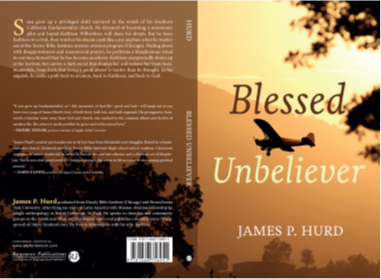
The novel was written partly for people of nonfaith. I am happy some have read it and commented on it. I am thrilled that Koorong, largest Christian book publisher in Australia, will distribute Blessed Unbeliever.
Blessed Unbeliever (paper or Kindle version) can be found at Wipf and Stock Publishers, Amazon https://a.co/d/9su5F3o or wherever good books are sold.
Writer’s Corner

Tip for writers: After finishing your rough draft, label each paragraph with an italicized word or phrase at the beginning of each paragraph. For example, Sally meets John. Use WORD “outline” mode and select “first line only.” You will see only the first lines of all your paragraphs, including your italicized labels. Easy now to see the structure of your piece, and to move paragraphs around to create a better flow.
Word of the month: SKIPLAGGING. Refers to air travel. You book a through flight with one stop in-between and you get off at the in-between stop. The airlines don’t like this because sometimes they lose money.
I asked which five books you would take if stranded on a desert island: I dunno, but here are my ideas of books and authors: Bible, Cadfael Chronicles by Ellis Peters, Henry Noewen, Charles Dickens, C.S. Lewis.
New story: The Churched Atheist
Really though—if you’re an atheist you need church as much as believers do! Behold, all the benefits of churchgoing—singing, making friends, potlucks, social service, moral guidance, coming of age rituals (e.g., confirmation, graduation), social intensification rituals (e.g., births, baptisms, weddings, funerals). You may find a loving, accountability group (e.g., Christian AA) that offers hope instead of despair. You will find a good job-seeker network. A support group for life crises. A place to get married or buried. A place that offers meaning to your life. You might even find free babysitting! You can have all these things without abandoning atheism because so much of church life does not demand any belief in the supernatural
Turns out that churchgoing is good for your health. A 2020 study published in the International Journal of Epidemiology reported that church attenders had a 26% reduced risk of dying and a 34% lower risk of heavy drinking. Church attendance was also associated with less anxiety, depression, hopelessness and loneliness. Church attenders lean toward healthy family and community behaviors. You’ll find good mentors who will hold you accountable and give you honest critique. If you’re older, just getting out of the house and doing something—anything—is good for you. If you’re younger, hey, it might be worth going just to make your parents happy! . . .To read more, click here: https://jimhurd.com/2023/08/31/churched-atheists/ Leave a comment on the website and share with others. Thanks.
This month’s puzzler
Adapted from Car Talk Puzzler archives
Here is a list of six words.
Which one of these words does not belong, and why?
(Answer will appear in next month’s WINGSPREAD newsletter.)
Answer to last month’s puzzler:
Remember that a man’s son asked about hitting 160 miles per hour in both the Mustang and the BMW. How did the man know that the BMW would not hit that speed, and that the Mustang would?
Because when he looked down at the speedometer, he also looked at the tachometer. Both of these cars redline at about 6000 RPM. So, at 60 miles an hour which he was traveling at that time, the BMW was doing 3100 RPMs. And he knew that at 120 miles an hour, it would be beyond the redline and incapable of doing 160 miles an hour.
And the Mustang he was driving at 60 miles an hour was doing less than 2000 RPM. It was running around 1750 at 60 miles per hour. So at that point, he knew that this car could possibly get to 160 without redlining.

Subscribe free to this Ezine
Click here https://jimhurd.com/home/ to subscribe to this WINGSPREAD ezine, sent direct to your email inbox, every month. You will receive a free article for subscribing. Please share this URL with interested friends, “like” it on Facebook, retweet on Twitter, etc.
If you wish to unsubscribe from this Wingspread Ezine, send an email to hurd@usfamily.net and put in the subject line: “unsubscribe.” (I won’t feel bad; promise!) Thanks.
Wisdom
How many of these 21st century words do you know?


You knew somebody would think of this sooner or later . . .
*Yogi Berra played catcher for 18 seasons with the New York Yankees.
Happy reading and writing!
 Wingspread

