
Silver Acres Formed Me
“The President,” sarcastically so called because he was thermometer-thin, unathletic and mute, sat alone on a bench near the Orange High School snack shop. I felt pressure rising in my gut as I sat down to “witness” to him about how all people are sinners and how he needed to “accept Christ” to escape eternal damnation. He said nothing. After about twenty minutes I got up and walked away—and never spoke to him again. My most embarrassing day in high school; I felt like I violated him.
Witnessing to The President was an example of what fundamentalists did. Twice on Sunday and most Wednesday nights our family would drive the eight miles to the church that cradled my childhood: Silver Acres. The men would arrive in suits and women in hats, some with veils. Pop McIntosh led the singing, waving his arm to keep the beat. Before I left elementary school, I had memorized the lyrics of “Power in the Blood,” “It is Well with my Soul,” “Abide with Me,” “Blest Be the Tie that Binds,” etc. Earl Ward taught me to play chess and on men’s potluck night, Mr. Ballew always bought cherry pies, baked by his Emma.
Before Brother Cantrell preached his sermon, he would invite people to join the church: “We’re fundamentalist, independent, unaffiliated, Bible-believing, premillennial, pretribulational.” I thought, if you understood that string of big words serves you right if they baptize you. After church Bro. Cantrell and Walter Loitz would talk Bible and football.
At 10 I could recite all the biblical books in order: Genesis, Exodus, Leviticus, Numbers . . . We would have “sword drills,” using our “sword” to see who could look up verses the fastest. I became a Bible nerd, reading my Scofield Bible, and devouring Bro. Cantrell’s big words: Inerrancy means that the Bible contains no errors of any kind. The world is that territory “beyond the pale,” outside the camp, that place of temptation that lies under control of the Evil One. The rapture, tribulation and millennial kingdom referred to events happening at the end of time. He talked a lot about the end times. Modernist referred to people or churches we shunned, some of which questioned the resurrection, the virgin birth and biblical inerrancy. Some fundamentalists even practiced “secondary separation”—separating from those (e.g., Billy Graham) who themselves fraternized with modernists (e.g., Martin Luther King, Jr.). My friend Jerry was mainline Methodist—I once asked him if his church celebrated Easter! Unlike them, we did not kneel in church or make the sign of the cross. No crosses hung on the wall at Silver Acres, no pictures of Jesus. Instead of liturgy and sacraments we anchored our beliefs in Bible verses.
Growing up, I felt as if knew God’s plans for my life and for the world. And I confess, I carried a teeny bit of pride in my arcane vocabulary. I felt no need to help make the world a better place because the world was under control of the Evil One. So we endeavored to only persuade people to join us as we waited for Jesus to come back.
After WWII, many middle-class Americans valued high morals and a conservative lifestyle but fundamentalists went further. Bro. Cantrell preached against smoking, drinking, dancing, movie theaters and gambling. Of course I grew interested in the church girls. I watched Kay Cantrell sitting broadly on the piano bench in her see-through blouse (pushing the boundaries of fundamentalist norms). One day in the Cantrell parsonage I saw two books lying on the dining room table: What Every Christian Boy Should Know and What Every Christian Girl Should Know. The second sounded more interesting but as I was paging through it, Mrs. Cantrell walked in and warned me, “Jamie, that book is only for girls.”
I was the only one in my grade who did not take square dance classes in middle school. Even into college I never touched a cigarette, never gambled and never drank alcohol. Do I regret these constraints? No. Years later, these same moral values restrained me from jumping into bed with an over-eager girlfriend. I harbor a teeny regret missing the great movies—I never entered a theater until my twenties.
The Scofield Bible, with its authoritative notes, clarified biblical complexities. It erased the ambiguities, melted the mysteries, quieted my questioning and defeated my doubts. It felt good to be certain—you demonstrated your faith by not questioning. I learned that Jesus, son of the transcendent God, died not only for the world but for me.
But we did not merely parrott propositions. It was a social movement created by a faithful band of people who wished to live separate from the world. As a young person I embraced fundamentalist faith and enjoyed being part of the ingroup. It gave me a way to understand the Bible and embrace life-orienting beliefs. It gave me a task—carrying God’s message to the world. I understood why evil existed in the world, understood how to protect myself from it. This buoyed me through the tempests of my early life.
Silver Acres gave me a moral gyroscope that helped me survive the pains of adolescence. It assured me of who I was and what my purpose was in the world. I received precious gifts—a loving community, a dense network of friends and supportive adults. I knew who my people were and who my God was. Silver Acres insulated me from that world of sin and temptation beyond the pale. Later, the church pointed me toward Bible Institute and Christian mission.
And yet, as I moved into adolescence I began to feel like a social leper—different, conspicuous, isolated. There weren’t many fundamentalists out there. I grew to dislike worldly people, criticized their wrong beliefs, judged their lifestyles. I became more and more socially isolated and confused.
Further, I started doubting the great fundamentalist doctrines. The ordinance of communion bored me. Bro. Cantrell would spend half the service assuring us that “this is only grape juice and crackers; nothing to see here.” Ushers passed crumbled saltines and little plastic cups of grape juice along the rows. If communion food was merely grape juice and crackers, why bother? I longed for something deeper, more connective as I explored how far I could tip the communion cup without spilling the juice.
Since the Bible was inerrant, I was terrified I would find one small mistake that would destroy my whole faith. I worried about conflicts between the gospel accounts and how to reconcile the Old Testament God who commanded the destruction of the Canaanites with the New Testament God-in-Jesus who preached unconditional love?
Fundamentalists argued that the Bible is literally true “in all it affirms.” But how could the book of Revelation be literally true? Locust-shaped horses with women’s hair and stingers in their tails, stars falling to earth, a beast with ten heads . . . Surely these were symbolic?
I had the most trouble when the text touched scientific subjects—the “four corners” of the earth, the sun rising and setting. If you did the genealogies in the Bible, the universe seemed to be only 6,000 years old. How could this square with scientific findings? Surely the text was pre-scientific? How convince worldly people to accept something I myself had trouble believing?
When I moved to Cal State Fullerton and joined Intervarsity Christian Fellowship, I encountered a wonderful community that included strong Christians from mainline and Catholic traditions. I enjoyed friendships at Cal State with non-Christians and even atheists. My very questions and doubts gave me a kinship with them. I became more transparent and found they would frequently open up about their own questions. I was expanding my scope, widening my tent, embracing the world beyond the pale. I had found an expression of faith I could believe in and even more important, a faith that I could celebrate and share.
Not long ago, I boarded the Amtrak to travel from Mattoon, Illinois back to Minneapolis. Finding my assigned seat, I discovered a young man stretched out across it, asleep. I cautiously woke him. sat down, and for the next two hours, enjoyed an amazing conversation. Jamil, married and in his early twenties, was Palestinian, a “man without a country.” And Muslim. Formerly, I would have argued with him about the Bible or the deity of Christ. But this day, I found I was talking to a man in transition. His marriage was in trouble and he was looking for a mosque and an imam he could relate to. He was full of questions. I sympathized, talking about my own quest for a church and minister. We parted friends and talked by telephone a couple of times after that.
I treasure my fundamentalist foundations but today I’m happy living “beyond the pale” and learning how to embrace all people in God’s beloved world, happy learning that we all are on a spiritual quest.
I can’t control what people mean by “evangelical” any more than I can demand that non-English speakers understand my English. A word means what the hearer thinks it means. Meanings of words change. For instance, “gay” used to mean bright and happy, as in “a gay party.” “Cool” used to refer to air temperature. In the last few decades, “evangelical” has grown to mean something different. It used to be that people thought a fundamentalist was an evangelical on steroids and an evangelical was a fundamentalist on Prozac No more.
I started out fundamentalist, not evangelical. At Silver Acres church Pastor Cantrell would say, “If you wish to join our church, we’re independent, non-denominational, unaffiliated, Bible believing, pre-millennial, and pre-tribulational.” I thought, if you understood all that, you deserved to be baptized! Two things were important: right belief and right lifestyle. Right belief meant belief in an inerrant Bible. At Silver Acres, a wall-to-wall mural showed scenes of the fantastic beasts of Revelation and the elect (us) flying up to heaven before the world’s tribulation and the coming of the millennial reign. I don’t remember studying Jesus’ Beatitudes; fundamentalists thought these were applicable only in the millennial age. We concentrated more on the epistles.
We fundamentalists soldiered through life separated from the corrupt world, trying to recruit others to our small band. We avoided a select list of behaviors—I didn’t go to a dance until I was 22 years old. Ditto for drinking alcohol or attending a public movie theater. I never even tried smoking. My sister and I watched Spade Cooley smoking on a black and white show and knew he wasn’t a Christian. These prohibitions, not the Beatitudes, guided my behavior and made me feel superior to the worldly folks around me. At the same time, I felt myself a weak outsider to their way of life.
After graduating Moody Bible Institute I attended Cal State Fullerton. My fundamentalist identity didn’t work very well there so I started calling myself evangelical. I sought to make friends with “worldly” people and broadened my tolerance for other Christians—even Catholics.
People used to define an evangelical as “somebody who liked Billy Graham” (even though fundamentalists would criticize him for hanging around with the liberal “modernists”) According to British historian David Bebbington, an evangelical Christian believed in four essential doctrines: 1. A person must have a “born again” conversion experience—hence evangelicals were known as “born-again Christians.” 2. Jesus’ death on the cross atones for humankind’s sins. 3. The Bible is the ultimate spiritual authority. (When you ask, “How does God come to you?” an evangelical is more likely to say, “through the Bible.”) 4. Christians ought to actively share their faith through witnessing and good works.
And yet today most people hearing the word “evangelical” don’t think of pious, separated, sober people who take the Bible seriously. “Evangelical” has fuzzy boundaries. A 2022 comparative survey asked the question, Would you describe yourself as a born again evangelical? Between 15 – 25% of Mormons, Muslims and Catholics answered “yes.” (https://www.graphsaboutreligion.com/p/the-rise-of-the-non-christian-evangelical) Today, some of the people in the following groups self-identify as evangelical: People in historic “mainline” churches (Lutheran, Methodist, Presbyterian, Episcopal and also Catholic). People of other religions such as Islam. Even some people who are atheist or agnostic. What do these people mean by “evangelical?”
Today, for many people,“evangelical” means a certain political persuasion. The conservative evangelical block is the most reliable voting block for right-wing political causes. This block is even rehabilitating the term “Christian nationalism.” To help pay his legal bills, the Republican nominee for President is now hawking the “God Bless the USA” King James Bible ($59.99) which also contains the US Constitution and Declaration of Independence, thus lending bible’s advertising campaign his name, likeness and image.
Today, “evangelical” may refer to people who would vote for anti-abortion laws. They would favor restricting trans people from church leadership and would oppose blessing same-sex couples. Many would oppose D.E.I. (diversity, equity and inclusion) being taught in public schools. All of this seems more political than biblical.
Sadly, the term “evangelical” has been contaminated by right-wing politics and thus has lost its traditional meaning to most people outside the church. Thus, if you wish to identify today as an evangelical Christian (in the traditional sense) you must use a different term!
So, do I call myself an evangelical? If I’m talking to evangelical “insiders” who share the old definition, maybe. But in general I avoid the term with people outside the church. I use “Christ follower” or simply “Christian.” Why? Because if you wish to maintain your true identity you must use the language, not of your grandparents, but of contemporary hearers. To maintain the meaning you must change your words.
How do you like to go up in a swing,
Up in the air so blue?
Oh, I do think it the pleasantest thing
Ever a child can do!
Up in the air and over the wall,
Till I can see so wide,
Rivers and trees and cattle and all
Over the countryside—
Till I look down on the garden green,
Down on the roof so brown—
Up in the air I go flying again,
Up in the air and down!
—Robert Louis Stevenson, “The Swing”
While my father taught me to love all modern speed machines, Mother taught me to love reading. A stay-at-home mom (an unexceptional choice in the 1940s), she reared five children in our Cambridge Street home in the orange grove. She created time to read stories to us from the green Thornton W. Burgess books— “Chatterer the Red Squirrel,” “Bobby White,” “Old Man Coyote.” She read from his Mother West Wind “Why” Stories—”The Adventures of Danny Meadow Mouse” and “Why Peter Rabbit Cannot Fold His Hands.” It seems Peter was once able to fold them, but Mother West Wind took away this ability because he was lazy. “I like these stories,” Mother said, “because they all end happy” [except for Timmy Trout, who disobeyed his mother, got hooked and landed in a frying pan]. I consumed these stories first from her lips and then from my own reading.
I visualize my Southern California childhood, filled with snowless winters, hot summers, and throat-burning Los Angeles smog that dissipates only when the dry Santana winds blow in from the desert. I see myself lying on our backyard grass under our wooden windmill clothesline, gazing up at the clouds and dreaming childish dreams—dreams that Mother feeds. When I tell Mother I’m bored, she says, “Read King Arthur and the Knights of the Round Table,” or “Let’s play cards.” Our Fundamentalist church frowns on playing with regular “Euchre deck” cards, so we play Authors, where each suit has a picture of an author and each card is one of the author’s books, such as Louisa May Alcott (Little Women, Eight Cousins) or Robert Louis Stevenson (Treasure Island, A Child’s Garden of Verses). When I call for a card, Mother always insists that I name the author and book title. I learn to love these books long before I read them.
I carry this love of writers and writing into Mrs. Brennan’s first grade class, where I remember the smell of her paper—unlined, manila colored, with tiny flecks of embedded wood pulp—on which we use our #2 pencils to create letters that represent sounds. Mrs. Brennan believes passionately in two things—phonetics and flashcards. She teaches us to read, not by recognizing words, but by sounding out letters. She holds up a card with an “A” on it and the whole class says, “Ahh, ahh.” When the card has a “B,” we say, “Buh, buh.” When she shows us the “Ph” card, she touches her fingertips together and moves her forearm forward and back imitating a long neck and says, “Remember the goose, class.” We all hiss, “Fff, fff,” and then wipe the saliva off our desks.
She reads to us out of oversize Dick and Jane books, with Dick, Jane, little Sally and their dog, Spot. “Dick, Dick, see Jane.” “Jump, Spot, jump, jump.” I think, I don’t know anybody who talks like that. Why do they keep repeating themselves? Yet the stories burn word-symbols into my brain.
When we graduate to our Friends and Neighbors book in second grade, I discover a new universe—the East. Here, all the white children live in tidy houses under huge oak and maple trees and no one is poor. No bullies in this neighborhood—all the kids are friendly. My California neighborhood is different. The Mexicans speak Spanish to each other, bullies (white ones) meet me after school and beat me up, and many of us live in houses where the paint peels from the siding and where the kitchen linoleum shows worn, black spots. In the East, happy boys in knickers sled down snowy hills as squirrels scramble up nearby maple trees. In Orange I never see knickers, squirrels, snow banks or sleds, though Dad assures me that when he was growing up in Minnesota he himself had worn knickers. I still remember that “Friends and Neighbors” town—I imagine I’ve searched for it my whole life.
In third grade I can’t wait for Mrs. Surowick to read to us about Pinky and Blacky, two roguish cats who share great adventures wandering around a museum late at night. I never suspect that these wonderful stories are teaching us world history and the love of reading.
About that same time I discover Robert Louis Stevenson’s “The Swing” (above). He has me at the swing. I long for the world over the wall—distant, unknown and far from the groves of Orange, my hometown.
At twelve I get pimples, a crackly voice, body hair and something else—a black-leather King James Bible that I carry to church like a stubby fifth limb. Mother considers the King James Version (KJV) a lifeboat that will bear me through adolescence, protect me from the fierce fires of a godless world, lead me into a blessed adulthood, and finally to heaven. Approved by King James in 1611, the KJV guided the faithful at the time of the Pilgrims. I smell the leather, finger the onionskin pages, and bury myself in it like a wood tick. The Bible looms large at home. When I say, “Mom; I’m bored,” she responds, “Memorize Bible verses.” The Bible introduces me not only to faith but also to great literature. Later, when I read Shakespeare, I am surprised to find a King James English familiar to me.
I soon learn to speak KJV, but not always with understanding—too many strange words and stranger ideas. Fortunately, Cyrus Ingerson Scofield’s notes come to the rescue, notes that seem clearer than the text itself. He outlines the Tribulation, the Millennium and the seven Dispensations—a complete panorama of salvation history—candy for the mind. These notes answer life’s big questions—where did I come from, what does it all mean, where am I going, who is God, and what does He require? (In those days, God was always a “He,” and was always capitalized.) Early on, these answers form my view of the world.
At our Silver Acres Church Pastor Cantrell preaches from the same Scofield Bible and I become a junior expert in the text. I don’t understand all the King James words—mandrakes, begot, shew (I pronounce it “shoe”)—but, like the Pledge of Allegiance that I learned in first grade, these words gather meaning as I mature. I read for prizes. My Sunday school teacher, Mr. Hayden, sets tiny airplanes on tracks running across a map of the world. I read the most, advance my plane the farthest and eventually win a matching pen and pencil set.
I learn Christianity from my pastor, from other men who preach at summer camps and from faithful women who teach in Daily Vacation Bible School, all of them Bible-wise. They mesmerize me with their stories about God, sin, salvation and especially about the End Times, which holds the promise of heaven or the threat of hellfire. To gain the first and escape the second, I walk down the aisle each time a visiting preacher comes to town with his big white tent and sawdust floor. Besides, I want their little red book—a free Gospel of John with important verses underlined. In all these ways the Bible teaches me the English language, forges my reading habits, shapes my beliefs. The Bible also introduces me to history and geography as well as to human greatness and frailty.
Reading gives me a passport to far countries, introduces me to historic figures, lets me witness great events and dazzles me with strange ideas. Reading fires my curiosity to think, to dream, to venture out into the world. Later, when I travel to genuine eastern “Friends and Neighbors” towns, I stomp in the snow and marvel at the squirrels (but never see a boy in knickers). I pilot a plane over distant lands and see the world over the wall that Stevenson helped me dream about.
But Mother read to me first.

Spreading your wings in a perplexing world
May 2023 James P. Hurd
Please forward and share this E-zine with others. Thank you.
Contents
BLESSED UNBELIEVER
It’s exciting to see the interest in Blessed Unbeliever, a novel about religious zeal that morphs into religious doubt, and the persistence of pursuing grace.
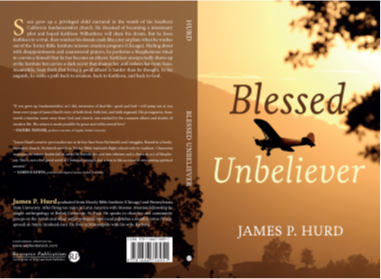
Sean McIntosh lives in a California world of Fundamentalist certainty—until his world unravels. He’s trying to make sense of losing his girlfriend and losing his dream of becoming a missionary pilot. And he’s shaken by contradictions in the Bible. His despair leads him to commit a blasphemous act and declare himself an atheist—all the while at Torrey Bible Institute!
Blessed Unbeliever (paper or Kindle version) can be found at Wipf and Stock Publishers https://tinyurl.com/27pvdkyp , Amazon https://a.co/d/9su5F3o or wherever good books are sold.
Writer’s Corner
Punctuation matters!

Word of the Month: EN MEDIA RES. Latin, meaning “in the middle of things.” It is effective to start a story, not at the beginning, but en media res, just before or just after the climactic event. Then you can fill in the details as the story unfolds.
Tip of the month: “If it sounds like ‘writing,’ I rewrite it.” Elmore Leonard. Our readers should be captured by the story, not impressed by “the writing.” Writing is only the container, the medium that carries the story to the reader.
Your turn: Who is the most interesting character you’ve ever read about, biographical or fictional? (I like Sherlock Holmes. He is hilarious, but he doesn’t know that.)
This month’s puzzler
Adapted from Car Talk Puzzler archives
I’m going to give a series of names, a series of words, okay?
I’m going to give you a piece of the series, a sub-set of words, and your task will be to give me the rest of the series and tell me what the series is.
And here they are:
And that’s it. That’s all I can give you. Pretty rough one huh? Good luck.
(Answer in next month’s Wingspread ezine.)
Last month’s puzzler:
Recall that Ralph, an auto mechanic, can’t seem to get through airport security. He empties all his pockets, even takes off his belt, but still sets off the alarm. The TSA guy asks, “What’s your work?” Ralph replies, “Auto mechanic.” “Ah; that explains it!” says the TSA guy. What did the TSA guy realize?
Answer: To protect his feet, Ralph wore steel-toed boots—which set off the alarm. Removing them, he zipped through security.
New story: “Fearful of Finding the Fatal Flaw”
. . . In short, I became a Bible nerd. My faith depended on big words: dispensationalism, eternal security, election, the millennium, pre-Tribulational rapture and especially inerrancy. We sang, “The Bible stands, like a rock undaunted, far above the wrecks of time. . . .” The Bible was without error (in the original). . . . But I despaired of finding the answers I was seeking. I even considered becoming an atheist. . . .
To read more, click here: https://jimhurd.com/2023/05/03/fearful-of-finding-the-fatal-flaw/
(Leave a comment on the website and share with others. Thanks.)
Subscribe free to this Ezine
Click here https://jimhurd.com/home/ to subscribe to this WINGSPREAD ezine, sent direct to your email inbox, every month. You will receive a free article for subscribing. Please share this URL with interested friends, “like” it on Facebook, retweet on Twitter, etc.
If you wish to unsubscribe from this Wingspread Ezine, send an email to hurd@usfamily.net and put in the subject line: “unsubscribe.” (I won’t feel bad, promise!) Thanks.
Wisdom

Last football wisdom (I promise!)
What does the average Alabama player get on his SATs?
Drool.
How many Michigan State freshmen football players does it take to change a light bulb?
None. That’s a sophomore course.
How did the Auburn football player die from drinking milk?
The cow fell on him.
Two Texas A&M football players were walking in the woods. One of them said, ” Look, a dead bird.”
The other looked up in the sky and said, “Where?”
What do you say to a Florida State football player dressed in a three-piece suit?
“Will the defendant please rise.”
How can you tell if a Clemson football player has a girlfriend?
There’s tobacco juice on both sides of his pickup truck.
What do you get when you put 32 Kentucky cheerleaders in one room?
A full set of teeth.
University of Michigan Coach Jim Harbaugh is only going to dress half of his players for the game this week. The other half will have to dress themselves.
How is the Kansas football team like an opossum?
They play dead at home and get killed on the road
How do you get a former University of Miami football player off your porch?
Pay him for the pizza.
These exquisite insults are from an era before the English language got boiled down to four-letter words.
1. “He had delusions of adequacy ”
Walter Kerr
2. “He has all the virtues I dislike and none of the vices I admire.”
Winston Churchill
3. “I have never killed a man, but I have read many obituaries with great pleasure.” Clarence Darrow
4. “He has never been known to use a word that might send a reader to the dictionary.”
William Faulkner (about Ernest Hemingway)
5. “Poor Faulkner. Does he really think big emotions come from big words?”
(Ernest Hemingway about William Faulkner)
6. “Thank you for sending me a copy of your book; I’ll waste no time reading it.”
Moses Hadas
7. “I didn’t attend the funeral, but I sent a nice letter saying I approved of it.”
Mark Twain
8. “He has no enemies but is intensely disliked by his friends.”
Oscar Wilde
9. “I am enclosing two tickets to the first night of my new play; bring a friend, if you have one.”
George Bernard Shaw to Winston Churchill
10. “Cannot possibly attend first night, will attend second… if there is one.”
Winston Churchill, in response
11. “I feel so miserable without you; it’s almost like having you here”
Stephen Bishop
12. “He is a self-made man and worships his creator.”
John Bright
13. “I’ve just learned about his illness. Let’s hope it’s nothing trivial.”
Irvin S. Cobb
14. “He is not only dull himself; he is the cause of dullness in others.”
Samuel Johnson
15. “He is simply a shiver looking for a spine to run up.
Paul Keating
16. “He loves nature in spite of what it did to him.”
Forrest Tucker
17. “Why do you sit there looking like an envelope without any address on it?”
Mark Twain
18. “His mother should have thrown him away and kept the stork.”
Mae West
19. “Some cause happiness wherever they go; others, whenever they go.”
Oscar Wilde
20. “He uses statistics as a drunken man uses lampposts… for support rather than illumination.”
Andrew Lang (1844-1912)
21. “He has Van Gogh’s ear for music.”
Billy Wilder
22. “I’ve had a perfectly wonderful evening. But I’m afraid this wasn’t it.”
Groucho Marx
23. Exchange between Lady Astor & Winston Churchill:
Lady Astor: If you were my husband I’d give you poison.
Churchill: Madam: If you were my wife, I’d drink it.
24. “He can compress the most words into the smallest idea of any man I know.” Abraham Lincoln
25. “There’s nothing wrong with you that reincarnation won’t cure.”
Jack E. Leonard
26. “They never open their mouths without subtracting from the sum of human knowledge.”
Thomas Brackett Reed
27. “He inherited some good instincts from his Quaker forebears, but by diligent hard work, he overcame them.” James Reston (about Richard Nixon)
My pious mother and father helped start Silver Acres Church (Santa Ana, California) and immersed us in weekly Sunday school, countless Fundamentalist sermons, and an arsenal of memorized Bible verses. In short, I became a Bible nerd. My faith depended on big words: dispensationalism, eternal security, election, the millennium, pre-Tribulational rapture and especially inerrancy. We sang, “The Bible stands, like a rock undaunted, far above the wrecks of time. . . .” The Bible was without error (in the original).
Pastor Cantrell preached, “If you question inerrancy you question God. The doctrine of inerrancy rests, not on examining the text, but on the belief that God would never allow mistakes.” It made good sense—if God wrote the Bible, how could it contain errors?
The summer of my sixth grade I attended Pine Valley Christian camp. Being a Bible nerd I often launched frivolous questions at our speakers. What was the first mention of baseball in the Bible? (the Big-inning). First mention of smoking? (when Rachel lit off her camel). Shortest person in the Bible? (Eliphaz the Shuhite). You get the idea.
I asked one speaker: “Where’s the first mention of tennis in the Bible?” He didn’t know. I told him, “When David served in Saul’s court.”
He was not amused. “Son, you should not make fun of the Bible. It’s God’s holy word.” I turned away, chastened. Silver Acres and Pine Valley taught me that the Bible did not, could not have any mistakes in it—inerrancy on steroids.
Later, I enrolled in Moody Bible Institute. Impersonal Chicago intimidated me, although I felt comfortable behind the sacred gates of Moody’s big stone arch that fronts LaSalle Street. I expected that by studying my inerrant Bible at Moody I would find the answers to my nagging questions: How understand my loneliness? Lack of friends? My social awkwardness? But I was disappointed and sank further into depression.
I feared I would find one fatal, unanswerable flaw in the Bible that would bring my whole faith crashing down. I consulted my roommate George: “I’m really confused. The numbers don’t agree. I Kings 7:26 says that Solomon’s basin held two thousand baths, while II Chronicles 4:5 says it held three thousand baths. Were these two different basins? Did Solomon have four thousand horse stalls (I Kings 4:26) or forty thousand (II Chronicles 9:25)? Did Jesus’ sermon occur on the mountain (Matthew 5:1–2) or on the plain (Luke 6:17, 20)? Did Judas, Jesus’s betrayer, hang himself, or was he eviscerated in a field? Three of the Gospel writers list three different ‘last words’ of Jesus. They disagree about whether Jesus was two or three days in the tomb. Which of these is inerrant? All of them? And why doesn’t God answer my prayers?” George only nodded his head thoughtfully.
And the scientific contradictions. When Job states that God “hangs the earth on nothing” (Job 26:7), my teachers saw an ancient confirmation of modern science. But elsewhere in the same book we learn that God “laid the foundations of the earth,” (38:4), a pre-scientific view.
My teachers pointed with approval to Isaiah’s phrase “the circle of the earth” as an example of ancient scientific knowledge (Isaiah 40:22). But when John mentions the “four corners of the earth” (Revelation 7:1) they protested that he was only using a metaphor.
I despaired of finding the answers I was seeking. I even considered becoming an atheist.
“Inerrancy” is a modern controversy. Even the great 16th century theologians John Calvin and Martin Luther allowed mistakes in the Bible. They treasured a God-inspired text in spite of the contradictions they found.
After college I was speaking at a graduate school where I suggested that the notion of Biblical inerrancy is a “shibboleth” (that is, a symbol, a code word to signal the difference between “us” and “them.”) To separate us from the people with the wrong doctrines. After the talk, the grand old man of the school took me aside and told me, “Inerrancy is not a shibboleth; it’s an essential doctrine of the Christian faith!” I felt like a Cub Scout in knee pants being scolded by his scoutmaster.
But eventually I turned again to read the Gospels where I discovered that inerrancy and other doubtful questions, while important, paled in the brilliant light of the man Jesus who had “nothing beautiful or majestic to attract us to him, did no wrong, was despised and forsaken, yet bore all of our weaknesses and sorrows.” Today, this man’s love, his words and his deeds, overwhelm any doubts that may trouble me.
 Wingspread

