
Spreading wings in a perplexing world
May, 2025 James P. Hurd
Please forward and share this Ezine with others. Thank you.
Contents
- Writer’s Corner
- Blessed Unbeliever
- This month’s story
- This month’s puzzler
- WINGSPREAD Ezine subscription information
- Wisdom
**Alert: WINGSPREAD has a new email address: hurdjames1941@gmail.com. The old usfamily address is dead; do not use.
Writer’s Corner
Writer’s tip: Separate a list of items by commas (e.g., “… pliers, wrenches, hammers, and nails). The last comma is known as an “Oxford” comma. (I, however, avoid, flee from, resist and omit this last comma because I think it is unnecessary.) If a list has an item that itself includes a comma, use semicolons to separate instead of commas. E.g., “. . . pieces of plaster; rusty nails; old, discarded wooden studs; and glassless, paintless window frames.”
Word of the month: EPONYMOUS. Do we really need this word? Or is it just used by nerdy people showing off? It means “named after someone or something.” E.g., “Henry Ford and his famous, eponymous car company.”
Reminds me of William Faulkner’s friendly jab at Ernest Hemingway, “He never uses a word that sends a man to a dictionary.” Probably true of Hemingway. I will occasionally employ a little-used word because it really nails what I wish to express (e.g., disingenuous, effluvium, sclerotic). Not too often, though. Sometimes I’ll use an obsolescent word (saturnine, sartorial). Each word is a world of meaning, a priceless tool in the writer’s toolkit. In your own writing, wield words well.
Task for you: Invent a new word (people do this all the time). For instance, turn a noun into an adjective or a verb, etc. Send me your examples (along with definitions) and I’ll put them in the next Wingspread.
Magazine of the month: CHRISTIANITY TODAY. While you could label this magazine evangelical, I find it covers a broad range of Protestant and Catholic issues and also issues in other world religions, fully engaging the social, political and cultural milieu in which all religion is embedded.
BLESSED UNBELIEVER novel
I confess I sometimes more enjoy talking to atheists than Christians. My atheist friends seem honest about their doubts. Although my own doubts have been answered, they have not been quenched. Since I am a doubter, I find much in common with atheists. I believe we are all on a spiritual quest and I wish to know the quest of each person I meet. Blessed Unbeliever (below) is the story of one such quest. Much is autobiographical (I won’t tell you which parts!). But the names have been changed to protect the innocent.
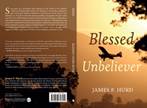
Sean McIntosh left his Fundamentalist childhood and walked the road toward becoming an atheist—while attending Torrey Bible Institute! Spoiler alert: it didn’t work out very well. Blessed Unbeliever (paper or Kindle version) can be found at Wipf and Stock Publishers, Amazon https://a.co/d/9su5F3o or wherever good books are sold.
Story: “The Snow Sermon” (first used several years ago)
“Barbara, the snow’s late this year.”
She looks up from her piecrust work. “Yes, it’s only five days ’til Thanksgiving.”
But today, the wind chills. I gaze out the window at the fine flakes falling here in Minnesota, hundreds of miles away from my California childhood. This harbinger snow warns, “Nothing is forever.”
Our first snow is inevitable but still a surprise. We turned the clocks back just two weeks ago (“spring ahead; fall back”), but today, less than a month from winter solstice, the sun appears tardily over the far end of Pleasure Creek pond, rising in its low southern arc, only to set early.
We are the shrouded ones, billeted in carpentered cocoons. Mine is a bookish breed. At home, my fingers rest on computer keys, pretending that the seasons never change. At work, I inhabit an indoor world smelling of classroom chalk, students to-ing and fro-ing in the halls, my days seasoned with specialty coffee and good conversation. . . .
To read more, click here: https://tinyurl.com/57t9p6n2
Leave a comment on the website and share with others. Thanks.
This month’s puzzler (thanks to “Car Talk”)
No fair doing an internet search but if you do, don’t reveal the answer if you find it.
Long before airplanes were invented, some engineers were contemplating building a suspension bridge across the gorge of Niagara Falls. There’s a big gorge there. A gorge is a canyon with a river at the bottom, basically.
So they were thinking of building this bridge, but there was no way to get the cables from one side to the other, because there was no boat that could fight that current in the raging water below. They didn’t have powered boats back then. This was in the days of steam, and wind for power. When sailors were made of steel and ships were made of wood.
Anyway, they figured out they had to get the cables across somehow. And the builders staged a contest open to the public to solve their problem. The contest was won by a young kid, a boy. Shortly after the contest was completed, they were able to run the cables from one side of the gorge to the other.
The puzzler question is very simple.
How did they do it?
(Answer will appear in next month’s WINGSPREAD newsletter.)
Answer to last month’s puzzler:
So what movie prominently featured a Ferrari and a Renault?
I’m guessing that the people who tried to Google this one were pretty disappointed. Because this was a trick question!
The Ferrari and Renault in question here are not cars, but character names. There full names were Signor Ferrari and Captain Louis Renault.
And these are characters from the very famous movie, Casablanca.
Now, don’t be mad about the trickery here. We never once said that the Ferrari and the Renault were cars . . . .
Subscribe free to this Ezine
Click here https://jimhurd.com/home/ to subscribe to this WINGSPREAD ezine, sent direct to your email inbox, every month. You will receive a free article for subscribing. Please share this URL with interested friends, “like” it on Facebook, retweet on Twitter, etc.
If you wish to unsubscribe from this Wingspread Ezine, send an email to hurdjames1941@gmail.com (**Note the new email address!!) and put in the subject line: “unsubscribe.” (I won’t feel bad, promise!) Thanks.
Wisdom

THOUGHTS FOR THE DAY
- Autocorrect has become my worst enema.
- Exquisite insult: “He’s a bubble off plumb.”
- “When I fed the poor they called me a saint. When I asked why they were poor, they called me a Communist.” —Bishop Dom Helder Camara of Recife, Brazil
- “They’re like grits in the South, whether you want them or not they show up!”
- A kleptomaniac is somebody who helps himself because he cannot help himself.
- A Freudian slip is where you say one thing but mean a mother.
- Ambition is a poor excuse for not having enough sense to be lazy.
- Hard work pays off in the future; laziness pays off now.
- I intend to live forever… So far, so good.
- If Barbie is so popular, why do you have to buy her friends?

- Eagles may soar, but weasels don’t get sucked into jet engines.
- What happens if you get scared half to death twice?
- My mechanic told me, “I couldn’t repair your brakes, so I made your horn louder.”
- Why do psychics have to ask you for your name?
- If at first you don’t succeed, destroy all evidence that you tried.
- A conclusion is the place where you got tired of thinking.
- Experience is something you don’t get until just after you need it.
- The hardness of the butter is proportional to the softness of the bread.
- To steal ideas from one person is plagiarism; to steal from many is research.
- The problem with the gene pool is that there’s no lifeguard.
- The sooner you fall behind, the more time you’ll have to catch up.
- The colder the x-ray table, the more of your body is required to be on it.
- Everyone has a photographic memory; some just don’t have film.
- If at first you don’t succeed, skydiving is not for you.
- If your car could travel at the speed of light, would your headlights work?
 Wingspread
