Tag Archives: flying

Pitch Perfect

It’s a normal smoggy day at Chino airport. I’ve just taken off with my student, Stan, whom I’m checking out in his two-seater, fabric-covered Taylorcraft. The takeoff goes normally but after we level off and pick up speed, Stan can’t keep the plane’s nose down.

“Trim forward, Stan.”

“I am.”

“Trim down more.”

“I am!”

The plane is still pitching up violently, threatening to stall. I see Stan straining to push the control wheel forward, but it isn’t helping. What’s wrong?

I’m studying anthropology at Cal State Fullerton and need a little extra cash so when Hank Bradford lures me over to Chino with the promise, “I’ll give you a twin-engine checkout in the Aero Commander” (a larger twin-engine plane), I jump at the chance to work for United California Aviation—the outsize name for Hank’s dubious fixed-base operation. UCA consists of an office, a small workroom with a picture of a naked woman hanging on the wall and a few hundred square feet claimed from the vast and empty adjoining hangar. Hank has opened a small café and offers hamburgers to a few army personnel temporarily stationed here. He acts as a maître d, circulating through the room chatting up the troops as he follows a waitress around, pretending to grab her hips.

I never see the promised Aero Commander. Rather, I end up doing routine maintenance on random aircraft that show up. No tools available—I bring my own. But one day I arrive at work about noon on a Thursday and Hank says, “Wanna’ take the Apache and fly some fishermen down to Baja for the weekend?” Immediately I say yes, even though I’ll miss a day of my classes and even though I have little time to prepare for the flight. But you never turn down a chance to fly a multiengine plane. A fun weekend.

Now today I’m still trying to figure out why Stan can’t control his airplane. “Stan! Give me the wheel.” I grab the dual control wheel and it just about hits me in the face! The airplane is still trying mightily to pitch up. If the nose rises a bit more, the airplane will stall and plummet us to the ground. I barely keep it level, forcing the control wheel forward. “Stan, we have to turn back to the airport; something’s wrong. I’ll land the plane because I don’t know how it’ll react if we slow up.” I hold forward pressure on the wheel all the way through the landing.

I walk around the plane, suspecting something’s wrong with the elevator control system, those “flippers” at the tail that pitch the airplane up or down but they seem to be operating normally.

Then I notice the small trim tab hinged at the rear of one of the elevator surfaces. This tiny deflector moves the larger elevators up or down. So I yell to Stan who is still in the cockpit, “Stan; turn the trim tab crank counterclockwise.” As Stan turns the crank to lower the nose, I see the trim tab moving downward. In flight, this would force the elevator up, which would pitch the nose up­—the opposite of how it’s supposed to work. The mechanic (probably my boss, Hank) had hooked up the trim tab control cable backwards! “Stan; we’re done flying until I get this control fixed!”

This flight could have been a disaster—I hate to think what would have happened if Stan had been flying without an instructor. In the future I determine that after maintenance is done on an airplane I need to perform a more thorough preflight check—including the trim tab.

WINGSPREAD for March, 2024

Please forward and share this Ezine with others. Thank you.

  • Writer’s Corner
  • Blessed Unbeliever  available
  • New story: “Pitch Perfect”
  • This month’s puzzler
  • Wingspread Ezine subscription information
  • Wisdom

This month’s writing quote: “If it sounds like writing, I rewrite it.” Elmore Leonard

Tip for writers: Begin your story in media res. You do not have to “begin at the beginning.” Try starting your story just before or just after the peak of the action. Example: “I’m not dead! But I have no idea what happened.” This hooks the reader. Then, go back and start at the beginning.

Word of the month: OBLIQUE DIALOGUE. Good dialogue makes a good story. It should sound natural, though. Just statement-response, statement-response gets stilted and boring; it doesn’t sound natural. Oblique dialogue means that the response is oblique; not just a simple response. For example—Kathy: “I wonder when Mom will get home.” Bill: “I worry about her being gone so much.”   Another—Kathy: “Do you think this dress makes me look fat?”  Bill (a wise husband): “I think you have great taste in clothes.” Notice he doesn’t directly answer the question.

Question for you:  How to overcome writer’s block?

  • Get a list of “prompts” and write briefly on several of them.
  • Take a piece you’ve written and try to condense into just 100 words.
  • Ask “what if?” For instance, what if a character is carrying a dark secret? What if she were born in a different town?
  • Mine your own life for people and events that you can use to transform your writing.
  • Freewrite. Just start writing. The only rule is do not stop.

BLESSED UNBELIEVER novel

Blessed Unbeliever (paper or Kindle version) can be found at Wipf and Stock Publishers, Amazon https://a.co/d/9su5F3o or wherever good books are sold.

A normal smoggy day at Chino airport. I’d just taken off with my student, Stan, whom I was checking out in the Taylorcraft.

The takeoff was normal, but after we leveled off, our increasing speed tended to force the nose up.

“Trim the nose down, Stan.”

“I am trimming down.”

“Trim down more.”

“I am!”

“Give me the controls.”

I grabbed the dual control wheel and it just about hit me in the face! The airplane was trying mightily to pitch up. . . .

To read more, click here  https://jimhurd.com/2024/03/09/pitch-perfect/

Leave a comment on the website and share with others. Thanks.

(Thanks to Car Talk puzzler archives.)
A friend of mine who works at a bank was doing her accounting duties. She noticed that there was a balloon payment coming up and she said, “Well, that’s interesting. Balloon. b.a.l.l.o.o.n. There are two sets of double letters in that word. Hmm.”

And so she thought to herself, is there a word in the English language that has three sets of double letters in a row? And as I was working on this one, I came across a word that has two H’s in it, back to back. 

So the puzzler has two parts. What word has three sets of double letters in it? And what word has a double H?

Now, there may be 2500 answers to this one, I know. Just have fun with it. 

(Answer will appear in next month’s WINGSPREAD newsletter.)

Answer to last month’s puzzler: 

Recall Uncle Enzo had 11 antique cars and his will specified: one-half of them should go to his oldest son, one-fourth to his middle son and sixth of them to his youngest son. How will they divide them up?

Then Uncle Vinny shows up with his car and he says, “Look, I will lend you my car.” So, once he lends them his car, they have 12 cars.

So, now with 12 cars, 6 of them go to the oldest son. That would be half. A fourth of the cars, or 3 cars, go to the middle son, and a sixth of the cars, or 2 cars, go to the youngest son. That leaves only one car.

Then, Vinny takes his car back. The split has happened the way Uncle Enzo wanted it to, because 6, 3 and 2 make 11. 

Fractions are fun, right?

Subscribe free to this Ezine  

Click here https://jimhurd.com/home/  to subscribe free to this WINGSPREAD ezine, sent direct to your email inbox, every month. You will receive an article for subscribing. Please share this URL with interested friends, “like” it on Facebook, retweet on Twitter, etc.

If you wish to unsubscribe from this Wingspread Ezine, send an email to hurd@usfamily.net and put in the subject line: “Unsubscribe.” (I won’t feel bad, promise!) Thanks.

Wordplay — thoughts on modern era marketing signage

Signage for an Electrician’s truck: Let us remove your shorts

Signage for a curtain delivery truck: Blind man driving

Signage for a Podiatrist’s office: Time wounds all heels

Signage for a Septic Tank Truck: Yesterday’s Meals on Wheels

Signage for an Optometrist’s Office: If you don’t see what you’re looking for, you’ve come to the right place.

Signage for a Plumber’s truck: We repair what your husband fixed. Don’t sleep with a drip. Call your plumber.

Signage for a Tire Repair Shop: Invite us to your next blowout

Signage for a Maternity Room door: Push. Push. Push.”

Signage for a Car Dealership: The best way to get back on your feet—miss a car payment.

Signage for a Muffler Shop: No appointment necessary. We hear you coming.

Signage for a Veterinarian’s waiting room: Be back in 5 minutes. Sit! Stay!

Signage for a Shoe repair store: We will heel you and save your sole, we will even dye for you.

Signage for an Electric Company: We would be delighted if you send in your payment on time. However, if you don’t, YOU will be de-lighted.

Signage for a Restaurant: Don’t stand there and be hungry; come on in and get fed up.

Signage for a Funeral Home:: Drive carefully. We’ll wait.

Signage for a Propane Filling Station: Thank Heaven for little grills.

Signage for a Radiator Shop: Best place in town to take a leak.

And—last but not least—Signage for another Septic Tank Truck: Caution—This Truck is full of Political Promises.

When I fed the poor they called me a saint. When I asked why they were poor, they called me a Communist.                —Bishop Dom Helder Camara of Recife, Brazil

Pitch Perfect

A normal smoggy day at Chino airport. I’d just taken off with my student, Stan, whom I was checking out in the Taylorcraft.

The takeoff was normal, but after we leveled off, Stan was having trouble keeping the plane’s nose down. This was normal, since our increasing speed tended to force the nose up.

“Trim the nose down, Stan.”

“I am trimming down.”

“Trim down more.”

“I am!”

“Give me the wheel.”

I grabbed the dual control wheel and it just about hit me in the face! The airplane was trying mightily to pitch up. If the nose had risen a bit more, the airplane would have stalled and plummeted toward the ground. I could barely keep it level by forcing the control wheel forward. “Stan, we need to turn back to the airport; something’s wrong.” I said.  Let me land the plane because we don’t know how it will react.”

I held forward pressure on the wheel all the way to landing, then jumped out and walked around to the tail. What was I looking for? The horizontal tail surface of the aircraft has two moveable parts—elevator and trim tab. The elevator moves up and down in flight, causing the airplane to pitch up or pitch down.

On the back of the elevator is a tiny trim tab operated by a trim tab wheel in the cockpit. Rolling the wheel back causes the trim tab to turn down into the slipstream (the wind that flows past the airplane in flight). This pushes the whole elevator up, causing the nose of the plane to pitch up. When the tab is turned up, the elevator is pushed down, causing the nose to pitch down.

So I yelled to Stan who was still in the cockpit, “Stan; roll the trim wheel forward.” He rolled. I carefully observed the trim tab back at the tail. As Stan rolled the wheel forward, the trim tab was turning downwards! In flight, this would force the elevator up, which would pitch the nose up, the opposite of how it was supposed to work. The mechanic (probably my boss) had hooked up the trim control cable backwards! “We can’t fly this airplane until we get this control fixed!” I told Stan.

You don’t normally check the trim tab movement when preflighting an airplane. But this mistake could have been disastrous. I hate to think if Stan had been flying without an instructor.

We Tell Ourselves Lies

The story of Bernice

Why is it so hard to tell ourselves the truth? During my Cal State Fullerton days I met Bernice—attractive, available and interested. After our first date she said, “I never know how to say ‘thank you.’” On the next few dates she found out. Hugs escalated to kisses and eventually to long couch sessions.

It felt good but I was puzzled. I assumed women were the sexual gatekeepers and that most women had sturdy boundaries, But Bernice seemed to have none. Instead, I felt her drawing me in. I felt the urge to embrace longer, to move faster, further. I began having fantasy dreams. My conscience told me God disapproved. I could not justify a sexual relationship, even to myself. I knew I needed to deescalate. But instead, I began working on my self-deception (SD) project—lying to myself. I told Bernice I loved her. Maybe I thought that telling her would make it so, or that the declaration would justify my passions.

I told myself that she was dialing up our passion, not I; that I wasn’t forcing her into anything; that we would marry (eventually, maybe?). That I was under complete control and could stop at any point. That premarital sex wasn’t so bad. That God would forgive me (later). But lust is like scratching a scab. Scratching feels good. Soon you’re compelled to scratch, obsessed with scratching, even if it gets bloody.

What was this doing to her? I wasn’t even thinking about how our passions might affect Bernice. Later, after she started dating someone else, she came to me teary-eyed and said, “I can’t stop!” My behavior had clearly perforated her already porous boundaries.

All the while the voice of conscience was telling me: “You’re headed for something you know is wrong. You must respect her, regardless of how she behaves. You aren’t in love; just in lust.” Eventually, conscience won out, or more accurately, a loving God restrained me from doing something stupid. Later years have only confirmed my gratitude to God that I turned away from my lustful promptings. But the point is, I almost talked myself into it. I just about bought the flawed logic. I just about violated a deeper good in favor of a lesser. My self-deceived reasoning almost led me to disaster.

Although my tryst with Bernice did not rise to the level of “petting” (as our elders called it), sexual fantasies still disturb me today. A few years ago I was alone in my motel room, four thousand miles from home. Flipping through the TV channels, I came across a pornographic movie. I quickly kept flipping (but memorized the number so I could avoid it). I approached the same channel again and thought I’d better verify that it was the porn channel (so I could avoid it). Then I got hooked. I told myself I was powerless to change channels.

Classic self-deception—I talked myself into a lie so that I could fulfill an intense desire that would work against my long-term interests. The experience shook me. Immediately afterward I repented and my resolve stiffened. But why did I even give myself permission?

Self-deception (SD) is so common. People say all the time—“I know I shouldn’t but… It’s only this one time… I’ll quit tomorrow…. Rules are for other people… I can drive over the speed limit because I’m more skillful (or intelligent)… It won’t hurt anybody….”

Even statisticians play the lottery and believe they’ll win, although they know that statistically they’ll lose money. People say “I’ll stop smoking tomorrow,” and mean it, but no real intention, no plan, and the next day, the conviction fades.

What is SD anyway? It seems contradictory—believing two opposite things at the same time. It’s distinct from other deceptions because in SD, the deceived and the deceiver are one person. It’s not just bad judgment or ignorance, because in those, there’s no deceiver involved. It’s not a mental illness, unless you allow that all people on the planet are mentally ill.

In SD, you yourself are both the deceiver and the deceived. You give yourself permission to do something that your “better angels” knows is wrong. You privilege the immediate over the future, the short-term over the long, the easy over the hard, your own needs over those of others. You deceive yourself when you start acting on the lies you tell yourself, lies you know aren’t true.

Why I eat junk food

Like most people, I have two contradictory desires: to satisfy my food cravings and to live a heathy, long life.

When I was a teenager, I didn’t hear much about nutrition. I knew I needed Vitamin D (milk) and I knew I needed protein. That was about it. I was skinny, so I didn’t worry about getting fat.

Every weekday while I was waiting to pick up my papers at the Orange Daily News, I would walk next door, put a dime in the pop machine (it was a long time ago), and get a cold bottle of Coke. Then on the way to my paper route I would stop at the gas station and buy a Heath candy bar. I ate all the dessert I could get hold of. Once I bought a quarter pound of fudge, took a chaste bite, and then devoured the whooole thing in ten minutes [for your ears, only—it was totally worth it]. Even today, I favor ice cream and chocolate over leafy vegetables, carrots, peas, and green beans.

My wife, the voice of reason, fights a faithful but futile battle against my cravings. She cooks healthy meals even though I still major on desserts. She says, “I give up! Eat what you want. But don’t expect me to take care of you when you get sick” (an empty threat). She’s already picked out my tombstone epitaph: “I tried to tell him, but he wouldn’t listen.”

Despite all I’ve learned about nutrition, despite the scientific evidence, despite my wife’s rational suggestions, I still eat junk food.

There’s a reason I eat this way—I’m an SD expert. I tell myself: “I eat better than my friends. I’ll eat better next week. I know a guy who ate junk food and lived into his 90s. Just this one time. I’ll take just one piece.”

Do I believe these lies? Well, it’s complicated. The best explanation is that I believe the lie now. (Why spoil a great experience!) Then, just after eating, I can repent and listen to the voice of reason. This allows me to preserve my self-respect, to see myself as a rational, disciplined person. But of course, my repentance is a lie also and my fake resolve doesn’t motivate me to change my behavior.

SD is always motivated—you practice SD because you want something. What you want is to have your cake and eat it too—to act on one conviction that contradicts a different conviction. You want to enjoy a delicious taste, avoid the hard choice, satisfy an immediate desire, or give yourself permission to violate a moral code. You have reasons to deceive yourself.

What’s wrong with a little SD?

Why worry about a little innocent SD? Because it’s not innocent. The stories above show how SD can be dangerous, or deadly. SD promotes lazy, habitual behavior that may lead to addiction. It represents a divided care for yourself, and works against a healthy, integrated personhood. Most serious, it tempts you to “self-divinize”— to substitute your own flawed judgment for God’s.

SD works because of our compartmentalized brains. Each of us has a “reptile” brain—the amygdala—older, simpler and associated with instinctual behavior such as fight or flight. In addition we have a neocortex (“new brain”) that is rational and deliberating—the part of our brain that says, “Wait a minute—will this serve your long-term interest?” We can call the amygdala “Junior,” and the neocortex “Mother.” Junior does what he wants to do; Mother does what she plans to do. SD occurs when we let Junior bully Mother.

 The story of the city in a bowl

Looking back, I recognize that my flying days produced the most vivid examples of SD. I based in San Cristobal where we flew the Mission Aviation Fellowship plane out to little airstrips across southern Mexico.

San Cristobal de Las Casas (in Chiapas State, Mexico) lies in a huge bowl circled by towering peaks. All the rainwater courses down a huge, natural ground hole at one end of the bowl.

One day, I’m stuffing a missionary family and their belongings into the small Cessna 180. They’re traveling from Yaxoquintelà (a jungle training camp for Wycliffe Missionaries) back to San Cristobal. A norther has blown in, and clouds lie like cotton balls over the mountains and down into the valleys, so I’m flying just below the clouds at 8,000 feet, following the Comitán road. The road winds through a narrow pass and then plunges down into the San Cristobal bowl.

The afternoon light fades as I eye the narrow pass through the blurry rain. I see that I could barely slip through the pass clear of clouds. Or, we could turn around now and head to nearby Tuxla Gutierrez, a large town beyond the mountains with a good airport, lights, and good weather. At this point, I know a few things: a) We’re at high altitude and engine performance is reduced. b) Transiting the pass is a high-risk operation, and who knows the weather conditions in the bowl? c) I’m a good pilot, better than average. d) If we landed in Tuxla, we’d have to find overnight lodging. Suddenly I resolve to try getting through to San Cristobal. We high-jump the pass and dive into the bowl.

Except now I can’t see the ground. There’s no opening ahead, just solid clouds and rain, even though the airstrip is only five miles away. It would be deadly trying to climb out through the clouds with mountains all around. I must turn around and go back through the pass. But we’re in a narrow canyon and we’re well below the bowl rim. And is the Comitán pass behind us still open?

I pull on flaps to shorten our turn radius and make a steep bank left, narrowly clearing the encircling clouds. But now I’m looking at the high pass directly in front and above me. At best angle of climb we barely squeak out over the rim. Then we circle outside the bowl to the right, find a crack in the clouds, and descend to land in San Cristobal just at dusk.

In flying, as in so many other endeavors, it’s amazing how your vision and judgment clarifies after you’re back home sitting in your easy chair. You can call it cockpit judgment vs. armchair judgment. Safely at home, I reflect on the irony. In bad weather, when you make a good decision and return to your departure airport or divert to another airport, your passengers criticize and grumble and you feel like a failure. If you make a bad decision and forge ahead, the passengers praise you for your amazing piloting skills. And you feel good that you’ve accomplished your mission! But now I reminded myself of certain fatality statistics in similar circumstances. I knew I made a bad decision, and I felt guilty. Of course, my San Cristobal passengers didn’t know that I had made a foolish decision—to continue through a cloudy mountain pass at dusk.

I repented, and vowed never to do that again. But of course I did do similar things again, all employing sturdy rationales. This is classic SD, built on the lie that I am an exceptional pilot and can beat the odds. But in truth, the exceptional pilot would have put prudence and passenger safety over convenience. It’s true: there are old pilots and bold pilots, but no old, bold pilots.

Why tell myself lies? These lies arise out of a mental “board of directors.” SD occurs when one mouthy, loud, ignorant board member trumps all the other members and argues for the act. I let mouthy Junior (the reptile brain) drown out Mother’s voice (the more rational neocortex). I, the chair of the board, found myself trying to persuade Mother to accept Junior’s shortsighted, dangerous suggestion.

SD comes in many guises: overconfidence; seeking immediate rather than long-term gratification; choosing the easier, rather than the better action. “Rationalization” means constructing a plausible reason for doing something I shouldn’t do.

One common type of SD discounts probability statistics. People make good yes or no choices, but if an outcome is only probable, they make poor choices. For example people might say, “I could win the lottery!” “It can’t happen to me,” “I drove 30 miles over the speed limit and got away with it.”

The simplest airplane to fly

One day I jumped into an Ercoupe (“the simplest airplane there is to fly”), a plane I’d never flown before. I did a takeoff and landing in 50 mph winds, despite knowing that I should have gotten a thorough checkout before flying that plane. I just about wrapped it up in a little aluminum ball.

In Amarillo, Texas, I took three passengers on a sightseeing flight in a twin-engine Cessna 310, and decided to do a practice shutdown of one engine. Bad judgment doing this with passengers and I also used wrong procedure. The engine did not immediately restart, and we almost ended up landing in the weeds.

A different time (in Venezuela), I crammed seven small schoolchildren into the MAF Cessna 185 and leaded for Tama Tama, an hour away through heavy clouds. We flew blind for thirty minutes, and when we broke out I saw rain and lightning ahead. We were low on fuel, and I should have diverted to Santa Barbara, but that would have meant overnighting with these children on a remote, abandoned airstrip. So I grabbed the control wheel with my sweaty palms and flew through the rain and storm. Flying only 200 feet above the curving Orinoco River, we pushed ahead until I glimpsed Tama Tama airstrip through the bleary windshield. If I had failed to find Tama Tama, I would have had insufficient fuel to fly back to Santa Barbara.

What were the lies I was telling myself? In the Ercoupe incident, I convinced myself I was an expert pilot who could safely fly a strange airplane in high winds without a thorough checkout. In the 310, I convinced myself I knew emergency procedures well enough that I could safely stop and restart an engine, even though I had very few hours of experience in the airplane. I didn’t know what I didn’t know until it was too late to learn it. In the Cessna 185, I convinced myself that risking fuel exhaustion over a hostile jungle was more acceptable than the prospect of spending the night at a strange, abandoned airport with seven young children—I chose convenience over safety.

How tell yourself the truth?

If self-deception is so common, if it is corrosive and harmful, how do you avoid its traps?

You should begin by naming the deception; stripping it bare it so you can see it as it is. You must tell yourself the truth. For Bernice, above, I should have told myself the truth—that I did not love her.

Another good idea—when you fly (or drive), ask yourself, “What are the risk factors on this trip?” (bad weather, illness, nighttime, distractions, etc.) Tell yourself the truth about the risks.

You must prepare your defenses against SD ahead of time. Before I fly, I make a “Go-No Go” list, specifying the conditions under which I will cancel the trip. I establish rules about my health (exhaustion, illness, anger), airplane condition (rough engine, malfunctioning instruments, quantity of fuel), and weather conditions (e.g., demanding a cloud forecast that is scattered but not broken or overcast). If my neocortex creates these clear rules ahead of time, I’m less likely to violate them when the pressure is on. After making these checklists, it’s good to over-train—practice procedures you already know, so that in an emergency you’re more likely to do the right thing.

You need “accountability partners,” people who will tell you the truth. For instance, I promise my pilot friends that I will confess to them my safety violations—and let them scold me. When flying, I can ask myself, “What would my pilot friend Sam do in this situation?” We need accountability partners.

Beyond self-discipline and accountability groups, I can embrace my true identity in God. As the poet says, “Man [Mortals] cannot name himself. He waits for God, or Satan, to tell him who he is.”

How beautiful to exchange a distorted view of oneself for a godly view. Christian conversion means rejecting SD and letting God define me. I can confess sin and pray for forgiveness, for insight and discipline. I can see the world clearly with a God-s-eye view. This is the best antidote for SD.

 A final story—fuel valve trouble

When I was in Honduras, Paul, our program manager, asked me to fly the Piper Pacer—a nasty little fabric-covered plane that drops like a rock when you pull back the power and prefers going down the runway tail-first. I’d never flown a Pacer before so I assumed I’d get a thorough checkout. But Paul said, “Simple airplane. Just take ‘er out and make several practice landings. You’ll be fine.” I was too proud to admit I needed a thorough checkout. Plus, the flight was today and it was urgent—a sick patient needed to be flown to the hospital. So I quieted Mother’s voice in my head and listened to Junior. I told myself: Simple airplane. I’m experienced and highly-skilled. No problem.

But on the return flight I switched to the right fuel tank and the engine quit! Was the valve broken? The fuel line clogged? I switched back to left tank; the engine roared to life. But I wasn’t certain I had enough fuel to make it back on only left tank. I called base and said I was going to divert and land nearby and please bring fuel out to me. John, my fellow pilot, said, “Aw, you’ll have enough fuel—just come on in.” John’s confidence (how did he know?) and Junior’s voice in my head encouraged me to “come on in.” I did and landed with minimal fuel.

Then I checked the fuel valve, located down by my left knee. I noticed that you turn the valve left for Right Tank, straight up for Left Tank, and to the right for Off. I had mistakenly turned the fuel valve to Off!

No checkout. Didn’t read the manual. Bad judgment. Pride. Hurry. Classic SD.

Self-deception is common but subtle and has many complex causes. We can practice raising our consciousness about its dangers, we can make good decisions ahead of time and stick to them, and we can create accountability partners to check our bad judgment. And finally, we can know that we if we humble ourselves, God will lead us into truth.
Lone, Wandering, but Lost?

How can some birds find their way from New York to Chile while I can get lost three blocks from home? I’ve had trouble navigating all my life—missing exits on the freeway, getting lost on cross-country flights, even walking out of a downtown store and turning north instead of south. What’s up? Am I just not paying attention?

Take driving. We have just visited Amish friends near the tiny town of Canton, Minnesota and are driving home, inhaling the smell of our sweet, Amish-baked bread. We’re on the proper road—US 52—but nothing looks familiar. Then Barbara points out the Iowa highway signs. We’re headed south instead of north.

I have driven multiple times to our friends’ house in Roseville. But today I’m not sure: do I take Rice Street or Lexington? What’s the street you turn off on? They’re on the corner of—which streets? Embarrassing to use a GPS to navigate to a friend’s house you’ve visited so many times.

I feel like a failure when I resort to using “Penelope,” our GPS. If Penelope speaks with a beautiful British accent sitting in London, how can she know about the secondary streets in Minneapolis-St. Paul, say nothing about traffic backups and construction zones? She dazzles in her directions but in rare cases she leads us down rabbit trails. One time Penelope points us a different direction than the way I pretty much know. Furthermore, my wife-navigator insists we’ve already gone beyond our destination. I do not sleep with Penelope so I defer to my wife, do a U-turn, and get lost. Penelope gets ticked and goes silent.

And walking. I have frustrating dreams about walking at night lost in the rain. Or I’m walking in a vast city and recognize no landmarks. Or I’m late heading to teach my college class but have forgotten my pants, or my notes, or haven’t prepared anything. Forgotten where the classroom is. Even forgotten where the bathrooms are.

Have you ever been on foot in a large city, crossed the street to enter a store and walked up a couple stories? Then you come down, exit onto the busy sidewalk and walk away in the wrong direction. Anybody? Anybody? I’ve done that multiple times.

I always go to the same ENT doctor. But each time I have to verify: is it the office building near Unity hospital or the one near Mercy? Which floor? The nurse leads me through a labyrinth of antiseptic-smelling hallways to a consultation room. But when I leave she needs to hold my moist hand to get me back to the lobby. Then when I walk out I’m forced to use the panic button on my smart key to find my honking car.

At our apartment in Oak Crest we must navigate a football-field-sized building stretching 50 yards down each wing. Today I walk down the fresh-scented hallway and burst unannounced into Larry and Julie’s apartment. “Hi, Larry and Julie! No, nothing; just dropping by.” Their door is the last door on the right in the east wing. My apartment door is the last door on the right in the west wing. Not only have I done this three times but I don’t know why and don’t know how to avoid it next time.

Even flying small planes. It’s 1965 and I’m flying a twin-engine Cessna 310 from Amarillo to Kansas City. I don’t have instrument charts so I’m forced to fly visual below a rainy cloud layer. I’m too low to receive navigation signals so I follow the compass, aiming far ahead, trying to correct for wind drift. Roads, rivers, railroad lines, small towns and fields flash by so fast and close I can almost smell the corn but I can’t identify anything with certainty. Finally I circle a water tower to read the name of the town and identify it on my chart.

It’s 1970 and I’m flying in Venezuela with an airplane full of missionary kids. They’re screaming as we fly through dark, lightning-filled clouds. I smell sour milk. Suddenly we burst out over the Orinoco river—second only in size to the Amazon. But I’m not sure if my destination is upriver or downriver and I’m low on fuel, flying over the broccoli of the vast jungle where airstrips are spaced out an hour or two apart. I let down to 100 feet and turn upriver, flying through the painful air, peering through a bleary windshield with the river racing backwards under our wings. We finally spot the grass airstrip.

More recently Jeremy and I are flying to Princeton, Minnesota, only fifteen minutes north. We will park there and walk over to the Hi-Way Inn for breakfast. (It’s a “$100 breakfast” if you include cost of the plane rental.) The restaurant lies on US 169, a major highway; can’t miss it. But we fly right past Princeton and have to circle back. I caution Jeremy—“Don’t tell your mom.”

Another anxious dream. I’m flying at high speed along city streets below the building tops. Or I have landed and am taxiing through a grove of pine trees on a rainy night, the propeller throwing up mud onto the windshield. But I’ve forgotten the way to taxi back to the airport.

So what’s going on? Years ago I failed only one portion of my flight program—navigation. I’ve worked really hard but have no evidence I’ve made much improvement so I pay extra attention and do a lot of crosschecking when I fly cross-country. Am I fated to fail? Or will I find some golden key that will perfect my navigational skills? I doubt it..

So when my wife asks me, “Do you know where we’re going?” I just say, “No, but I figure if I get in the general area we can drive around honking until someone finds us and tells us where to go.” She rolls her eyes and then stares straight ahead, mute.

Navigating

Why do some birds find their way from New York to Chile while I can get lost three blocks away from my own home? (True story.) I’ve had trouble navigating all my life— missing exits on the freeway, getting lost on cross-country flights, even walking out of a downtown store and turning north instead of south. What’s up? Am I just not paying attention? Is it genetic?

Take driving. We’ve just visited Amish friends near the tiny town of Canton, Minnesota and are headed north and home. We’re on the proper road—US 52—but nothing looks familiar. Then Barbara points out the Iowa highway signs. We’re going south.

I have driven multiple times to our friends’ house in Roseville. But today I’m not sure: do I take Rice Street or Lexington? What’s the street you turn off on? They’re on the corner of—which streets? Embarrassing to use a GPS to navigate to a friend’s house you’ve been to so many times.

I feel like a failure when I have to use GPS. “Penelope” speaks in a British voice but if she’s sitting in London, how can she know about the secondary streets in Minneapolis-St. Paul, not to mention traffic backups and construction zones? She usually dazzles in her directions but in rare cases she leads us down rabbit trails. In the worst case, Penelope points us a different direction than the way I pretty much know. Furthermore, my wife-navigator is certain we’ve already passed our destination. I do not sleep with Penelope so of course, I defer to my wife, do a U-turn, and get lost. Penelope gets ticked and goes silent.

Have you ever been on foot in a large city, crossed the street to enter a store and walked up a couple stories? Then you come down, exit, and walk away in the wrong direction? Anybody? Anybody? I’ve done that multiple times.

I always go to the same ENT doctor. But each time I have to verify: is the office building near Unity hospital or is it near Mercy? Which floor? The nurse leads me through a labyrinth of antiseptic-smelling hallways to the consultation room. But when I leave she needs to hold my moist hand to get me back to the lobby. Then when I walk out, I’m forced to use the panic button on my smart key to search for the honking car.

At our apartment in Oak Crest we have a football-field-sized main hallway, 50 yards down each wing. I walk home down the hallway and burst unannounced into Larry and Julie’s apartment. “Hi, Larry and Julie! No, nothing; just dropping by.” Their door is the last door on the right in the east wing. My apartment door is the last door on the right in the west wing. Not only have I done this three times but I don’t know why, or how to avoid it next time.

I have frustrating dreams about walking at night, lost in the rain. Or I’m walking in a vast city and recognize no landmarks. Or I’m late, heading to teach my college class but have forgotten my pants, or my notes, or haven’t prepared anything. Forgotten where the classroom is. Even forgotten where the bathrooms are.

I’m flying a twin-engine Cessna 310 from Amarillo to Kansas City. I don’t have instrument charts so I’m forced to fly visual below a rainy cloud layer. I’m too low to receive navigation signals so I follow the compass, aiming far ahead, trying to correct for the wind. Roads, rivers, railroad lines, small towns and fields flash by so fast and close I can almost smell the corn but I can’t identify anything. Finally I spot a water tower and circle it to read the name of the town and identify it on my air chart.

I’m flying in Venezuela and break out of the rainy clouds over the Orinoco river—second only in size to the Amazon. But I’m not sure if my destination is upriver or downriver and I’m low on fuel, flying over the broccoli of the vast jungle where airstrips are spaced out an hour or two apart.

Or take flying out of Anoka Airport, Minneapolis. This day I ask Jeremy to fly with me to Princeton, only fifteen minutes north. We can park there and walk over to the Hi-Way Inn for breakfast. (I call it the $100 breakfast.) The restaurant lies on US 169, a major highway; can’t miss it. But we fly right past Princeton and have to circle back. I warn Jeremy, “Don’t tell anybody.”

Anxious dreams. I’m flying at high speed along city streets below the building tops. Or I have landed and am taxiing through a grove of pine trees at night on a rainy, muddy track. Don’t know how to taxi back to the airstrip.

What’s going on? Years ago I only failed one portion of my flight program—navigation. I’ve worked really hard but have no evidence I’ve made much improvement so I pay extra attention when I fly cross-country.

Do I suffer from some genetic defect or something? Or is there some golden key that will perfect my navigational skills? I doubt it.

So when my wife asks me, “Do you know where we’re going?” I just say, “No, but I figure if I get in the general area we can just drive around honking and someone will find us and tell us where to go.” She rolls her eyes and stares straight ahead, mute.

WINGSPREAD Ezine for April 2023


Spreading your wings in a perplexing world

April 2023                                                    James P. Hurd

Please forward and share this E-zine with others. Thank you.

Contents

  • Blessed Unbeliever published!
  • Writer’s Corner
  • New story
  • This month’s puzzler
  • Wingspread Ezine subscription information
  • Wisdom

BLESSED UNBELIEVER is on the shelves!

In Blessed Unbeliever, Sean McIntosh lives in a California world of Fundamentalist certainty—until that world unravels. Now he’s shaken by contradictions in the Bible. Plus he’s trying to make sense of losing his girlfriend and losing his dream of becoming a missionary pilot. His despair leads him to commit a blasphemous act while at Torrey Bible Institute, Chicago. But, despite his honest attempt at atheism, grace pursues.

Blessed Unbeliever (paper or Kindle version) can be found at Wipf and Stock Publishers, Amazon https://a.co/d/9su5F3o or wherever good books are sold.

Writer’s Corner

Word of the Month: TYPESET or GALLEY version. The book is laid out, formatted and returned to the author for final corrections. (I found 100 errors in the typeset version of Blessed Unbeliever!)

Tip of the month: It’s helpful to sketch out your whole book. For each chapter or section, briefly list major scenes, major characters and major events, and maybe even the weather! This allows you to see the whole topography of your chronology and plot. Even Charles Dickens did this.

Author of the month: CHARLES DICKENS

Born in Portsmouth in 1812, Dickens saw his whole family sent to debtors’ prison while he himself was apprenticed to hard labor with a bootblack. His difficult life informed several of his novels (Pickwick Papers, David Copperfield, Hard Times, Bleak House).  The epitaph at his tomb in Poets’ Corner, Westminster Abbey reads: “. . . He was a sympathiser with the poor, the suffering, and the oppressed; and by his death, one of England’s greatest writers is lost to the world.”

Book of the month: Dickens based David Copperfield partly on the struggles in his own life. Here, he created one of his most infamous characters: the “‘umble” Uriah Heep.

Your turn: Who is the most interesting character you’ve ever read about, biographical or fictional? Why? (I’ll list some of these in the next ezine.)

New story: Muleticos: A graceful disaster

In Thee we trust, whate’er befall;
Thy sea is great, our boats are small.

—Henry van Dyke, from “O Maker of the Mighty Deep”

I see Muleticos airstrip appear from behind a hill—my last stop for the day. I test the brake pedals—they’re firm. Here in northwest Colombia the tiny grass airstrips dotting the landscape appear more like pastures than runways. Airstrips that most pilots would eschew. Turns out I should have eschewed Muleticos that day.

To read more, click here: Muleticos: A graceful disaster | Wingspread (jimhurd.com)    

(Leave a comment on the website and share with others. Thanks.)

This month’s puzzler: Ralph on a Jet Plane

Adapted from Car Talk Puzzler archives

Ralph, an auto mechanic, has to catch a flight late on a Friday night after a long workday but he’s forgotten to bring his change of clothes. So he changes into a crisp new mechanics uniform that he finds in the shop.

When he walks through security the metal detector alarm sounds. So the guard goes, “Excuse me, sir, would you kindly empty the contents of your pockets?”

So, Ralph empties his pockets. Puts all his stuff in the little tray. Wallet, keys,  everything. He tries to walk through again, but the alarm goes off again. So they ask him to remove any jewelry he has or his belt and try to walk through again. He does that and then walks through a third time. And the alarm goes off, for the third time. 

So finally, the guard looks at him and says, “What do you do for a living?”

And Ralph says, “I’m a mechanic, I fix cars.”

The guard smiles and says, “Oh; that explains it.”

So, what’s happening here? Hint: it wasn’t just auto repair mechanics that were having this issue. And remember, this was a long time ago, so this issue never happens now. But it happened then.

(Answer in next month’s Wingspread ezine.)

Last month’s puzzler. Recall the three candidates for a detective job. The head detective gives them a test, with a clue in one of the town’s libraries “stuck inside a book between pages 165 and 166.” Two of the candidates rushed out the door. The third just sat there—and he got the job. Why?

Answer: Everyone knows this, but not many people think about it. There is nothing between pages 165 and 166, just as there’s nothing between pages one and two of the book. Page one is the right-hand page and page two is printed on the back of that page.

Subscribe free to this Ezine  

Click here https://jimhurd.com/home/  to subscribe to this WINGSPREAD ezine, sent direct to your email inbox, every month. You will receive a free article for subscribing. Please share this URL with interested friends, “like” it on Facebook, retweet on Twitter, etc.

If you wish to unsubscribe from this Wingspread Ezine, send an email to hurd@usfamily.net and put in the subject line: “unsubscribe.” (I won’t feel bad, promise!) Thanks.

Wisdom

Football Wisdom

“Football is NOT a contact sport, it is a collision sport. Dancing IS a contact sport.” 
– Duffy Daugherty / Michigan State 

After USC lost 51-0 to Notre Dame, the coach’s post-game message to his
team was: “All those who need showers, take them.” 
– John McKay / USC 

 If lessons are learned in defeat, our team is getting a great education.” 
– Murray Warmath / Minnesota 

“The only qualifications for a lineman are to be big and dumb. To be a back, you only have to be dumb.” 
– Knute Rockne / Notre Dame

“We live one day at a time and scratch where it itches.” 
– Darrell Royal / Texas 

“We didn’t tackle well today, but we made up for it by not blocking.” 
– John McKay / USC 

“I’ve found that prayers work best when you have big players.” 
– Knute Rockne / Notre Dame

Why do Auburn fans wear orange? So they can dress that way for the game on Saturday, go hunting on Sunday, and pick up trash on Monday. 

Mary brings good News to Eve

Muleticos: A graceful disaster

In Thee we trust, whate’er befall;
Thy sea is great, our boats are small.

—Henry van Dyke, from “O Maker of the Mighty Deep”

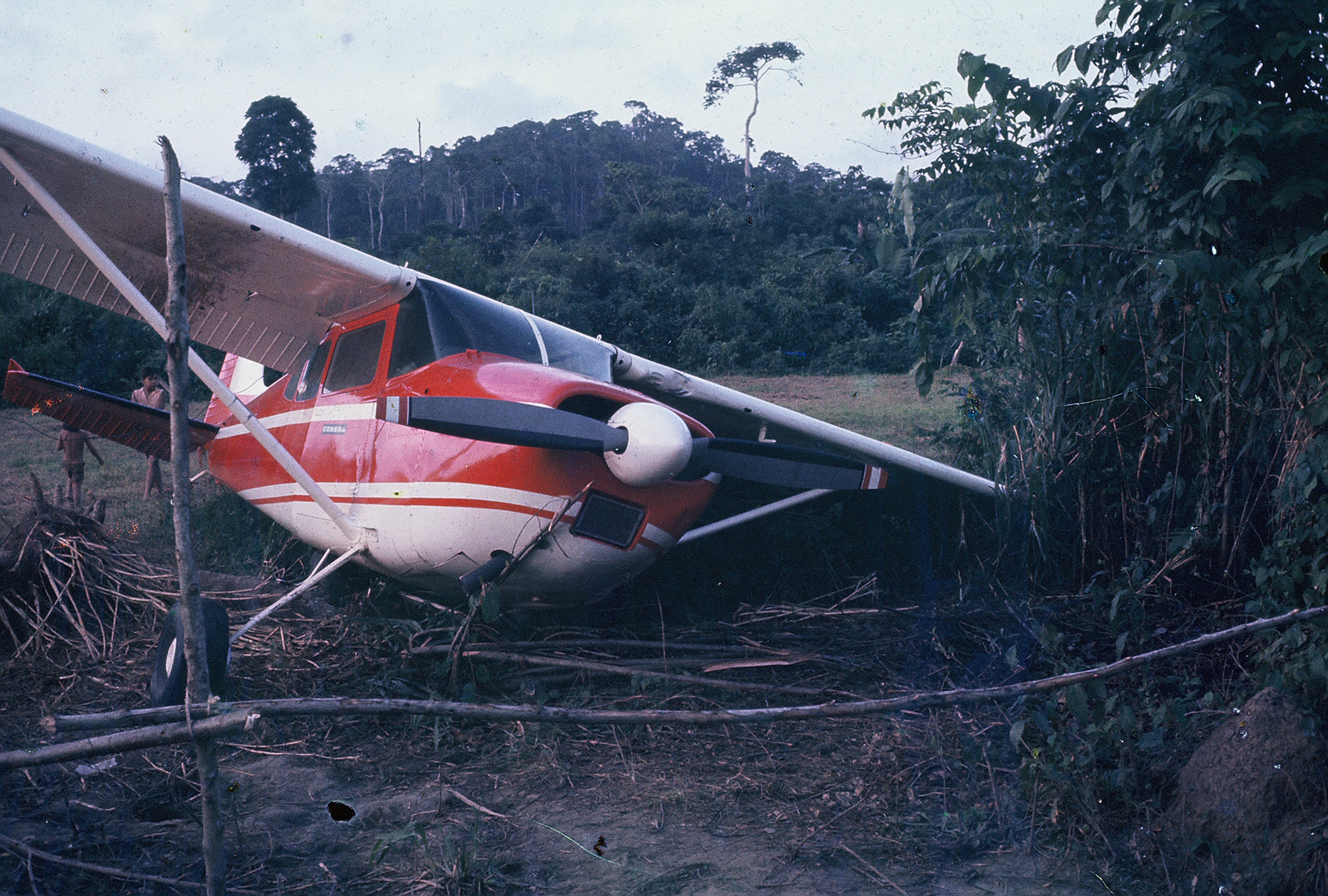
I see Muleticos airstrip appear from behind a hill—my last stop for the day. I test the brake pedals—they’re firm. Here in northwest Colombia the tiny grass airstrips dotting the landscape appear more like pastures than runways. Airstrips most pilots would eschew. Turns out, I should have eschewed Muleticos that day.

I remember Barbara and I and our three-year-old Kimberly flying into Barranquilla, Colombia where our new coworkers, Bill and Carole Clapp, meet us at the airport. On the long bus ride down to our new home in Monterìa, the blacktop undulates in the heat. I’m fatigued, pensive and plagued with doubts. Have we made the right decision to come to Colombia?

Bill, the great pilot and genius mechanic. He’s been with Mission Aviation Fellowship for several years. Some swim; he walks on water. Thirtyish, he’s slightly built with sandy hair and comes equipped with a can-do attitude. In his orientation, I don’t learn much from him about the people, culture or the long-standing Colombian civil war. He focuses on the machine we fly and the tiny airstrips we service. It is as if we live in our own mechanical world, insulated from everything around us. When he checks the oil, he wipes the dipstick off in the crook of his knee and says, “Just don’t let your wife catch you doing that.” He reminds me, “Bush flying isn’t safe, it’s dangerous—you gotta constantly manage the risks. Once a kid rammed a stick in my elevator hinges. Another time a drunk climbed up on the back of the fuselage just as I was about to take off.”

Knowing these risks, MAF fields some of the best bush pilots in the world. Some fly on skis in the snows of Nepal; others fly over the jungles of Brazil. In its first twenty-five years, MAF flew thousands of missions around the world with no fatal accidents. I began my flying knowing all men are mortal, but I somehow assumed we MAF pilots were an exception. And yet, shortly after I started my Mexico tour, George Raney crashed in New Guinea. A year later, Don Roberson crashed in Venezuela after an in-flight fire. Paul, my chief pilot and good friend in Honduras, ran into a mountain. So much for immortality. As I would fly over the vast jungles sustained only by a thin aluminum wing and a single propeller, I realized that I faced the same risks that had overwhelmed each of my friends.

Here in sparsely populated Northwest Colombia, no electronic navigation aids guide you so we fly mainly by compass and clock, trying to identify farmsteads, dirt roads and low hills. Crude homemade windsocks at some of the strips signal the wind’s direction and velocity. Bill says, “Always fly over first and check for people, animals, tools or debris on the airstrip.” After several orientation flights, he releases me on my own.

Today, like every day, I strap the airplane to my back and begin to-ing and fro-ing between Betania, San Pedro, Tierra Alta, Saiza and Nazaret, each flight taking less than thirty minutes. I notice that I’m flying the approaches just a tad faster than I did in my previous tour in Venezuela, touching down a little later and burning up a bit more strip before stopping—the price of taking two years off of flying. It’s late afternoon. I’m tired, sweaty and ready to be done for the day. I head for Muleticos with three people aboard including Adalberto, the hacienda owner. After Muleticos I can return home.

I circle over the 350-meter strip; it’s seems clear. Adalberto maintains the airstrip for the village because it connects him to the outside world where the paved road begins. Bill had told me, “Look how the strip here is fenced in. But those holes in the fence allow people and animals to cross. Always circle first and gun the engine. People will hear the plane and keep clear. You’ve got lots of room, but you can’t takeoff to the west. You would splat against that little hill, which would be counterproductive. You’ve got to land west and takeoff east.”

We bank to land to the west, steadily losing altitude. There’s not much wind. I’m glad that our Cessna 180 has a Robertson conversion—drooping ailerons and specially modified wings that give it a lower stalling speed and shorter landing roll.

I peg the airspeed at 55 mph and watch the boundary fence grow larger. I’m in the groove, staring at my touchdown point—a single tuft of grass. If the tuft moves up the windshield, I add power; if it moves down, I throttle back.

When we’re a thousand feet out, I notice the airstrip weeds standing as high as the top of the plane’s wheels. Too low now for a go-around—we’re committed to land.

I cross the fence and am flaring when out of the corner of my eye I see two black pigs running across the foot trail. The left landing gear shudders when it rips one pig in half, then the other—thunk, thunk!

I jam on the brakes. The right brake grabs, but the left brake pedal sinks to the floor. The collision must have severed the brake line! In tailwheel planes like this Cessna 180, if you swerve too much, the nose and tail will switch places. When we lurch right, I release the brake and the plane straightens, but the far fence looms large in the windshield and I’m alarmed to see several people hanging over it. I brake again and the plane again swerves right. I release the brake and the plane straightens. We’re running out of strip but still going 30 mph. I brake again, hard. The plane pivots right. I’ve lost all control now and I feel like I’m watching a slow-motion movie. We crash through the side fence and plow into a six-inch tree trunk.

As we slide to a stop, I yell, “Salgan todos ya!” (Everybody out now!) My passengers scramble out of the plane. I’m surprised at my first thought—Good; I won’t have to make any more flights today. I realize I’m completely drained.

We inspect the plane. It rests inert on its crippled left wing like a wounded insect. I smell aviation fuel, and ask someone to put a bucket under the dripping tank vent. The left landing gear lies curled back under the fuselage, tethered only by the brake line. The crash has severed the left wing strut. The dogs have carried the dead pigs away.

Curious campesinos gather around. “Hermano, will the plane fly tomorrow?”

“No.”

I’m barely able to communicate by HF radio with the distant control tower in Montería—”We’ve crashed here in Muleticos. Please phone my wife and tell her we’re all right. I’ll come out overland tomorrow.”

The local Christian brothers feed me a supper of rice and beans. It lies tasteless in my mouth. I feel weak, despondent. How will we ever repair the plane? I sink exhausted into my hammock and immediately fall asleep.

The next morning I sit astride a mule on the long, enervating trip home, my head down, one hand on the reins and the other balancing the plane’s battery on the mule’s neck. It hasn’t rained, and I choke on the dust swirling around my face. The mule’s sweat smells and the saddle chafes. Finally, we reach a waiting Land Rover and continue our journey over dirt roads that pass through many corral gates.

Long after dark I arrive home in Monterìa unshaven, covered with sweat and dirt, teared up and penitential. Barbara gives me a great hug at our door. I tell her, “I broke the airplane!” She reminds me of the many things I should be thankful for. The plane, completely out of control, miraculously avoided the people lining the fence. No one was injured. The plane is repairable. But how little gratitude I feel at that moment!

The next day I tell Bill. “The left strut’s severed; it’s useless. And the left landing gear’s broken off.”

Bill has restored whole airplanes in his home basement. Several times MAF has sent him to the other side of the world to help rebuild crashed airplanes. He decides we should go back immediately and patch the plane together, assuring me, “We’ll order a new strut down from the States.”

After another Land Rover and muleback journey we arrive at the airstrip where Bill casts an eye on the damaged plane. He minimizes the fact that the rear wing spar has two right-angle bends in it and enlists several men to help us lift the crippled left wing and shove a wooden rice-pounding mortar under the belly to support the plane. A donkey with half-closed eyes scratches his behind against one of the airstrip markers and dumps a brown dollop on the grass. I think, He never has to worry about broken machinery.

We work two days. Bill hacksaws off the damaged part of the strut and asks one of the campesinos to go find a good hardwood tree. The man soon returns with a block of hardwood and using his machete, deftly fashions it to fit inside the severed strut stub. Bill’s tools seem a natural extension of his arms and fingers—he expertly attaches the wood splint with big PK screws. The broken landing gearbox presents the most complex problem. Bill says, “We need an electric drill to remove the large, severed rivets.” But no electricity.

Adalberto says, “I’ll bring my light plant over from the hacienda to run your drill.” Soon a donkey shows up with the light plant balanced on his back. We drill out the rivets in the landing gear attach bracket and install large bolts.

After much patching up of the airplane, we finally start the engine. At 1800 rpm the whole airplane shakes. The bent prop is an inch out of track! We use a wooden prybar to attempt to pull the blade back into alignment, but it doesn’t budge. And yet Bill, ever the can-do optimist, says, “It’ll push air fine. We just won’t fly it at 1800 rpm.”

The airplane now stands on its own two feet, the lower part of the left wing strut an unpainted hardwood stub. Large bolts secure the damaged landing gear to the fuselage. A mass of PK screws and duct tape strengthens the wrinkled aluminum at the end of the left wing. The controls seem to work fine.

Meanwhile, Aeronautica Civil has helicoptered in to inspect the crash. They give us permission to sacar la avioneta (take the airplane out). That means we can dislodge the plane from the bush and set it upright on the airstrip. But Bill employs a more liberal interpretation—“sacar la avioneta”means we can fly it to Bogotá! (He follows the dictum, “It’s easier to ask forgiveness than to ask permission.”) When he runs the engine up it seems fine. So he advances the throttle, hurtles down the strip, and soon disappears over the hill. I feel lonely, abandoned. All that remains is another day-long muleback and Land Rover trip home to Montería.

A few days after returning home, I fall ill with a rising, burning fever. When the fever breaks I’m covered with sweat, shivering with shuddering chills. Barbara piles on blankets, but they don’t warm. Then the fever rises again and the cycle repeats. I think, I have malaria. But after some blood tests the doctor declares, “You’ve got typhoid fever.”

I take antibiotics and lie in bed for one month, weak as a flaccid noodle, rehearsing the accident a thousand times. Should I have intentionally ground-looped? Pumped the brake more? It will be two months before the airplane returns to service. Yet I’m perversely cheered that my typhoid provides an excellent excuse not to help Bill with the airplane repairs in Bogotá. I eventually recover and we finish the repairs together.

Our months in Colombia stretch into three years. We suffer eight robberies. The bank forecloses on the owner of our rented house. We launch an abortive communal living experiment. A school bus backs into our Land Rover and then a loaded dump truck crashes into it with Barbara driving. Were we wrong to insist on going to Colombia instead of Nicaragua, where MAF assigned us? Was it a bad decision to land at Muleticos in the one-foot-high grass? Should I have tried to ground-loop the airplane?

Yet Colombia provides us many treasures. We encounter many memorable people—Mario, the pastor of the local church; Andrés, the agriculturalist who helps improve the campesinos’ cacao crops; Gregorio, the faithful pastor who carries in his pocket two letters of reference: one to the army and the other to the guerillas.

I eventually stop asking why the accident happened and start asking, “God, what do you have for me in this? How should I respond?” I realize that life is fecund, full of God-surprises. I’m thankful for Barbara’s faithful support and thankful for all the rare and wonderful experiences in Colombia. That’s why grace is called grace. Every curse becomes a blessing. No one was injured in the accident, I survived typhoid fever, and while in Montería we adopted two more precious children—Tim and Jennifer.

Colombia, I embrace you. You’re a contradiction, a harsh teacher. But you’re also a vehicle of grace. I love the slightly-modified bumper sticker I’ve seen —“Grace Happens.”

Why Do I Make Stupid Mistakes?

I do stupid things. I know; everyone does. But I’ve elevated it to an art form. I turn on the wrong stove burner, miss doctor’s appointments, forget to put the car in park. I’ve locked my padlock key in the gym locker, forgotten to close the garage door for the night, forgotten to lock the house doors, showed up for a wedding, and later a funeral, on the wrong day, turned into the wrong side of a divided highway, backed into a light pole guywire.

Take when I crashed my 2011 Toyota Prius. The hybrid Prius is easy to get used to. But being a hybrid, the car runs on an engine plus an electric motor, and the car can be “on” even when the engine is stopped.

This day I pull up to our mailbox and put the four-way flashers on. When I jump out, the car begins rolling forward until I jump back in and slam on the brake.

Another time I’m waiting in line for gas and get out to see how many cars are ahead of me. The car starts rolling. I jump in and brake just before I slam into the car in front of me.

I tell myself, “I’ll never do that again.” But  I do, and the next time I pay for it.

I pull into my garage and sit there with my foot still on the brake, listening to MPR on the radio. The engine has stopped. After five minutes I turn the radio off and get out. The car then runs ahead into my workbench and damages the bumper ($700). Once again I’d forgotten to put the car in park and also forgotten to turn the car off.

Why did this happen? For starters, I was stopping the car for long periods of time keeping my foot on the brake without putting the car in park. Then I was taking my foot off the brake without checking that the car was in park or turned off.

Then there was the time I ran a red light. We are leaving my friend’s medical appointment in an unfamiliar part of the city. I’m talking animatedly about his procedure, our families, church. I approach an intersection, carefully look both ways—and then roll through a red light! I was focused on our conversation instead of focusing on my driving.

Worse when people do stupid stuff in the air. I flew a twin engine Cessna 310 to Amarillo, Texas, and offered to take three friends up for a ride. After we take off and climb to 4000 feet, I switch from using the main fuel tanks to the auxiliary tanks. Then I decide to practice flying single engine, so I shut down and feather the right engine. All goes well, but when I try to restart the engine it won’t start. I’m slowly losing altitude. I add full power on the good engine and frantically try to restart the dead engine. Nothing. Still losing altitude.

I decide we’ll have to land on a single engine, so I enter the Amarillo traffic pattern. We’re sinking lower and lower and I worry we won’t make the runway. I am so obsessed trying to restart the engine that I fail to check other systems.

I start my prelanding checklist and almost too late, I realize three things. I should never have practiced engine shutdown with a full load of passengers. The extended landing gear is creating more drag and causing our rapid descent.

Plus, I notice I’m still running on the aux fuel tanks. I switch the tanks back to mains and the engine immediately starts. Turns out that only the main fuel tanks have a boost pump to push the gas up to the engines. So you always need to start the engines on the main tank.

So how do I avoid doing stupid stuff? Problem is, there are different kinds of stupid mistakes. We can divide them into mistakes of knowledge, of skill, and of judgment.

First, mistakes of knowledge.  When I ran the red light, I didn’t know the streets and intersections well; first time I’d been in that area of town. In the Cessna 310 case, I did not know the fuel valve had to be on the main tank for starting.

Once I worked three hours trying to fix the brakes on my car. Then I checked out a YouTube video and was able to finish the job in twenty minutes. I needed more knowledge.

Flight instructing at Orange County Airport (now John Wayne Airport), my boss told me to test-fly a repaired plane. I jumped into the little Ercoupe (“so simple anyone can fly it”) and took off. When I came back to land in a roaring crosswind, I just about wrapped it up in a little aluminum ball. I should have known that the landing gear swivels so that the airplane can land with its nose cocked into the wind. I hadn’t even glanced at the owner’s manual. Lack of knowledge almost killed me.

Preplanning builds knowledge. Once we were driving with some friends to a small-town event in Wisconsin and ended up driving one hour north instead of south. We missed the event. If I would have studied  a map, we would have arrived in time.

Renting a car? Speeding away from the rental office at night, in the rain, in an unfamiliar car, in an unfamiliar city makes for some interesting (and dangerous) gymnastics in the first ten minutes. Always take the time to check out mirror-adjusts, emergency brake, headlights, four-ways, instrument panel, windshield wipers before moving.

A planning calendar, consulted weekly or even daily, means fewer missed appointments. In aviation, many (fatal) accidents could have been avoided if the pilot had checked the weather conditions beforehand. In flying, as in driving, you cannot do too much preplanning before you go.

Second, mistakes of skill. With my Prius, I had the knowledge; I knew how the hybrid system worked. But I had not practiced driving the car in various scenarios. I hadn’t developed good skills, such as never stopping without putting the car in park, or never removing my foot from the brake without checking to see if the car begins rolling.

In aviation, instructors talk about “overlearning”—continued practicing after you have learned a maneuver. Many states restrict driving privileges at night until the driver has practiced during the daytime.

My flight instructor would tell me, “Report incidents; prevent accidents.” Pay attention to incidents. An incident means you need more practice.

In aviation we practice emergency landings, flying with instrument failures, flying in unexpected weather. One should also (safely) practice emergencies in driving a car—loss of brakes, loss of steering, uncontrolled skids. Practice makes perfect.

Checklists build skill. With the Cessna 310, I failed to use the emergency checklist that would have reminded me to switch to main tanks for startup. Even in a car, it’s good to have a checklist. Checklists reduce the chance of missing something.

Be intentional. Do not rely on “muscle memory”—those automatic movements you are familiar with. Once my friend was flying, coming in to land. We were talking. He automatically reached down to pull on the carburetor heat but pulled the mixture instead. The engine stopped until I yelled, “mixture!”

A friend was transitioning to a new airplane. He landed, then reached over to raise the flaps—and pulled the landing gear up underneath him! In this new airplane, the landing gear lever was in the same location as the flaps lever in the previous plane.

Distractions. Managing distractions is a learned skill. After running the red light, I realized I needed to stop talking and concentrate on my driving in an unfamiliar environment. Other distractions: trying to talk to someone sitting in the back seat, juggling a soft drink and a sandwich while fiddling with the heater and the GPS. Answering your cellphone. Many pilots have the rule of a “sterile cockpit”: no talking or other distractions five minutes before takeoff or five minutes before landing. I try to have the rule of no distractions when driving through an intersection or even when driving in an unfamiliar neighborhood. For instance, I turn the radio off.

But mistakes of judgment are the most dangerous.

Risk factors. Years ago I drove through a construction zone at high speed—at night, in the rain, tired. I saw fast-moving bright lights, swerved, and barely missed a huge rumbling earthmover. I had underestimated the multiple risk factors: Night. Windy. Unfamiliar road. Construction zone. Exhausted driver. Any one of these is manageable but when they pile up, you’re in danger. For instance, you may be safe driving at night, but if it’s windy and the roads are icy, you’ve multiplied your risk factors. You must be conscious of how many risk factors you’re dealing with. Three strikes and you’re out.Good judgment demands assessing the risk factors.

Overconfidence. I ran the red light not only because I was distracted; I was also overconfident. Most people assume they’re better drivers than other people. We tend to overestimate our abilities—think about the sixteen-year-old boy who drives confidently at 100 mph in a residential neighborhood. The greatest judgment mistake is overconfidence.

So, how to avoid doing stupid things? Here’s a starter list:

  • Read the instructions (written or digital)
  • Plan carefully before executing a complex task
  • Consider a written checklist and follow it
  • Practice emergencies before you experience them
  • Take “incidents” very seriously, and change your behavior
  • Be intentional; don’t rely on muscle memory
  • Reduce distractions
  • Remember that multiple danger factors multiply risk
  • Avoid the trap of overconfidence

We all need to learn more, practice more, and use better judgment. I still do stupid things—just not quite as often.

Here’s to your increased safety!