
Spreading your wings in a perplexing world
February, 2024 James P. Hurd
Please forward and share this E-zine with others. Thank you.
Contents
- Writer’s Corner
- Blessed Unbeliever
- New story
- This month’s puzzler
- Wingspread Ezine subscription information
- Wisdom
Writer’s Corner
Tip for writers: Rabbit trails. Wonderful paragraphs, or even chapters, that interrupt the narrative but may enrich the story. (E.g., in Les Miserables Victor Hugo interrupts the narrative by inserting four chapters of deep, miasmic description of the extensive sewer system under Paris.) How does a writer get away with this—the modern reader may lose interest if the author abandons the narrative. Some answers: 1. Break up these interruptions into smaller bits. 2. Insert some narrative into the diversion. 3. Never put a diversion in the first chapter of the book. 4. Include a protagonist or main character in the diversion. 5. Explain to the reader the purpose of the diversion. 6. Know that some readers may skip over a rabbit trail to get on with the dominant narrative. Charles Darwin, in his own family’s reading together, called this skipping “skipibus.” It’s alright; you have my permission.
Word of the month: REVENANT: One that returns after long absence or after death. E.g., “He thought I was dead; I was a revenant from his distant past.”
Book of the month: LES MISERABLES. Victor Hugo. 1862. Translated by Charles Wilbour. Modern Library: New York. 1200 pages. A vast narrative set in Paris and its environs in the early 1800s. Fleeing from police inspector Javert, the convicted thief Jean Valjean robs a kind bishop who has sheltered him, but the bishop refuses to turn him over to the authorities. Valjean resolves to amend his life. He adopts little Cossette, daughter of a prostitute. Javert pursues them but at the insurrection barricades, Valjean saves Javert’s life. When Cossette falls in love with Marius Valjean hates him for stealing him away from her. And yet, Valjean saves Marius’ life, delivers him to precious Cossette, and as his own life ends, endows the happy couple with great wealth.
Question for you: How do you personally overcome writer’s block? I’ll put some of your responses in the next Wingspread.
BLESSED UNBELIEVER novel
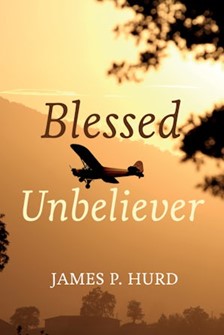
Blessed Unbeliever (paper or Kindle version) can be found at Wipf and Stock Publishers, Amazon https://a.co/d/9su5F3o or wherever good books are sold.

New story: “A Letter to my Fourteen-Year-Old Self: You are not Weird”
It’s too late for me, so you ask Grandpa Anderson what it was like building his tarpaper shack on the South Dakota prairie. Or ask him how he survived the death of his two young boys (your uncles), Jamie and Calvin. Grandpa and Grandma won’t be around forever, and after they’re gone you’ll long to be able to ask them questions. Ask them now. . . . To read more, click here https://jimhurd.com/2024/02/06/a-letter-to-my-fourteen-year-old-self-you-are-not-weird/
Leave a comment on the website and share with others. Thanks.

This month’s puzzler
(Thanks to “Car Talk Archives”) Many years ago, we had an uncle named Enzo. We only vaguely remember him. We were very young. Anyway, he went back to Italy. But before he went, he had 11 antique cars here. Each of them had a value of about 500 bucks. This was a while ago.
So, when our Uncle Enzo died, he left a very interesting will. His will said that his 11 cars be divided among his three sons. But he wanted the oldest son to get more of his estate, due to his age.
Half of the cars would go to the eldest son. One fourth of the cars to the middle son. And one sixth of the cars to the youngest son.
So after the reading of the will, everyone was puzzled. Because there are 11 cars, and 11 is a prime number, it cannot be divided in halves, fourths or sixths.
So just as everyone is scratching their heads not knowing what to do, our Uncle Vinny shows up in his 1962 Chevy Bel Air and says, “Don’t worry. I know what to do. I can help with my car.”
And the puzzler is, how do they do it?
Good luck.
(Answer will appear in next month’s WINGSPREAD newsletter.)
Answer to last month’s puzzler:
“Crusty” the mechanic had a little test to check out how good a car’s engine was. So, what was Crusty doing under the hood?
This little test is something he could do with his eyes closed. He didn’t even have to look at the engine. In fact, he often did this with his eyes closed so as not to be distracted by anything else.
What he was doing was disconnecting the coil wire so the engine would crank, but it wouldn’t start. It was a kind of compression test. So he was listening for how the engine would crank and whether or not it would crank evenly. So as every piston came up on its compression stroke, he would hear the cadence of the engine. Cool, huh?
Subscribe free to this Ezine
Click here https://jimhurd.com/home/ to subscribe to this WINGSPREAD ezine, sent direct to your email inbox, every month. You will receive a free article for subscribing. Please share this URL with interested friends, “like” it on Facebook, retweet on Twitter, etc.
If you wish to unsubscribe from this Wingspread Ezine, send an email to hurd@usfamily.net and put in the subject line: “unsubscribe.” (I won’t feel bad, promise!) Thanks.
Wisdom
Joyce Johnson said: Artists are nourished more by each other than by fame or by the public. To give one’s work to the world is an experience of peculiar emptiness. The work goes away from the artist into a void, like a message stuck into a bottle and flung into the sea.
He who has a “why” can bear any “how.” Nietzsche
The more often a man feels without acting, the less he will be able ever to act, and, in the long run, the less he will able to feel. C.S. Lewis
The difficulty of literature is not to write, but to write what you mean. Robert Louis Stevenson
He was too cowardly to do what he knew to be right, as he had been too cowardly to avoid doing what he knew to be wrong. Charles Dickens
 Wingspread
