Tag Archives: life

WINGSPREAD Zine for November, 2026

Please forward and share this zine with others. Thank you.

The world is a beautiful, mysterious, and sometimes disappointing place. This zine is dedicated to that awesome mystery.

  • Writer’s Corner
  • New Book: Navigating the Seasons
  • This month’s puzzler:
  • WINGSPREAD Ezine subscription information
  • Wisdom

Dedicated to the world of words and the people who use them.

Want to browse archived WINGSPREAD stories? Click under “archives” at https://jimhurd.com/ These stories include memoirs, stories about bush flying, and personal essays. You can type keywords in the webpage “search” function.

Reggie Radcliffe and the Fundamentalists    https://jimhurd.com/?s=fundamentalist

Praying in a Ruined Cathedral Near York    https://jimhurd.com/2015/05/28/praying-in-a-ruined-cathedral-near-york/

Social media quiz:  At the end of her text, your granddaughter writes “IYKYK.” What does that mean?

Writer’s tip: If you’re editing a manuscript for publication, don’t worry too much about formatting or layout because the size of the printed page will be different from your 8.5 x 11” page. But work hard on grammar, punctuation and spelling. Be consistent—for instance, with hyphens, en and em dashes and ellipses.

Word of the Month: PODRISHENERS. A word my pastor made up to refer to faithful church people who week by week view the podcast of the service rather than actually attending.

Metaphor of the month: His face looked like an envelope without an address.

Digital resources: UNSPLASH.COM: A searchable website full of pictures that you can use without needing copyright permission. (But note the source in your acknowledgements.)

Streaming series of the month: Agatha Christie’s detective novels are all over the streaming services, e.g., Britbox, Amazon Prime, etc.

Task for you: The next story you write, practice writing it to one single person you know (e.g., a fellow writer or a friend). That will give you focus and fluency.

Navigating the Seasons: A Journey Into Gratitude.
James P Hurd

In press with Wipf and Stock, it will be published in a couple of months. I am arranging a 40% pre-publication discount.

“I trace my journey through the ‘seasons’ of life, with the hope that the stories will strike a chord with your own journey. I tell stories about flying bush planes for Mission Aviation Fellowship in Mexico, Honduras, Venezuela, and Colombia, and stories about teaching anthropology at Bethel University, St. Paul. The “spiritual” stories trace my childhood fundamentalist faith, the doubts of adolescence, and the joy of finding a more generous faith in later years. And of course, a story about meeting Barbara.”

Email me if you’re interested in the 40% pre-publication discount.

Eleven Odd Words

Suggested by Ted Proffitt.

How many of these can you use in your next piece of writing?

  • Kerfuffle

Have you ever heard the word “kerfuffle”? It is a delightful linguistic oddity that describes  a state of mild chaos or disorder.

This peculiar term originated from Scottish dialects in the late 18th century, derived from the Gaelic cur, meaning to twist or bend, combined with fuffle, suggesting disorderly movement or commotion. As with quite a few examples on this list, the very sound of the word itself evokes its meaning.

  • Discombobulate

Another word that rarely gets thrown around, “discombobulate,” aptly describes a state of confusion, disorientation, or bewilderment.

The prefix dis- means negation or reversal, while combobulate is an invention that might have been influenced by similar-sounding words like “discompose” or “discomfit.” Together, they form a word that evokes the sensation of being mentally perplexed.

  • Bumfuzzle

Another word that describes a state of confusion, “bumfuzzle,” originated in the Southern United States in the mid-19th century with an uncertain etymology, possibly arising from a blend of “bamboozle” and “fuddle.”

This term embodies the linguistic treasure found in regional dialects, showcasing English’s ability to develop expressive terms to portray the complexity of human emotions.

  • Flummox

A word that closes this trilogy of confusion terms, “flummox,” also describes a state of bewilderment, perplexity, or confusion.

Making its first appearance in 19th-century England, its exact etymology remains uncertain, possibly derived from combining flummock, a word meaning to bewilder or confuse, with the suffix “-ox,” adding emphasis or exaggeration.

  • Flibbertigibbet

“Flibbertigibbet” is a term that can be used to describe someone who is frivolous or overly talkative. Its origins can be traced back to Old English, where flibbert denoted a frivolous person and gibbet referred to an inconsistent and unstable individual.

The word, as hard to pronounce as it is, serves as an apt definition for a lively yet disorganized individual. Think of someone who, when exposing his thoughts, is enthusiastic yet all over the place.

  • Whippersnapper

We all know a “whippersnapper,” even if we probably don’t call them that way. The term is used to describe a young and inexperienced person, often with an air of arrogance or impudence.

The word dates back to the 17th century, blending “whip,” meaning something small or insignificant, with “snapper,” suggesting someone who talks back or is impertinent. It was initially used to mock young men who cracked whips while herding cattle, and it evolved into a light-hearted term teasingly aimed at youthful individuals displaying an excess of self-assurance.

  • Bibble

If you’ve ever heard someone eating, sipping, slurping, or drinking noisily, then you have heard someone “bibble.” As with many cases in the English language, the origin of the word is very possibly rooted in onomatopoeia: a written emulation of the very sound that it aims to describe. The word is not to be confused with “nibble,” which means “to take small bites” of something.

  • Gobbledygook

One –even less used– cousin of the term “gibberish,” “gobbledygook” is an endearing linguistic oddity used to describe incomprehensible or jumbled language, often mixed with obscure slang or meaningless words.

Coined in the 1940s by Texas Congressman Maury Maverick, this term blends “gobble,” reminiscent of turkeys’ sounds, with “gook,” signifying muddled, unclear speech. Initially aimed at criticizing bureaucratic language, it was eventually used to describe similar discourse in every other sphere as well.

  • Abibliophobia

The kind of phobia that will turn anybody’s home into a library, “abibliophobia,” is a charmingly peculiar term that describes the fear of running out of reading material or being without books.

While not officially recognised in psychological dictionaries, its origins can be traced to the Greek roots a-, meaning without, biblio-, referring to books, and -phobia, denoting fear. This word defines the anxiety book lovers might experience at the thought of an empty shelf or an absence of new reading material.

  • Cattywampus

A regional dialect, “cattywampus,” is a term that describes either something positioned diagonally or something that is going the wrong way.

In either case, the word evokes a sense of playful disorder or misalignment and is an example of the English language’s knack for inventing expressions that illustrate situations that aren’t quite straight or are plain wrong, but in a lighter sense.

  • Collywobbles

A funny word to describe a not-so-funny sensation, “collywobbles” refers to a feeling of nervousness, unease, or fluttering in the stomach.

Its origins trace back to the 19th century, merging “colly,” an old English term for coal dust or darkness, with “wobbles,” implying an unsettled or wobbly sensation. Initially describing a feeling of stomach discomfort or anxiety, it evolved to signify a broader sense of nervousness or apprehension.

  • Unwonted

The most fitting word on this list was left for the last. “Unwonted” is a very rarely used term that describes something uncommon, unusual, or not customary.

Coming from Old English, it combines “un-” as a prefix denoting negation or reversal and “wonted,” which is derived from wont, meaning accustomed or habitual. An unwonted word in itself, this was a much more used term in the days of Charles Dickens and Henry James, when prose and spoken language were more adorned.

It’s 1942. You’re sitting at a table covered with pennies, some heads up, some tails.

You’re blindfolded and wearing mittens, so you can’t see or feel which side is up. You’re told that exactly 10 pennies are heads up.

Your job: separate these coins into two groups, with the same number of heads in each group.

You can move, pick up, shake, or listen to the pennies, but no peeking.

The question is: Can you do it? If so, how?

(Answer will appear in next month’s WINGSPREAD newsletter.)

Answer to last month’s puzzler:

So, what was the weird thing about the building?

It was an elevator company in a one-story building.

We tricked you.

You’d think a company that sells elevators might want a building with, you know… an elevator. But this place had only one floor, so they couldn’t even demonstrate their own product there. To see an elevator in action, you’d have to go to another building.

So the joke was simply the mismatch: an elevator company in a one-story building.

Not exactly a great showroom.

If you wish to unsubscribe from this Wingspread Ezine, send an email to hurdjames1941@gmail.com and put in the subject line: “unsubscribe.” (I won’t feel bad, promise!) Thanks.
My last visit to the doctor’s cost $300. I said, “Doctor; I had to pay $300 for this visit; you were only with me for ten minutes.”

“Oh, sorry,” he said. Shall we talk about family or sports for another 25 minutes?”

“If you’re not at the table, you’re on the menu.” Mark Carney, Canadian Prime Minister (paraphrased), arguing for cooperation with the EU.
You’ll be surprised what ideas your readers get out of your stories.

I’m convinced I’m getting stronger. I didn’t used to be able to carry $50 of groceries all by myself.
WINGSPREAD Ezine for June, 2025

Please forward and share this ezine with others. Thank you.

  • Writer’s Corner
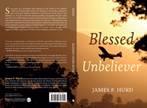
  • Blessed Unbeliever 
  • This month’s story
  • This month’s puzzler
  • WINGSPREAD Ezine subscription information
  • Wisdom

Writer’s tip: “If it sounds like writing, I rewrite it.” Elmore Leonard

Word of the month: DEIPNOSOPHIST: An expert in the art of discourse while dining

Task for you: Find a piece of writing that you really enjoy and use it as a template for your own writing: style, vocabulary, metaphors, characterizations, description of scenes, plot.

I confess I sometimes more enjoy talking to atheists than to Christians. My atheist friends seem honest about their doubts. Although my own doubts have been addressed, they have not been quenched. I believe we are all on a spiritual quest and I wish to know the quest of each person I meet. Blessed Unbeliever (below) is the story of one such quest. Much is autobiographical (I won’t tell you which parts!). But the names have been changed to protect the innocent.

Blessed Unbeliever (paper or Kindle version) can be found at Wipf and Stock Publishers, Amazon https://a.co/d/9su5F3o or wherever good books are sold.

*Note: This is a different kind of essay where I trace my personal journey from fundamentalism into a more ecumenical faith.

“The President,” sarcastically so called because he was thermometer-thin, unathletic and mute, sat alone on a bench near the Orange High School snack shop. I felt pressure rising in my gut as I sat down to “witness” to him about how all people are sinners and how he needed to “accept Christ” to escape eternal damnation. He said nothing. After about twenty minutes I got up and walked away—and never spoke to him again. My most embarrassing day in high school; I felt like I had committed a violation.

Witnessing to The President was an example of what fundamentalists did. . . . To read more, click here:  https://tinyurl.com/asepunwc

Leave a comment on the website and share with others. Thanks.

Years ago, back in the 80’s, a guy walks into a hardware store to purchase something for his house.

He asks the clerk, “How much is one?”

The clerk says, “60 cents.”

And the guys say, “Okay, how much for 12?”

The clerk says, “$1.20.”

So the guy says, “Okay then. I’ll take 200.”

And the clerk says, “That’ll be $1.80.”

And the puzzler is very simple. 

What was he buying?

Good luck, friends.

 (Answer will appear in next month’s WINGSPREAD newsletter.)

Answer to last month’s puzzler: 

How start building a bridge across Niagara Falls? They held a kite-flying contest. The first kid to be able to get his kite to land on the other side of Niagara gorge won the contest.

So once the kite was across, they attached a rope to the kite string and pulled it across. And they did this with the rope until they were able to pull the cable across. Pretty brilliant. 

And the kid’s name was Homan Walsh, a 16-year-old kid from Ireland who won the contest and made history. 

Subscribe free to this Ezine  

Click here https://jimhurd.com/home/  to subscribe to this WINGSPREAD ezine, sent direct to your email inbox, every month. You will receive a free article for subscribing. Please share this URL with interested friends, “like” it on Facebook, retweet on Twitter, etc.

If you wish to unsubscribe from this Wingspread Ezine, send an email to hurd@usfamily.net and put in the subject line: “unsubscribe.” (I won’t feel bad, promise!) Thanks.

C.S. Lewis’s stepson tells the story of a time when Lewis was walking with a friend and a person on the street came up and asked him for spare change. Lewis emptied his pockets and gave it all to the man, and once he had left, the friend challenged him, “You shouldn’t have given that man all that money, he’ll only spend it on drink.” To which Lewis replied, “Well, if I’d kept it, I would have only spent it on drink.”

The upward path of human evolution

Empathy. These eleven short stories make us think twice about the daily happenings in our lives.

1. Today, I interviewed my grandmother for part of a research paper I’m working on for my Psychology class. When I asked her to define success in her own words, she said;
“Success is when you look back at your life and the memories make you smile.”

2. Today, after my 72 hour shift at the fire station, a woman ran up to me at the grocery store and gave me a hug. When I tensed up, she realized I didn’t recognize her. She let go with tears of joy in her eyes and the most sincere smile and said;
“On 9-11-2001, you carried me out of the World Trade Center.”

3. Today, after I watched my dog get run over by a car, I sat on the side of the road holding him and crying. And just before he died, He licked the tears off my face.

4. Today at 7 AM, I woke up feeling ill, but decided I needed the money, so I went into work. At 3 PM I got laid off. On my drive home I got a flat tire. When I went into the trunk for the spare, it was flat too.

A man in a BMW pulled over, gave me a ride, we chatted, and then he offered me a job. I start tomorrow.

5. Today, as my father, three brothers, and two sisters stood around my mother’s hospital bed, my mother uttered her last coherent words before she died.

She simply said, “I feel so loved right now. We should have gotten together like this more often.”

6. Today, I kissed my dad on the forehead as he passed away in a small hospital bed. About 5 seconds after he passed, I realized it was the first time I had given him a kiss since I was a little boy.

7. Today, in the cutest voice, my 8-year-old daughter asked me to start recycling. I chuckled and asked, “Why?” She replied, “So you can help me save the planet.” I chuckled again and asked, “And why do you want to save the planet?”

Because that’s where I keep all my stuff,” she said.

8. Today, when I witnessed a 27-year-old breast cancer patient laughing hysterically at her 2-year-old daughter’s antics, I suddenly realized that I need to stop complaining about my life and start celebrating it again.

9. Today, a boy in a wheelchair saw me desperately struggling on crutches with my broken leg and offered to carry my backpack and books for me. He helped me all the way across campus to my class and as he was leaving he said, “I hope you feel better soon.”

10. Today, I was feeling down because the results of a biopsy came back malignant. When I got home, I opened an e-mail that said, “Thinking of you today. If you need me, I’m a phone call away.” It was from a high school friend I hadn’t seen in 10 years.

11. Today, I was traveling in Kenya and I met a refugee from Zimbabwe. He said he hadn’t eaten anything in over 3 days and looked extremely skinny and unhealthy. Then my friend offered him the rest of the sandwich he was eating. The first thing the man said was, “We can share it.”

A Letter to my Fourteen-Year-Old Self: You are not Weird

Hello, Jamie. Here I am over 80 years old and I realized something—you’re not weird! I found this out about you much later. Know that I’m in your corner pulling for you, interested in all your details. Right now, you’re wondering why your nose is too high on your face, how to get rid of freckles, how to get a tan on non-tannable skin. How to grow more muscle. How to stand up to bullies. How to afford the clothes that the Big Men on Campus wear. How to get more than a glance from girls. I know; I’ve been there.

I know it’s easy to think about what’s not going right in your life—few friends, no girlfriends, clumsy at sports, lack of money, too much control from parents. Even questioning your faith. Instead of obsessing about what’s wrong. But I recommend you focus on all you have, all the stuff you’re taking for granted, stuff most people in the world do not have: job opportunities, faith formation and church, health, the privilege of whiteness, a peaceful life, shelter, transportation, plenty of food, education, mentors and friends—you’ve got it all.

Constantly rehearse what God has done for you—how he’s gotten you out of trouble, what he’s given you. Treasure your interest in mission aviation—it will channel so many of your life choices. Remember that God will protect you from the trap of lust.

Embrace the truth that God has a plan for your future. Indeed, you are his beloved. I know—sometimes all you see is that you’re alone and discouraged but God is supporting you, directing your future. I know you think that to get friends you need to be a strong, funny, handsome, interesting person. Only after high school did I learn the truth—people are interested in people who are interested in them. Learn to talk in terms of the other person’s interests, not your own. (Read Dale Carnegie, How to Win Friends and Influence People.) Focusing on others will attract others to you. Actually, people want to talk about themselves. Ask questions and pursue conversations without jumping in with your own problems, your own stories. Don’t interrupt. I’m still working on being a good listener. People like people who will listen.

Your social life will only get better through high school and beyond—you gotta believe it. You will mature a ton and be better able to handle the challenges you will face. You will gain more friends, have more girlfriends. You will find people are becoming truly interested in you.

Are people opposing you? Hey; to be alive is to have conflicts. But when people accuse you or put you down, know that a lot of that comes from their own insecurity. Don’t be defensive. If someone criticizes you, just smile and say, “I’ve got lots of things I’m working on.”

Look around at the adults who believe in you—your pastor, teacher, your parents’ friends, your employer, your school counselor. Let them know you’re thankful for all their interest and advice. Looking back, I am stunned at how many of these people I took for granted and never even thanked.

It’s too late for me, so you ask Grandpa Anderson what it was like building his tarpaper shack on the South Dakota prairie, or ask him how he survived the death of his two young boys (your uncles), Jamie and Calvin. Grandpa and Grandma won’t be around forever, and after they’re gone you’ll long to be able to ask them questions. Ask them now.

After I married and had kids, I realized that having my own teenagers was punishment for the way I treated my parents when I was a teenager! Notice how your parents sacrifice for you—time, money, acts of kindness. Thank them for this. Cherish their love and support for all you do. Don’t take this stuff for granted.

Take time to explore your world. Learn where your water comes from, your electricity. Learn how your neighborhood is laid out. Go on a mission or a service trip. Travel, if you can. You will not have much time for this later.

Think about a part-time job and start saving a little money each month. Get smart on money matters—saving, investing, spending. Don’t buy a bunch of stuff. These things won’t matter when you get older.

Read the Bible each day and pray the Scriptures. Wise Solomon counsels—“Remember now thy creator in the days of thy youth . . .”

Believe it and believe God when he proclaims—“You are not weird!”