Monthly Archives: September 2024

WINGSPREAD Ezine for September, 2024

Please forward and share this Ezine with others. Thank you.

Contents

  • Writer’s Corner
  • Blessed Unbeliever 
  • This month’s story
  • This month’s puzzler
  • WINGSPREAD Ezine subscription information
  • Wisdom

Tip for writers: Ideally, the first paragraph of your story should do the following: 1. Introduce the main character(s), characters whom readers are willing to invest time getting to know, strong characters. 2. Give some idea of the world of the story: location, time period. 3. Hint at the main conflict or challenge. 4. Establish the tone of the story. 5. Fill the first paragraph with not only narrative or description; fill it with action.

Favorite metaphors: cow-flecked hills, moon with upturned horns, poster child for the human condition.

Book of the month: Isaac Azimov’s Foundation Series, 1950s. At some time in the distant future ships traveling faster than light ply the starry field of our Milky Way, knitting together several billion solar systems and quintillions of people The First Empire is destroyed and now it’s up to Hari Sheldon and the Foundation to construct a new empire. Nuclear blasters, mind control, a dangerous mutant—all this and more in a cosmic drama that unfolds across several millennia and the vast reaches of the galaxy.

Blessed Unbeliever (paper or Kindle version) can be found at Wipf and Stock Publishers, Amazon https://a.co/d/9su5F3o or wherever good books are sold.

September, 1946. Mother took my hand as we walked the dirt along Mr. Wheeler’s avocado orchard, turned to walk the three blocks of Culver Street, then crossed the playground toward Center Street school. I raised my eyes to view the enormous three-story wooden cube with its green-shingled hip roof and windows that stared out with unblinking eyes. I was excited about the classroom work but worried about meeting new kids. Mother pointed to a cave-like opening under the entrance stairs. “That’s the boys’ bathroom. The girls’ is on the other side; never go in there.” She said goodbye as I climbed the wooden steps to where Mrs. Brennan extended her carefully-tended white hand. She wore her greying hair up in a bun and her blue dress reached to her calves. I glanced behind me to see my mother disappearing across the playground. . . To read more, click here.  

Leave a comment on the website and share with others. Thanks.

An 11-year-old boy is standing at a bus stop in a very small town waiting for the #12 bus and holding his just-purchased fishing pole.

The bus finally arrives, but as the little boy begins to step up onto the bus, the bus driver stops him. 

“You can’t get on here with that fishing rod,” the bus driver says.

“Why not?” the little boy asks.

“There’s a new city ordinance that prohibits anything—packages, bags or anything at all—being carried on the bus that’s longer than four feet. And that fishing rod is longer than four feet. I’m sorry.”

“Well, how am I supposed to get home?” the little boy asks.

“That’s your problem, kid. That fishing rod is five feet long, so you can’t ride the bus.Sorry,” says the bus driver.

So, the kid figures he will have to return the fishing rod, get his money back, so he can get home on the bus. He goes to the store, and the clerk tells him, “No refunds. Sorry kid. You’re stuck with it.”

So he’s stuck with the fishing rod and no way to get home because he can’t take a cab because it’s too expensive.

He walks back into the store again, realizing he can’t return it. He stands thinking for a second. 

Five minutes later, he’s on the bus legally, riding home with the fishing rod, without altering it, breaking it, sawing it in half, or collapsing it. 

He does nothing whatsoever to alter the fishing rod.

How does he do it?

(Answer will appear in next month’s WINGSPREAD newsletter.)

Answer to last month’s puzzler: 

 You recall Julie’s dad had five daughters: June, July, August and September. What was the fifth daughter’s name? The fifth daughter? Julie! (Please don’t unsubscribe; the puzzler will be harder next time.)

Subscribe free to this Ezine  

Click here https://jimhurd.com/home/  to subscribe to this WINGSPREAD ezine, sent direct to your email inbox, every month. You will receive a free article for subscribing. Please share this URL with interested friends, “like” it on Facebook, retweet on Twitter, etc.

If you wish to unsubscribe from this Wingspread Ezine, send an email to hurd@usfamily.net and put in the subject line: “unsubscribe.” (I won’t feel bad, promise!) Thanks.

Disappeared words

Well, I hope you are Hunky Dory when you read this and chuckle. Here are some old expressions that have become obsolete because of the inexorable march of technology. These phrases included: Don’t touch that dial; Carbon copy; You sound like a broken record; and Hung out to dry.

Eeyoring (being glum, despondent)

Mergatroyd ? Do you remember that word? Would you believe the spell-checker did not recognize the word? “Heavens to Mergatroyd!”

The other day a not so elderly (I say 75) lady said something to her son about driving a Jalopy; and he looked at her quizzically and said, “What the heck is a Jalopy?” He had never heard of the word “jalopy!” She knew she was old . . . but not that old.

Back in the olden days we had a lot of moxie . We’d put on our best bib and tucker, to straighten up and fly right.

Heavens to Betsy!

Gee whillikers!

Jumping Jehoshaphat!

Holy Moley!

We were in like Flynn and living the life of Riley, and even a regular guy couldn’t accuse us of being a knucklehead, a nincompoop or a pill. Not for all the tea in China!

Back in the olden days, life used to be swell, but when’s the last time anything was swell? Swell has gone the way of beehives, pageboys and the D.A.; of spats, knickers, fedoras, poodle skirts, saddle shoes, and pedal pushers.

Oh, my aching back! Kilroy was here, but he isn’t anymore.

We wake up from what surely has been just a short nap, and before we can say, “Well, I’ll be a monkey’s uncle!” Or, “This is a fine kettle of fish!” We discover that the words we grew up with, the words that seemed omnipresent as oxygen, have vanished with scarcely a notice from our tongues and our pens and our keyboards.

Poof, go the words of our youth, the words we’ve left behind. We blink, and they’re gone. Where have all those great phrases gone?

Long gone: Pshaw, The milkman did it. Hey! It’s your nickel. Don’t forget to pull the chain. Knee high to a grasshopper.

Well, Fiddlesticks! Going like sixty. I’ll see you in the funny papers. Don’t take any wooden nickels. Wake up and smell the roses.

It turns out there are more of these lost words and expressions than Carter has liver pills.

This can be disturbing stuff! (Carter’s Little Liver Pills are gone too!)

Leaves us to wonder where Superman will find a phone booth.

See ya later, alligator! Okey Dokey .

From the heart

  • Some people are kind, polite, and sweet-spirited
    Until you try to sit in their pews. 
  • Many folks want to serve God,
    But only as advisers.
  • The good Lord didn’t create anything without a purpose,
    But mosquitoes come close.  
  • Opportunity may knock once,
    But temptation bangs on the front door forever. 
  • We’re called to be witnesses, not lawyers or judges.
  • I don’t know why some people change churches;
    What difference does it make which one you stay home from?
  • Be ye fishers of men. You catch ’em – He’ll clean ’em.
  • Coincidence is when God chooses to remain anonymous.
  • God grades on the cross, not the curve.
  • He who angers you, controls you!
  • What more could we want
    than to be a healing presence
    in each other’s life?

The prophetic tasks of the church are to tell the truth in a society that lives in illusion, grieve in a society that practices denial, and express hope in a society that lives in despair.
                                                                                                Walter Brueggemann

I will go out and carve a tunnel of hope from a mountain of despair.
                                                                                                Martin Luther King Jr.

The World of Center Street Elementary

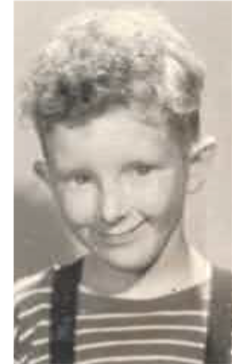
September, 1946. Mother took my hand as we walked the dirt along Mr. Wheeler’s avocado orchard, turned to walk the three blocks of Culver Street, then crossed the playground toward Center Street school. I raised my eyes to view the enormous three-story wooden cube with its green-shingled hip roof and windows that stared out with unblinking eyes. I was excited about the classroom work but worried about meeting new kids. Mother pointed to a cave-like opening under the entrance stairs. “That’s the boys’ bathroom. The girls’ is on the other side; never go in there.”

She said goodbye as I climbed the wooden steps to where Mrs. Brennan extended her carefully-tended white hand. She wore her greying hair up in a bun and her blue dress reached to her calves. I glanced behind me to see my mother disappearing across the playground. As we entered, I smelled the waxed hardwood floor and turned to gawk at the carved wooden staircase rising toward second floor.

When the noon buzzer rang, Mrs. Brennan told us, “You may eat downstairs in the lunchroom or outside under the playground shelter.” Students walked to the cloakroom and grabbed lunches out of their cubbyholes but I left the building and wandered around the playground hungry, wondering why my mother hadn’t packed me a lunch.

Principal Ebersole saw me. “Are you in kindergarten?”

“Yes.”

“Why are you still here? Kindergarten ends at noon.”

“Mrs. Brennan never told us to go home.”

“Mrs. Brennan? She’s the first-grade teacher. You should have been in Mrs. Baker’s class.”

“No one told me . . .”

Mother came to pick me up.

The next morning, my neighbor Jerry and I were walking to school along Culver when we passed a dark, stuccoed house with tall grass, scraggly bushes and the window shades pulled down. “A witch lives there,” Jerry told me. We started running.

A block farther on, we looked down Harwood Street and saw the tiny store that sold Bazooka gum, M&Ms, and candy cigarettes. We walked over, searching our pockets for change. I opened the little paper packet Mom had sent with me and used the money to buy M&Ms for Jerry and me. We arrived at Kindergarten all sweet and chocolatey.

After a few weeks of walking down Culver Street we got braver and shortcut through our orange orchard smelling the fragrant blossoms so we could cut through Joe’s Lumberyard—a chaotic assortment of broken chairs, metal tables, old doors, window frames with peeling paint, derelict staircases, ceiling trusses, broken strips of siding, toilet stools, bathtubs, kitchen sinks and faucets, piles of used lumber—all strewn helter-skelter with little rabbit runs winding between. It looked like a ghost town hit by a tornado.

Stray cats haunted the woodpiles, along with the occasional rabbit. Once we saw a coyote. And then there was Sam the Tramp who guarded the lumberyard with his snarly dog Butch. Unshaven, with his long dishwater-gray hair hanging to his earlobes, he wore torn brown pants too big for him, scuffed shoes with holes in the leather and a ripped straw hat, appearing as a person destiny had a serious grudge against. He slept in a tiny tarpaper shack that stood amidst the lumber and debris. He didn’t talk; he just sat in front of his shack on an old chair with missing spindles and stared at us until we took off running. “I think he’s a serial killer,” Jerry told me.

. Mrs. Baker, serious as a Puritan preacher, sat soberly with every inch of her body erect in her desk chair. When she rose to illustrate something, her fingernails would scratch the blackboard. And yet she had a great heart for her students. Her classroom had plastered walls reaching high to the ceilings, large windows that allowed the sun to beat in onto the hardwood floor and no air conditioning. Chains supported big hanging light fixtures that glowed beige. A sandbox stood in one corner. The letters of the alphabet in block letters and cursive ran along the top of the blackboards. We sat at cast-iron-legged wooden desks on which some past students had carved their initials. A hole was cut in the top that previously held an ink jar, the purpose of which, my dad told me, was for dipping the pigtails of the girl in front of you. A pencil sharpener hung on the wall near the blackboard. Once when I blew in it to clean out the shavings, pulverized lead flew out all over my face

We always began by reciting the Pledge of Allegiance but it was years before I learned what “republic” and “indivisible” meant. I liked learning about the pilgrims and singing patriotic songs—“God Bless America,” “America the Beautiful.” Then  a song about leading the tow-mules sixteen miles along the Erie Canal and finally, “Las Chiapanecas,” about the Mexican girls who danced twirling their full skirts. I don’t remember any opening prayers. I learned to form letters and to add and subtract. Being left-handed, I would pull my pencil across the page and slant the letters to the right. The teacher gave up trying to change me. When mid-morning came, we marched down to the lunchroom where we drank our little cartons of milk, free if your family was low-income.

Then we returned to class to read from Dick and Jane—a beautiful picture story book about little kids and their dog, Spot. “Look, Dick, look.” “See Spot run.” “Jump, Spot, jump.” Dick and Jane lived in an all-white neighborhood with no dirt or trash or crime, yet still patrolled by big, friendly, blue-suited policemen. Next, we had show-and-tell time when kids would stand in front of the class and tell stories about themselves. Some of these may have been true. Once Harold told his story with his fly open. Nobody said anything.

The next year I was sitting in Mrs. Brennan’s first grade class as the hands of the big Seth Thomas wall clock nibbled away at the morning until the piercing buzzer signaled lunchtime. We carried our lunches outside to eat under wooden shelters that shielded us from the sun. The kids who ate bologna and cheese sandwiches made fun of my mom’s sandwiches of mayonnaise and avocado, made with avocados from our own orchard. Once when Darlene walked by, a boy yelled, “I wish I had that swing in my back yard!” I didn’t know what he meant..

Out on the playground, the LA basin smogged our throats. But sometimes, hot, dry, fifty-mile-per-hour Santana winds would roll in from the east through the Banning pass. The wind blew all the smog out to sea, leaving the air so clean it quivered. The trees swung their leaves like nets and shed some of their smaller branches. Inhaling the smell of blowing dust, we tried out the merry-go-round, swings, a sagging, netless basketball hoop and the exercise bars. The merry-go-round was a marvel of perpetual motion that seemed to spin forever, making your head dizzy. But if it spun too fast, the bearings would grind and it would throw kids off. The tall swings had canvas seats held by long chains. The fifth graders told us they could pump the swings so hard they looped-the-loop. I had nightmares about looping, then crashing down on the high crossbar. I spent hours shooting baskets at the solitary, sad and sagging iron hoop.

Kids would jump and grab the parallel bars with gritty, sweaty hands, then do the dead man’s drop. You got swinging by your knees, then released at the top of the swing and tried to land on your feet. When I  tried it I landed on my backside and knocked my breath away. The girls would hang upside down on these bars with their dresses falling down over their heads, yelling at the staring boys, “Get your eyes full!” The Center Street girls fascinated me. They seemed a different species, walking around the gravely playground in their white dresses with the little starched collars, white bows in their hair.

We played kickball on the dirt diamond. When it was my turn to kick, Gary Bradley sauntered over, pushed me down and took my place. I started crying. I tried to avoid him but later, in middle school, he beat me up again. Gary—poster child for the human condition, terrifying pustule of ego with bulbous eyes, puffy face and wearing an attitude tough as nails, grated on people like tinfoil on a filling. He gave me my first bloody nose. Then Sherman, an unerupted volcano with an IQ below the range of his body temperature, would push boys down onto the gravel. I avoided him until the day Mom invited him to go to church with us. Awkward. I assumed. Jesus’ command to “love your enemies” did not include Gary or Sherman,

We met Okie and Arkie kids whose parents had fled to California from the Midwest of the 1930s to escape the terrible dustbowl droughts. They took over the jobs the locals did not want and began replacing the Mexican orange pickers in the orchards. The girls in their faded dresses looked as if their mothers had forgotten to comb their hair. The boys wore longer, disheveled hair, overalls instead of jeans, and they talked funny. Big belt buckles. You didn’t want to sit next to them. They smelled perspired and If they sniffed something, they would lean over and smell your crotch.

Most Mexicans lived on the other side of Glassell and went to Killefer School. In the 1940s, Orange Unified was one of the first districts to integrate so later, in first grade, we got Richard Herrera. Brown-skinned with straight black hair, he wore a tiny crucifix hanging from a gold chain. His English was pretty good. We became friends.

Every Wednesday, the higher grades got to practice jumping onto a fire escape slide that spiraled down from the third floor. During Cub Scout nights, some of us would sneak up to the dark third floor and feel our way over to the fire escape. One after another we launched, sailing down the slick slide. We found the exit doors locked, so we had to climb back up the slide, slipping and sliding. One night the principal caught us. It was totally worth it.

At the end of my fifth grade year, Center Street finally closed her doors. That day, anyone could slide down the fire escape—even the principal! But soon they bulldozed the school to the ground. When graduation day came we filed by the principal to receive our diplomas. Afterwards the teachers assembled the students to do the Bunny Hop. But Silver Acres Church was fundamentalist and Brother Cantrell preached hard against dancing. So instead of dancing, Kevin and I sat in the hallway at a table playing chess. Kevin was happy but I felt like a nerd. That summer Jerry and I were walking through Joe’s junkyard when we saw an abandoned metal helix lying on its side, forlorn and forsaken. We stared at the twisted metal of the derelict fire escape.

After graduation I thought my bullying troubles were over. Until I moved on to the anteroom of Hades—Orange Intermediate School. Another world to conquer!