Monthly Archives: June 2025

WINGSPREAD Ezine for June, 2025

Please forward and share this ezine with others. Thank you.

  • Writer’s Corner
  • Blessed Unbeliever 
  • This month’s story
  • This month’s puzzler
  • WINGSPREAD Ezine subscription information
  • Wisdom

Writer’s tip: “If it sounds like writing, I rewrite it.” Elmore Leonard

Word of the month: DEIPNOSOPHIST: An expert in the art of discourse while dining

Task for you: Find a piece of writing that you really enjoy and use it as a template for your own writing: style, vocabulary, metaphors, characterizations, description of scenes, plot.

I confess I sometimes more enjoy talking to atheists than to Christians. My atheist friends seem honest about their doubts. Although my own doubts have been addressed, they have not been quenched. I believe we are all on a spiritual quest and I wish to know the quest of each person I meet. Blessed Unbeliever (below) is the story of one such quest. Much is autobiographical (I won’t tell you which parts!). But the names have been changed to protect the innocent.
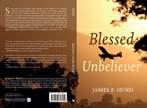
Blessed Unbeliever (paper or Kindle version) can be found at Wipf and Stock Publishers, Amazon https://a.co/d/9su5F3o or wherever good books are sold.

*Note: This is a different kind of essay where I trace my personal journey from fundamentalism into a more ecumenical faith.

“The President,” sarcastically so called because he was thermometer-thin, unathletic and mute, sat alone on a bench near the Orange High School snack shop. I felt pressure rising in my gut as I sat down to “witness” to him about how all people are sinners and how he needed to “accept Christ” to escape eternal damnation. He said nothing. After about twenty minutes I got up and walked away—and never spoke to him again. My most embarrassing day in high school; I felt like I had committed a violation.

Witnessing to The President was an example of what fundamentalists did. . . . To read more, click here:  https://tinyurl.com/asepunwc

Leave a comment on the website and share with others. Thanks.

Years ago, back in the 80’s, a guy walks into a hardware store to purchase something for his house.

He asks the clerk, “How much is one?”

The clerk says, “60 cents.”

And the guys say, “Okay, how much for 12?”

The clerk says, “$1.20.”

So the guy says, “Okay then. I’ll take 200.”

And the clerk says, “That’ll be $1.80.”

And the puzzler is very simple. 

What was he buying?

Good luck, friends.

 (Answer will appear in next month’s WINGSPREAD newsletter.)

Answer to last month’s puzzler: 

How start building a bridge across Niagara Falls? They held a kite-flying contest. The first kid to be able to get his kite to land on the other side of Niagara gorge won the contest.

So once the kite was across, they attached a rope to the kite string and pulled it across. And they did this with the rope until they were able to pull the cable across. Pretty brilliant. 

And the kid’s name was Homan Walsh, a 16-year-old kid from Ireland who won the contest and made history. 

Subscribe free to this Ezine  

Click here https://jimhurd.com/home/  to subscribe to this WINGSPREAD ezine, sent direct to your email inbox, every month. You will receive a free article for subscribing. Please share this URL with interested friends, “like” it on Facebook, retweet on Twitter, etc.

If you wish to unsubscribe from this Wingspread Ezine, send an email to hurd@usfamily.net and put in the subject line: “unsubscribe.” (I won’t feel bad, promise!) Thanks.

C.S. Lewis’s stepson tells the story of a time when Lewis was walking with a friend and a person on the street came up and asked him for spare change. Lewis emptied his pockets and gave it all to the man, and once he had left, the friend challenged him, “You shouldn’t have given that man all that money, he’ll only spend it on drink.” To which Lewis replied, “Well, if I’d kept it, I would have only spent it on drink.”

The upward path of human evolution

Empathy. These eleven short stories make us think twice about the daily happenings in our lives.

1. Today, I interviewed my grandmother for part of a research paper I’m working on for my Psychology class. When I asked her to define success in her own words, she said;
“Success is when you look back at your life and the memories make you smile.”

2. Today, after my 72 hour shift at the fire station, a woman ran up to me at the grocery store and gave me a hug. When I tensed up, she realized I didn’t recognize her. She let go with tears of joy in her eyes and the most sincere smile and said;
“On 9-11-2001, you carried me out of the World Trade Center.”

3. Today, after I watched my dog get run over by a car, I sat on the side of the road holding him and crying. And just before he died, He licked the tears off my face.

4. Today at 7 AM, I woke up feeling ill, but decided I needed the money, so I went into work. At 3 PM I got laid off. On my drive home I got a flat tire. When I went into the trunk for the spare, it was flat too.

A man in a BMW pulled over, gave me a ride, we chatted, and then he offered me a job. I start tomorrow.

5. Today, as my father, three brothers, and two sisters stood around my mother’s hospital bed, my mother uttered her last coherent words before she died.

She simply said, “I feel so loved right now. We should have gotten together like this more often.”

6. Today, I kissed my dad on the forehead as he passed away in a small hospital bed. About 5 seconds after he passed, I realized it was the first time I had given him a kiss since I was a little boy.

7. Today, in the cutest voice, my 8-year-old daughter asked me to start recycling. I chuckled and asked, “Why?” She replied, “So you can help me save the planet.” I chuckled again and asked, “And why do you want to save the planet?”

Because that’s where I keep all my stuff,” she said.

8. Today, when I witnessed a 27-year-old breast cancer patient laughing hysterically at her 2-year-old daughter’s antics, I suddenly realized that I need to stop complaining about my life and start celebrating it again.

9. Today, a boy in a wheelchair saw me desperately struggling on crutches with my broken leg and offered to carry my backpack and books for me. He helped me all the way across campus to my class and as he was leaving he said, “I hope you feel better soon.”

10. Today, I was feeling down because the results of a biopsy came back malignant. When I got home, I opened an e-mail that said, “Thinking of you today. If you need me, I’m a phone call away.” It was from a high school friend I hadn’t seen in 10 years.

11. Today, I was traveling in Kenya and I met a refugee from Zimbabwe. He said he hadn’t eaten anything in over 3 days and looked extremely skinny and unhealthy. Then my friend offered him the rest of the sandwich he was eating. The first thing the man said was, “We can share it.”

Venturing Beyond the Pale

“The President,” sarcastically so called because he was thermometer-thin, unathletic and mute, sat alone on a bench near the Orange High School snack shop. I felt pressure rising in my gut as I sat down to “witness” to him about how all people are sinners and how he needed to “accept Christ” to escape eternal damnation. He said nothing. After about twenty minutes I got up and walked away—and never spoke to him again. My most embarrassing day in high school; I felt like I violated him.

The Comfort of Certainty

Witnessing to The President was an example of what fundamentalists did. Twice on Sunday and most Wednesday nights our family would drive the eight miles to the church that cradled my childhood: Silver Acres. The men would arrive in suits and women in hats, some with veils. Pop McIntosh led the singing, waving his arm to keep the beat. Before I left elementary school, I had memorized the lyrics of “Power in the Blood,” “It is Well with my Soul,” “Abide with Me,” “Blest Be the Tie that Binds,” etc. Earl Ward taught me to play chess and on men’s potluck night, Mr. Ballew always bought cherry pies, baked by his Emma.

Before Brother Cantrell preached his sermon, he would invite people to join the church: “We’re fundamentalist, independent, unaffiliated, Bible-believing, premillennial, pretribulational.” I thought, if you understood that string of big words serves you right if they baptize you. After church Bro. Cantrell and Walter Loitz would talk Bible and football.

At 10 I could recite all the biblical books in order: Genesis, Exodus, Leviticus, Numbers . . .  We would have “sword drills,” using our “sword” to see who could look up verses the fastest. I became a Bible nerd, reading my Scofield Bible, and devouring Bro. Cantrell’s big words: Inerrancy means that the Bible contains no errors of any kind. The world is that territory “beyond the pale,” outside the camp, that place of temptation that lies under control of the Evil One. The rapture, tribulation and millennial kingdom referred to events happening at the end of time. He talked a lot about the end times. Modernist referred to people or churches we shunned, some of which questioned the resurrection, the virgin birth and biblical inerrancy. Some fundamentalists even practiced “secondary separation”—separating from those (e.g., Billy Graham) who themselves fraternized with modernists (e.g., Martin Luther King, Jr.). My friend Jerry was mainline Methodist—I once asked him if his church celebrated Easter! Unlike them, we did not kneel in church or make the sign of the cross. No crosses hung on the wall at Silver Acres, no pictures of Jesus. Instead of liturgy and sacraments we anchored our beliefs in Bible verses.

Growing up, I felt as if knew God’s plans for my life and for the world. And I confess, I carried a teeny bit of pride in my arcane vocabulary. I felt no need to help make the world a better place because the world was under control of the Evil One. So we endeavored to only persuade people to join us as we waited for Jesus to come back.

After WWII, many middle-class Americans valued high morals and a conservative lifestyle but fundamentalists went further. Bro. Cantrell preached against smoking, drinking, dancing, movie theaters and gambling. Of course I grew interested in the church girls. I watched Kay Cantrell sitting broadly on the piano bench in her see-through blouse (pushing the boundaries of fundamentalist norms). One day in the Cantrell parsonage I saw two books lying on the dining room table: What Every Christian Boy Should Know and What Every Christian Girl Should Know. The second sounded more interesting but as I was paging through it, Mrs. Cantrell walked in and warned me, “Jamie, that book is only for girls.”

I was the only one in my grade who did not take square dance classes in middle school. Even into college I never touched a cigarette, never gambled and never drank alcohol. Do I regret these constraints? No. Years later, these same moral values restrained me from jumping into bed with an over-eager girlfriend. I harbor a teeny regret missing the great movies—I never entered a theater until my twenties.

The Scofield Bible, with its authoritative notes, clarified biblical complexities. It erased the ambiguities, melted the mysteries, quieted my questioning and defeated my doubts. It felt good to be certain—you demonstrated your faith by not questioning. I learned that Jesus, son of the transcendent God, died not only for the world but for me.

But we did not merely parrott propositions. It was a social movement created by a faithful band of people who wished to live separate from the world. As a young person I embraced fundamentalist faith and enjoyed being part of the ingroup. It gave me a way to understand the Bible and embrace life-orienting beliefs. It gave me a task—carrying God’s message to the world. I understood why evil existed in the world, understood how to protect myself from it. This buoyed me through the tempests of my early life.

Silver Acres gave me a moral gyroscope that helped me survive the pains of adolescence. It assured me of who I was and what my purpose was in the world. I received precious gifts—a loving community, a dense network of friends and supportive adults. I knew who my people were and who my God was. Silver Acres insulated me from that world of sin and temptation beyond the pale. Later, the church pointed me toward Bible Institute and Christian mission.

Cracks in the Wall

And yet, as I moved into adolescence I began to feel like a social leper—different, conspicuous, isolated. There weren’t many fundamentalists out there. I grew to dislike worldly people, criticized their wrong beliefs, judged their lifestyles. I became more and more socially isolated and confused.

Further, I started doubting the great fundamentalist doctrines. The ordinance of communion bored me. Bro. Cantrell would spend half the service assuring us that “this is only grape juice and crackers; nothing to see here.” Ushers passed crumbled saltines and little plastic cups of grape juice along the rows. If communion food was merely grape juice and crackers, why bother? I longed for something deeper, more connective as I explored how far I could tip the communion cup without spilling the juice.

Since the Bible was inerrant, I was terrified I would find one small mistake that would destroy my whole faith. I worried about conflicts between the gospel accounts and how to reconcile the Old Testament God who commanded the destruction of the Canaanites with the New Testament God-in-Jesus who preached unconditional love?

Fundamentalists argued that the Bible is literally true “in all it affirms.” But how could the book of Revelation be literally true? Locust-shaped horses with women’s hair and stingers in their tails, stars falling to earth, a beast with ten heads . . . Surely these were symbolic?

I had the most trouble when the text touched scientific subjects—the “four corners” of the earth, the sun rising and setting. If you did the genealogies in the Bible, the universe seemed to be only 6,000 years old. How could this square with scientific findings?  Surely the text was pre-scientific? How convince worldly people to accept something I myself had trouble believing?

Opening the Door

When I moved to Cal State Fullerton and joined Intervarsity Christian Fellowship, I encountered a wonderful community that included strong Christians from mainline and Catholic traditions. I enjoyed friendships at Cal State with non-Christians and even atheists. My very questions and doubts gave me a kinship with them. I became more transparent and found they would frequently open up about their own questions. I was expanding my scope, widening my tent, embracing the world beyond the pale. I had found an expression of faith I could believe in and even more important, a faith that I could celebrate and share.

Not long ago, I boarded the Amtrak to travel from Mattoon, Illinois back to Minneapolis. Finding my assigned seat, I discovered a young man stretched out across it, asleep. I cautiously woke him. sat down, and for the next two hours, enjoyed an amazing conversation. Jamil, married and in his early twenties, was Palestinian, a “man without a country.” And Muslim. Formerly, I would have argued with him about the Bible or the deity of Christ. But this day, I found I was talking to a man in transition. His marriage was in trouble and he was looking for a mosque and an imam he could relate to. He was full of questions. I sympathized, talking about my own quest for a church and minister. We parted friends and talked by telephone a couple of times after that.

I treasure my fundamentalist foundations but today I’m happy living “beyond the pale” and learning how to embrace all people in God’s beloved world, happy learning that we all are on a spiritual quest.