Spreading your wings in a postmodern world
April 2026 James P. Hurd
Please forward, and share this zine with others. Thank you.
The world is a strange, beautiful, mysterious and sometimes disappointing place. This zine is dedicated to that mystery.
CONTENTS
- Writer’s Corner
- Blessed Unbeliever novel
- This month’s story
- This month’s puzzler:
- WINGSPREAD Ezine subscription information
- Wisdom
WRITER’S CORNER
Dedicated to the world of words and to the people who love them.
Writer’s tip: If you’re writing fiction or even memoir, remember—if you don’t have conflict, you don’t have a story. Think Downton Abbey. There’s always a problem—shunned love, dangerous secrets, great loss, unwelcome change, upstairs/downstairs troubles, money problems, legal problems. You get the idea—if there’s no conflict, you don’t have a story.
Want to browse archived WINGSPREAD stories? Click under “archives” at https://jimhurd.com/ These stories include memoirs, stories about bush flying, and personal essays. You can typeany keywords in the webpage “search” function.
Here are a few examples:
“Once Again to Colombia” (mission trip to Cartagena) https://jimhurd.com/2016/02/08/once-again-to-colombia/
“Brave New World of Cooking” (single again; how does one learn to cook?) https://jimhurd.com/2025/03/
Word of the Month: SANEWASHING
The act of minimizing the perceived radical aspects of a person or idea in order to make them appear more acceptable to a wider audience. His loyalists constantly sanewashed his comments and actions.
Metaphor of the month: “He was the kind of man that destiny had a serious grudge against.”
Digital resources: Use AI to do background research for your stories and memoirs. E.g., “What were the streets that ran by the old Madison Elementary School?” “What are the trees native to northern California?” “What was the date John F. Kennedy was shot?”
TV series of the month: OUR MUTUAL FRIEND. Based on the eponymous book by Charles Dickens. Greed, treachery, death, young love, charity, secrets, beauty. Follow John Harmon as he conceals his identity and pursues the beautiful yet prideful young Bella. Four longer episodes on the BBC streaming service. (The BBC streaming service is wonderful! Christie’s Piorot, Conan Doyle’s Sherlock Holmes, Chesterton’s Father Brown, Jane Austin’s stories, Shakespeare and many others.)
Task for you: Start a list of metaphors you have heard or read that you love. When you write your next story, glance over your list and see if you can use any of them. Send me your best finds.
BLESSED UNBELIEVER novel
An Excerpt from Blessed Unbeliever
Late one night Sean McIntosh sat alone, gazing out the window of Norbert prayer room, trying hard not to pray. Why am I in a prayer room? he asked himself. I don’t even believe God exists—I’m like a Nazi in a synagogue. He smelled the humid carpet and a chill gripped him—was the radiator working? I guess you don’t ever become a perfect atheist; you just work harder and harder at it. Am I working hard enough? He slammed his fist down on the table. “Damn it—tonight I’ll burn some bridges.”
He walked in stocking feet down the hall to fetch the steel wastebasket from his dorm room along with some towels, a paper bag, a jar of water and a book of matches he’d picked up from a restaurant. And his Bible. Propping a chair under the knob of the closed prayer room door, his hands trembled as he picked the Bible up and opened to the inscription on the flyleaf: “For you, Son, on your twelfth birthday. God bless you. Love, Mom.” This black leather Scofield Bible symbolized his fundamentalist Christian life. But tonight, he was leaving it all behind. Why couldn’t he just throw it away? No, he had to do something more, something to make a clean break with his past.
His heart faltered as he heard footsteps outside, probably someone going to the bathroom. Grasping his Bible by the spine, he struck a match and held it under the hanging pages. When they curled and blazed into flame, he dropped the burning mass into the wastebasket. He stuffed some towels in the crack under the door. Coughing, he ran over and opened the window, hoping no one would smell the smoke. It seemed to him that the acrid smell, along with his childhood faith, was pouring out the window and disappearing into thin air. He felt the loss but at the same time felt empowered by his action.
When the smoke died down, he poured in the jar of water, heard the steam hiss and then sat a long time in one of the wooden chairs trembling. In his desperation he’d done the deed, committed the sacrilege, put into action his atheism—the boldest thing he’d ever done. And he’d done it in this sacred place of prayer. Henceforth his “Christian faith” would only be an act.
He scooped out the sodden mass and put it in the paper bag, trying to wipe the condemning wet ashes from his hands. Opening the prayer room door and looking both ways down the hall, he walked down to the men’s bathroom and stuffed the bag deep into the trash can. Just then he looked up at the mirror and saw a bulky form walk in and enter one of the stalls. Dean Winters! He must be on overnight duty this week. Sean panicked. He quickly washed the stains off his hands, hoping no lingering smoke smell would betray him, hoping Winters wouldn’t notice the soggy, burnt mass in the trash can. Then he crept back to his dorm room, threw himself on his bed exhausted and said out-loud, “I’ll never believe in God again. . . .”
#hashtags: #blessedunbeliever #christianwriter #babyloss #southerncalifornia #planes #aviation #humanist #pilotlife #religion #travel #aviationgeek #orangecounty #godless #atheism, #latinamerica
Available in paper or Kindle version at Wipf and Stock Publishers, Amazon https://a.co/d/9su5F3o or order it wherever good books are sold.
NEW STORY: AN AMISH DEATH
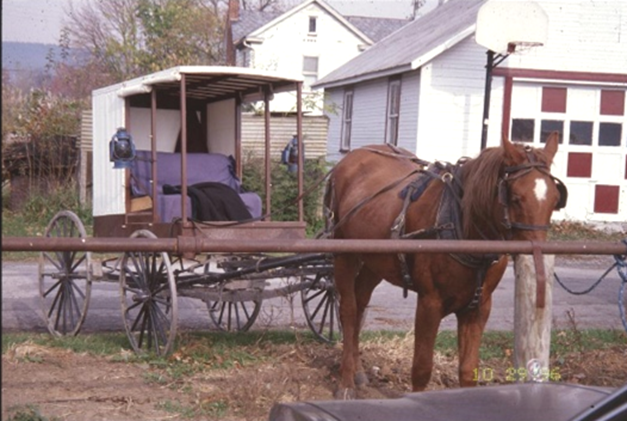
White buggy at the Belleville auction
Melinda Yoder, sister to the Amish bishop, has died. Since the church does not practice embalming, she must be buried within twenty-four hours. I have never met Melinda, but I have been living for several months in the home of her nephew, Eli. Today I go to her funeral, accompanied by Shirley Renno, one of her distant Mennonite relatives.
We drive into the barnyard on a bitter cold day to find some snow on the ground and many white buggies parked near Melinda’s farmhouse. The smell of tobacco drifts over from where some older men stand near the barn, rolling cigarettes and smoking. They all wear black hats, long-sleeved pullover shirts and brown pants and coats. Lacking suspender or belt, the pants are snugged with lacing in the back. We walk into the house to see a wooden coffin resting in the middle of the living room on two saw horses. I remove my hat. The Amish are a closed society, but sometimes a funeral draws many English (non-Amish) people. In this case, Shirley and I are the only outsiders. . . .
To read more, click here: https://tinyurl.com/5xnwpxfk
Leave a comment on the website, subscribe and share with others. Thanks.
You can also access my articles on Substack: James’s Substack | Substack
THIS MONTH’S PUZZLER, THANKS TO “cAR tALK”
This story is “The Bridge of Tom and Ray.” Here we go.
In Borneo, there is a bridge connecting two islands constructed of bamboo lashed together with hemp.
It’s been used for hundreds of years, pedestrian traffic, vehicular traffic, both directions. It’s four miles long.
Now this bridge has a weight limit of 20 tons.
One day, a truck filled with pigs pulls up to the bridge. Officials stop him and let him know they have to weigh the truck, due to the weight limit.
So the truck drives onto the scale. Turns out that with all the pigs, and the driver, this truck weighs exactly 20 tons.
The guy at the other end gets the signal and he stops all other traffic. Everyone has to stop.
The bridge is emptied, and this guy is allowed to drive over the bridge alone.
He is right at the limit, at 20 tons, so he has to drive over completely alone.
As he drives across, a sparrow begins to follow alongside, flying in the air along with the truck.
The sparrow begins to hover over the truck, flapping its wings. When he’s a little beyond the halfway point, the sparrow lands on the truck.
What does the driver do at that moment to keep the truck from plunging into the water?
(Answer will appear in next month’s WINGSPREAD newsletter.)
Answer to last month’s puzzler:
Okay, so, what quick adjustment did the mechanic make that enabled Jeffersonville Fire Department to take home the trophy in the race?
Because they were racing counterclockwise around a track, he wanted to make it so that the Jeffersonville truck would be able to negotiate those constant left hand turns easier than the East Norriton truck.
So without using any tools, he simply let a little air out of the left side tires of the Jeffersonville truck.
Because if you have low pressure in one of your tires, your car will tend to pull in that direction.
So since they are going counter clockwise, that means a lot of left turns. And with the tires just a little light on the left side, the truck wants to go in that direction anyway.
And this way, they were able to win their competition.
Not sure that is truly legal, but we are going with it anyway!
Subscribe free to this Ezine
Click here https://jimhurd.com/home/ to subscribe to this WINGSPREAD ezine, sent direct to your email inbox, every month. You will receive a free article for subscribing. Please share this URL with interested friends, “like” it on Facebook, retweet on Twitter, etc.
If you wish to unsubscribe from this Wingspread Ezine, send an email to hurdjames1941@gmail.com and put in the subject line: “unsubscribe.” (I won’t feel bad, promise!) Thanks.
WISDOM
I will go out and carve a tunnel of hope from a mountain of despair.
Martin Luther King Jr.
The most incomprehensible thing about the universe is that it is comprehensible. Albert Einstein
We don’t like their sound, and guitar music is on the way out.
Decca Recording Co. rejecting the Beatles, 1962
Egotist: a person more interested in himself than in me.
Ambrose Bierce (1842-1914)
The nice thing about egotists is that they don’t talk about other people.
Lucille S. Harper
Egotism is the anesthetic that dulls the pain of stupidity.
Frank Leahy

On the outside, even donkey droppings are shiny.
Old Chinese folk saying
Nothing human can be strange to man.
Claude Levi-Strauss, anthropologist
Adam and Eve had an ideal marriage. He didn’t have to hear about all the men she could have married, and she didn’t have to hear about the way his mother cooked.
…Out of self to love be led…
John Greenleaf Whittier, from “Andrew Rykman’s Prayer”