
Silver Acres Formed Me

Spreading wings in a perplexing world
August, 2025 James P. Hurd
Please forward and share this ezine with others. Thank you.
Contents
Writer’s Corner
Writer’s tip: You can indent the first line of each paragraph but do not indent the first line of the first paragraph in your article or story, or the first line following a major subheading or break in the story.
Complaint of the month: Autocorrect has become my worst enema.
Task for you: Write a 100-word story using only dialogue. Dialogue grabs the readers’ attention. Remember, each change of speaker needs a new paragraph.
Book of the month: The Complete Tales of Winnie-The-Pooh, A.A. Milne
Button Children’s Books. A delightful story of a chubby, fuzzy little bear and his friends who live in the 100-acre wood. Winnie is a “bear of little brain” but he has a heart of gold. Good stories to reread in these troubled times
The only kind of writing is rewriting. Ernest Hemingway
Check out my BLESSED UNBELIEVER novel
Available in paper or Kindle version at Wipf and Stock Publishers, Amazon https://a.co/d/9su5F3o or wherever good books are sold.
New story: Delivering the Orange Daily News
I got off my bike, leaned it against the brick wall of the news alley and stared through the barred window at the bubbling pot of molten lead. This was the first day of my first job―delivering newspapers for the Orange Daily News. . . .
The Daily News hired Johnny to be part delivery supervisor and part wet nurse. He worked with the paperboys, handling screw-ups and drying tears. Johnny told us, “You guys are entrepreneurs, independent businessmen.” Turns out that meant less liability for the paper—and we had to eat our losses. He would take us out door-knocking―a bleak task where we tried to sign up new subscribers. But how sell something you weren’t crazy about yourself? We liked Johnny who organized games in the YMCA gym and told a few dirty jokes. He would hold up an orange, army-type hat with “Orange Daily News” printed on the side and say, “You’ll get one of these cool hats and for every five new subscribers you sign up, you’ll get to pin on one of these shiny buttons.” I thought, I’d rather just get more cash. . . . To read more, click here: https://tinyurl.com/4k73pdcb
Substack access: The article is on Substack but I haven’t yet learned how to grant public assess to it.
Leave a comment on the website and share with others. Thanks.
This month’s puzzler, “The Broken Stone.” Thanks to “Car Talk Archives“
This is a non-automotive puzzler. Here we go.
Years ago, somewhere far, far away.
A farmer had a 40-pound stone, which he could use to weigh 40 pounds of feed or hay.
He would sell feed in 40-pound bundles and hay in 40-pound bales. He had a balance scale. He put the stone on one side, and he piled the other side with feed or hay. When it balanced, he knew he had enough to sell.
Then one day, a neighbor borrowed the stone. But he had to apologize when he returned it because he had broken it into four pieces. And he felt really bad about it.
As it turns out, the farmer who owned the stone later told the neighbor that he actually had done him a favor.
The pieces of the broken stone could now be used to weigh any item, assuming those items were in one-pound increments, from one pound to 40 pounds, so the farmer thought this was a great improvement.
So the puzzler is, what were the weights of the 4 individual stones after the large stone was broken?
And here’s the hint―how would you weigh 2 pounds?
Good luck!
(Answer will appear in next month’s WINGSPREAD newsletter.)
Answer to last month’s puzzler:
Recall you have to decide which of three switches on the first floor turns on a light on the third floor. You’re allowed to go up and check the lightbulb only once.
Here is the answer.
Turn all the switches off.
Then you turn the first switch on and you leave it on for 10 minutes.
Then you turn it off and turn the second switch on.
You leave the third switch in the off position.
Then, you go upstairs to check the light.
When you get upstairs, if the bulb is on, then you know it is switch #2.
If the bulb is off, and it is cold, then it is switch #3.
If the bulb is warm, then you know it is switch #1.
And that is how you do it.
Oldy but goodie.
Subscribe free to this Ezine
Click here https://jimhurd.com/home/ to subscribe to this WINGSPREAD ezine, sent direct to your email inbox, every month. You will receive a free article for subscribing. Please share this URL with interested friends, “like” it on Facebook, retweet on Twitter, etc.
If you wish to unsubscribe from this Wingspread Ezine, send an email to hurdjames1941@gmail.com and put in the subject line: “unsubscribe.” (I won’t feel bad, promise!) Thanks.
Wisdom

An historic 1946 picture from Mission Aviation Fellowship archives of Betty Green, one of the founders and first pilot with the mission. In the background is her Grumman J2F Duck―a bi-wing, radial-engine amphibian that she flew in New Guinea. I was privileged to know this godly, gracious woman.
Spelled the same, but different pronunciations and different meanings:

1) The bandage was wound around the wound.
2) The farm was used to produce produce.
3) The dump was so full that it had to refuse more refuse.
4) We must polish the Polish furniture.
5) He could lead if he would get the lead out.
6) The soldier decided to desert his dessert in the desert.
7) He thought a birthday was a good time to present the present.
8) A bass was painted on the head of the bass drum.
9) When shot at, the dove dove into the bushes.
10) I did not object to the object.
11) The insurance was invalid for the invalid.
12) There was a row among the oarsmen about how to row.
13) They were too close to the door to close it.
14) The buck does funny things when the does are present.
15) A seamstress and a sewer fell down into a sewer line.
16) To help with planting, the farmer taught his sow to sow.
17) The wind was too strong to wind the sail.
18) Upon seeing the tear in the painting, I shed a tear.
19) I had to subject the subject to a series of tests.
20) How can I intimate this to my most intimate friend?
I called Willow Street, Pennsylvania cemetery about a tombstone for Barbara and me. Sticker shock–expensive. I delayed a month but finally called back and ordered one. They’ll put Barbara’s birth and death year on it and my birth year and a dash. Turns out they’ll charge me extra when they have to come back and chisel in my death date. So I think I’ll just ask them to put in “2060” right now. I figure it’ll give me something to shoot for.
I must be getting stronger. Last year I couldn’t even carry $50 of groceries with my two hands. James P Hurd

I got off my bike, leaned it against the brick wall of the news alley and stared through the barred window at the bubbling pot of molten lead. This was the first day of my first job―delivering newspapers for the Orange Daily News.
It was a small paper and “daily” was a stretch—we didn’t deliver on weekends. Some of the paperboys called it “The Orange daily butt-wipe.” The year I started, the Daily News certainly printed the big headlines—Emmett Till’s murder, Rosa Parks and the Montgomery bus boycott, Bill Haley’s sensational Rock Around the Clock, the launching of the first nuclear-powered submarine, building the first McDonald’s restaurant, and the spectacular Disneyland opening. But unlike the larger Santa Ana Register, the Daily News mainly covered local issues like road construction, the championship-bound Orange Lionettes softball team. It covered how my friend’s father embezzled money from the First National Bank or published the story of the Fourth of July parade with the barred jail sitting on the plaza where they would lock up local dignitaries. And of course, crossword puzzles and the Dear Abby column.
The Daily News offices sat on the Orange Plaza, an enormous roundabout in the center of Orange with tall palm trees and fountain. You entered the Daily News from the sidewalk, where the front office concealed the room behind with its rattling printing press that spit out thousands of papers each day.
I had two fights in the news alley—won one and lost one. When I hit Hawkins in the belly, he started crying and the fight was pretty much over. I felt strong and powerful―until Shockley did the same to me. I doubled over in pain and started bawling. Johnny, the delivery supervisor, took a dim view of fighting: “Knock it off! You boys can’t work here if you’re going to fight.” So pretty soon we learned our place in the pecking order.
We were never allowed to enter the press room but since the alley ran alongside, you could press your face against the protective window grill to watch the guy at the linotype, a marvelous machine that turns keystrokes into lines of brass molds. He would pour the lead-antimony-tin mixture into the molds to form the letters. The nearby printer swallows a huge roll of newsprint, then spits folded papers out the other end. You could smell the newsprint and almost feel the heat of the molten lead.
After Orange Intermediate would let out, I would bike through the city streets, park my Schwinn bicycle with its white sidewall tires in the news alley and wait with the other boys. Sometimes the papers were late so I would walk down the alley to a small jewelry store that had a cooler. You opened the lid to see where the Coke bottles hung on a rail, put your dime in the slot, then slid out an ice-cold bottle. It tasted marvelous on a hot summer’s day even if it froze your brain and people warned you that you could get instantaneous pneumonia. I bought one every day, reasoning that it was wise to form good habits.
The Daily News hired Johnny to be part delivery supervisor and part wet nurse. He worked with the paperboys, handling screw-ups and drying tears. Johnny told us, “You guys are entrepreneurs, independent businessmen.” Turns out that meant less liability for the paper—and we ate our losses. He would take us out door-knocking, a bleak task where we tried to sign up new subscribers. But how sell something you weren’t crazy about yourself? We liked Johnny who organized games in the YMCA gym and told a few dirty jokes. He would hold up an orange, army-type Daily News hat and say, “You’ll get one of these cool hats and for every five new subscribers you sign up, you’ll get one of these shiny buttons to pin onto it.” I thought, “I’d rather just get a bit more cash.”
An alley ran back about 75 feet alongside the building to the paper-folding room with its dirty brick walls, bleared windows and dark interior. It smelled like a sweathouse out of a Dickens novel. Sheet metal covered the tables where we slipped and folded the papers. “Slipping” meant putting a section or two inside the front section. On rainy days we had to shroud the papers in wax sheets. Folding was a work of art. You would fold the whole paper in half, then turn down a corner triangle, fold again, then tuck the triangle inside to make a little packet. After you finished folding you stuffed them into your white canvas bag labeled “Orange Daily News” and hung the bag over your bicycle handlebars.
I would ride out of the alley with my laden paper bags hitting my knees, head over to my Pine Street route in the northwest part of town. On the way, I swung by the gas station on Glassell Street that had a vending machine where I would buy a Heath bar. Reaching Pnne Street I would start throwing papers onto the porches or at least onto the sidewalk up near the door. The papers sailed and curved so you needed expert technique. We had to memorize the house numbers. Mrs. Weaver wanted me to walk up and leave the paper on her window sill and for my trouble, a shiny dime would appear on the sill on Fridays.
Most of my paper customers were nice people with only occasional complaints about late deliveries or stray papers. We loved the PIAs—“Paid in Advance” but we had to go out each month to collect from the other people. Sometimes they would say, “Come back next week.”
The route didn’t always go smoothly. I played on the Orange Intermediate basketball team and one day we had an away game. My dear mother picked up my papers downtown, folded them, then drove to the school and hung the paperbags on my bike. But when I arrived someone had pulled all the papers out and torn them up. I had to make a tearful, late trip to the office to pick up more papers and deliver them in the dark.
When I entered high school, I graduated to a six-mile, rural paper route. The houses sat far apart but most of them were PIAs so I didn’t have to collect. I didn’t have to bike downtown―they delivered the papers to our front lawn. If the papers were printed late and it was getting dark, my mom would drive me in our 1955 Ford station wagon while I sat on the tailgate throwing the papers.
Eventually I graduated to using my dad’s Cushman motor scooter. The route finished over on Santa Clara Avenue and there wasn’t a north-south street nearby so I would cut through the Fairhaven Cemetery to drive home. But if it got too late, they would close and lock the gates and I would have to make a long detour. One night it was very late and dark, the gates were still open and I had the headlight on when I entered the cemetery. I was traveling fast, eager to get home, riding along a line of Eucalyptus trees. I had to jog left through the trees to pass from the Santa Ana cemetery to the Fairhaven side. I jogged, but with it being late they’d put a chain across the break in the trees. I jammed on the brakes, left a dark skid mark and stopped with my front wheel touching the chain.
I somehow muscled the scooter under the chain and drove past a huge, dark building―the mausoleum that had fascinated us kids since we were in elementary school. We would tiptoe through the marble halls, talking in whispers. Then we’d yell and run, our voices echoing as we raced toward the door. I never would go in there alone. I passed on by, exited the cemetery at Fairhaven Ave., rode the half mile down Cambridge Street to our house and wheeled into the garage.
I wish now that I had told Mom how much I appreciated her helping with the route. And I wish I’d told her that, when I had to make the long ride home after dark, how I loved seeing the welcoming lights of home and smelling the late dinner she’d cooked for me.
Traveling out of state you never know what you’ll run into—alien environment, alien customs. You want to be open-minded but where do you draw the line?
After flying to San Francisco, embracing my dear California sister and catching up on our lives, I get up to use the bathroom. It smells fresh and has a new towel laid out. But when I reach for the toilet paper, it’s facing the wall—backwards!
I’ve known Anne all my life―her opposite political persuasion, her preference for a different kind of church. None of this ever came between us. But the toilet paper shakes me. Where did she learn this? I don’t remember this happening in our childhood home. If she does this to the toilet paper what else is she hiding? Have I missed her darker side? Uncontrolled passive aggression? Anger issues? Never before have I noticed any serious issues. Did she do it on purpose?
I determine to take the high road here. I turn the roll around on the holder, exit the room and greet Anne as if nothing happened. But when I later pop into the bathroom to brush my teeth, I feel slapped in the face―the toilet paper is reversed again! We never exchanged any angry words—she just reversed it without asking me.
I spend a sleepless night, tossing, turning and troubled. I give myself a lecture: You’re not the host; you’re a guest. You must go with the flow and overlook things. Get over it. And yet I can’t. I can eat different foods she prepares, engage in long conversations about topics I’m not interested in, go places I don’t want to go. But the toilet roll—I just can’t let it go.
In the morning neither of us say anything but I can feel the tension rising. I wonder if Anne has talked to her husband but I don’t sense any estrangement when I talk to him about cars, airplanes, softball. Maybe he doesn’t know about it, or worse, doesn’t care. I dread the coming weeks and months with this bone of contention lodged in my throat.
I have forgiven her, really, but I wonder if I shouldn’t talk to her. At breakfast, Rich hasn’t gotten up yet and Anne and I sit savoring the comforting coffee and scrambled eggs cooked with just a hint of tabasco sauce. I take a deep breath and begin: “Anne, I noticed the toilet paper was reversed and when I turned it around you turned it back. I want you to know I’ve forgiven you and will never bring it up again.”
My sister’s eyes widen and her mouth opens but nothing comes out. Finally, “Oh, Jamie; I didn’t know that was such a big deal. I’m sorry.” Not said patronizingly but full of respect and I don’t detect any anger. (I notice that women tend to apologize, even if they don’t think they’ve done anything wrong.) We share small talk for a few awkward minutes. I think this helps; I feel my muscles relax and the tension dissipate. From then on, I turn the roll her way but later I notice she comes in and turns it back my way. I count that as a sign of our mutual respect.
A couple days later I red-eye back to Minnesota and Uber home after midnight. My own kitchen, bedroom, bathroom. My bathroom! I feel relief wash over me as I reach for the toilet paper and find the loose end facing front. It feels so right.
Why make such a big deal of this? Because if you let things like this slide, next it’s slurping, double chip-dipping or maybe even grand larceny. I figure I did her a service by nipping bad behavior in the bud. And anyway; one of my strongest spiritual gifts is judgmentalism.
Since that difficult day I’ve moved on; I’m not holding on to it. Like, every time I call Anne, I assure her that I’ve put the toilet paper conflict behind us and will never bring it up again. And I congratulate myself on achieving reconciliation after such a sharp misunderstanding.
But I sometimes wonder if she’s still doing it wrong.

“The President,” sarcastically so called because he was thermometer-thin, unathletic and mute, sat alone on a bench near the Orange High School snack shop. I felt pressure rising in my gut as I sat down to “witness” to him about how all people are sinners and how he needed to “accept Christ” to escape eternal damnation. He said nothing. After about twenty minutes I got up and walked away—and never spoke to him again. My most embarrassing day in high school; I felt like I violated him.
Witnessing to The President was an example of what fundamentalists did. Twice on Sunday and most Wednesday nights our family would drive the eight miles to the church that cradled my childhood: Silver Acres. The men would arrive in suits and women in hats, some with veils. Pop McIntosh led the singing, waving his arm to keep the beat. Before I left elementary school, I had memorized the lyrics of “Power in the Blood,” “It is Well with my Soul,” “Abide with Me,” “Blest Be the Tie that Binds,” etc. Earl Ward taught me to play chess and on men’s potluck night, Mr. Ballew always bought cherry pies, baked by his Emma.
Before Brother Cantrell preached his sermon, he would invite people to join the church: “We’re fundamentalist, independent, unaffiliated, Bible-believing, premillennial, pretribulational.” I thought, if you understood that string of big words serves you right if they baptize you. After church Bro. Cantrell and Walter Loitz would talk Bible and football.
At 10 I could recite all the biblical books in order: Genesis, Exodus, Leviticus, Numbers . . . We would have “sword drills,” using our “sword” to see who could look up verses the fastest. I became a Bible nerd, reading my Scofield Bible, and devouring Bro. Cantrell’s big words: Inerrancy means that the Bible contains no errors of any kind. The world is that territory “beyond the pale,” outside the camp, that place of temptation that lies under control of the Evil One. The rapture, tribulation and millennial kingdom referred to events happening at the end of time. He talked a lot about the end times. Modernist referred to people or churches we shunned, some of which questioned the resurrection, the virgin birth and biblical inerrancy. Some fundamentalists even practiced “secondary separation”—separating from those (e.g., Billy Graham) who themselves fraternized with modernists (e.g., Martin Luther King, Jr.). My friend Jerry was mainline Methodist—I once asked him if his church celebrated Easter! Unlike them, we did not kneel in church or make the sign of the cross. No crosses hung on the wall at Silver Acres, no pictures of Jesus. Instead of liturgy and sacraments we anchored our beliefs in Bible verses.
Growing up, I felt as if knew God’s plans for my life and for the world. And I confess, I carried a teeny bit of pride in my arcane vocabulary. I felt no need to help make the world a better place because the world was under control of the Evil One. So we endeavored to only persuade people to join us as we waited for Jesus to come back.
After WWII, many middle-class Americans valued high morals and a conservative lifestyle but fundamentalists went further. Bro. Cantrell preached against smoking, drinking, dancing, movie theaters and gambling. Of course I grew interested in the church girls. I watched Kay Cantrell sitting broadly on the piano bench in her see-through blouse (pushing the boundaries of fundamentalist norms). One day in the Cantrell parsonage I saw two books lying on the dining room table: What Every Christian Boy Should Know and What Every Christian Girl Should Know. The second sounded more interesting but as I was paging through it, Mrs. Cantrell walked in and warned me, “Jamie, that book is only for girls.”
I was the only one in my grade who did not take square dance classes in middle school. Even into college I never touched a cigarette, never gambled and never drank alcohol. Do I regret these constraints? No. Years later, these same moral values restrained me from jumping into bed with an over-eager girlfriend. I harbor a teeny regret missing the great movies—I never entered a theater until my twenties.
The Scofield Bible, with its authoritative notes, clarified biblical complexities. It erased the ambiguities, melted the mysteries, quieted my questioning and defeated my doubts. It felt good to be certain—you demonstrated your faith by not questioning. I learned that Jesus, son of the transcendent God, died not only for the world but for me.
But we did not merely parrott propositions. It was a social movement created by a faithful band of people who wished to live separate from the world. As a young person I embraced fundamentalist faith and enjoyed being part of the ingroup. It gave me a way to understand the Bible and embrace life-orienting beliefs. It gave me a task—carrying God’s message to the world. I understood why evil existed in the world, understood how to protect myself from it. This buoyed me through the tempests of my early life.
Silver Acres gave me a moral gyroscope that helped me survive the pains of adolescence. It assured me of who I was and what my purpose was in the world. I received precious gifts—a loving community, a dense network of friends and supportive adults. I knew who my people were and who my God was. Silver Acres insulated me from that world of sin and temptation beyond the pale. Later, the church pointed me toward Bible Institute and Christian mission.
And yet, as I moved into adolescence I began to feel like a social leper—different, conspicuous, isolated. There weren’t many fundamentalists out there. I grew to dislike worldly people, criticized their wrong beliefs, judged their lifestyles. I became more and more socially isolated and confused.
Further, I started doubting the great fundamentalist doctrines. The ordinance of communion bored me. Bro. Cantrell would spend half the service assuring us that “this is only grape juice and crackers; nothing to see here.” Ushers passed crumbled saltines and little plastic cups of grape juice along the rows. If communion food was merely grape juice and crackers, why bother? I longed for something deeper, more connective as I explored how far I could tip the communion cup without spilling the juice.
Since the Bible was inerrant, I was terrified I would find one small mistake that would destroy my whole faith. I worried about conflicts between the gospel accounts and how to reconcile the Old Testament God who commanded the destruction of the Canaanites with the New Testament God-in-Jesus who preached unconditional love?
Fundamentalists argued that the Bible is literally true “in all it affirms.” But how could the book of Revelation be literally true? Locust-shaped horses with women’s hair and stingers in their tails, stars falling to earth, a beast with ten heads . . . Surely these were symbolic?
I had the most trouble when the text touched scientific subjects—the “four corners” of the earth, the sun rising and setting. If you did the genealogies in the Bible, the universe seemed to be only 6,000 years old. How could this square with scientific findings? Surely the text was pre-scientific? How convince worldly people to accept something I myself had trouble believing?
When I moved to Cal State Fullerton and joined Intervarsity Christian Fellowship, I encountered a wonderful community that included strong Christians from mainline and Catholic traditions. I enjoyed friendships at Cal State with non-Christians and even atheists. My very questions and doubts gave me a kinship with them. I became more transparent and found they would frequently open up about their own questions. I was expanding my scope, widening my tent, embracing the world beyond the pale. I had found an expression of faith I could believe in and even more important, a faith that I could celebrate and share.
Not long ago, I boarded the Amtrak to travel from Mattoon, Illinois back to Minneapolis. Finding my assigned seat, I discovered a young man stretched out across it, asleep. I cautiously woke him. sat down, and for the next two hours, enjoyed an amazing conversation. Jamil, married and in his early twenties, was Palestinian, a “man without a country.” And Muslim. Formerly, I would have argued with him about the Bible or the deity of Christ. But this day, I found I was talking to a man in transition. His marriage was in trouble and he was looking for a mosque and an imam he could relate to. He was full of questions. I sympathized, talking about my own quest for a church and minister. We parted friends and talked by telephone a couple of times after that.
I treasure my fundamentalist foundations but today I’m happy living “beyond the pale” and learning how to embrace all people in God’s beloved world, happy learning that we all are on a spiritual quest.

Spreading wings in a perplexing world
March, 2025 James P. Hurd
Please forward and share this Ezine with others. Thank you.
Contents
Writer’s Corner
Word of the month: RECRUDESCENCE. The return of something terrible after a time of reprieve. E.g., the recrudescence of the polio virus. Remember Faulkner’s critique of Hemingway: “He refuses to use a word that would send a person to a dictionary.”
Task for you: If you’re stuck, try responding to a probe. Here’s one: What was the most embarrassing incident in your life? Another: Choose a memorable incident. How would that incident have unfolded if you were the opposite gender? Different age? Different ethnicity?
Book of the month: I write this WINGSPREAD on March 17, St. Patrick’s Day, the great saint who led a non-violent conversion in Ireland in the 5th century. Some of his writings have come down to us. Just Google “St. Patrick’s Confession” and you can read his Confessio where he recounts being hauled off to Ireland as a slave, his miraculous escape, and his years of service to the people of Ireland.
BLESSED UNBELIEVER novel
I confess I enjoy talking to atheists who seem honest about their doubts. Although my own doubts have been answered, they have not been quenched. Since I am a doubter, I find much in common with atheists. I believe we are all on a spiritual quest and I wish to know the quest of each person I meet. Unbeliever (below) is the story of one such quest. Much is autobiographical (I won’t tell you which parts!). But the names have been changed to protect the innocent.
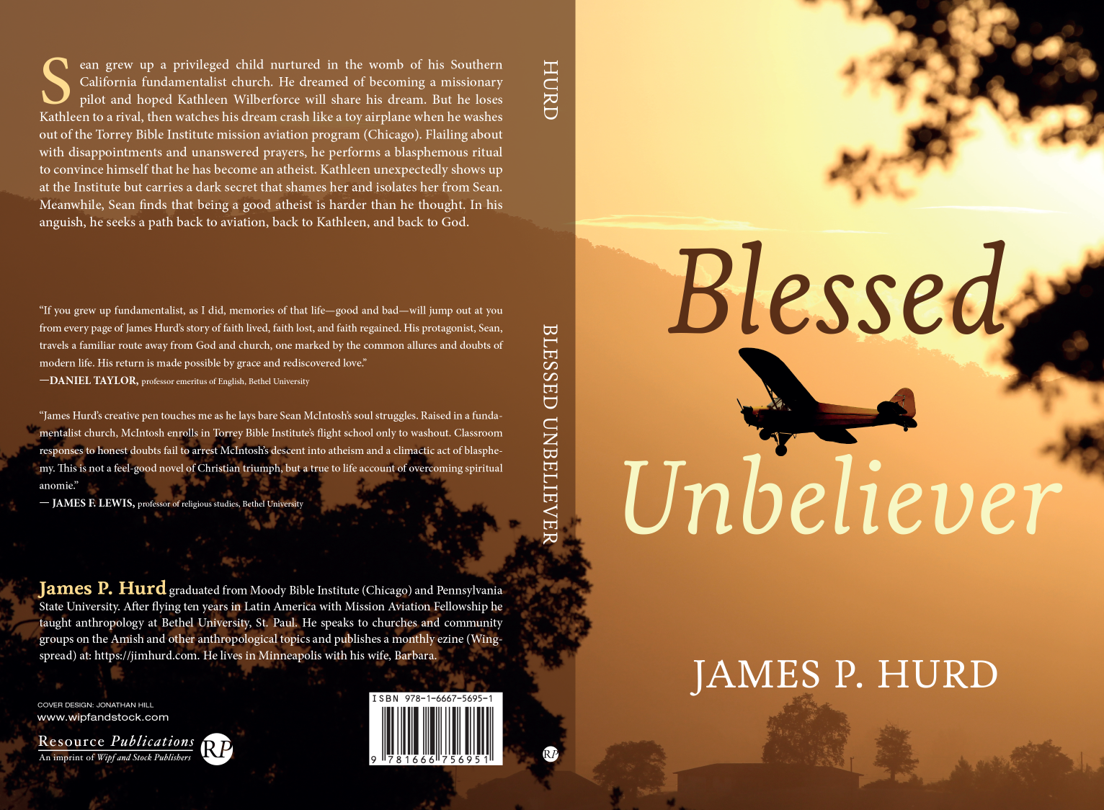
Sean McIntosh left his Fundamentalist childhood and walked the road toward becoming an atheist—while attending Torrey Bible Institute! Spoiler alert: it didn’t work out very well. Blessed Unbeliever (paper or Kindle version) can be found at Wipf and Stock Publishers, Amazon https://a.co/d/9su5F3o or wherever good books are sold.
New story: “Brave New World of Cooking”
I was no stranger to cooking; It was what happened before Mom or Wife called you to the dinner table. Most people on the planet know how to cook. This story is for the rest of us.
After I left home at eighteen, I ate institutional food at Moody Bible Institute for two years. When I moved out to Wooddale Airport for flight training I boarded at Mrs. Volle’s house and ate her excellent cooking. Then back to dorm life at Cal State Fullerton and eating in the cafeteria. When I departed to fly in southern Mexico for Mission Aviation Fellowship, I roomed in a boarding house. Great food—refried beans, eggs, rice, tamales and tortillas, sliced papaya, fresh tropical fruit juices, café con leche. I used to sit in the kitchen smelling the simmering pots and watching the Indian women scraping the leftover refried beans back in.
Moving to Honduras, I lived with Mario who worked as an assistant to the MAF dentist. A maid cooked all our meals—until Mario spied her lover’s shoes under the closet curtain and dismissed her. . . .
To read more, click here: https://tinyurl.com/4tu4rvd5
Leave a comment on the website and share with others. Thanks.
This month’s puzzler (courtesy of “Car-Talk Archives”)
Many years ago, when I was vacationing in upstate New York in a sleepy little town called Cold Springs, I had occasion to go to an antiques auction.
One of the items that comes up was a child’s sled, a wooden sled that the auctioneer claims was made by George Washington himself.
The auctioneer turns the thing over and carved into the one of the wooden slats on the back is this:
“G Washington, September 10, 1752.”
Now I remember from sixth grade that the square root of 3 was George Washington’s birthday. The square root of 3 is 1.732. And George Washington’s birthday is in 1732.
So, if this carving on the sled is accurate, that would make him 20 years old at the time. So it stands to reason that at the age of 20, before he started his military career, he might be making a sled for a niece or nephew or for his own kids. Who knows.
So, I’m ready to bid 20 bucks on the thing, when someone in the crowd pipes up and says, “It’s a fake.”
He was right. It was a fake. But the puzzler is, how did he know that?
Good luck.
(Answer will appear in next month’s WINGSPREAD newsletter.)
Answer to last month’s puzzler:
Recall Holmes told Watson he was 35 the day before yesterday and will be 38 next year. How is this possible? Tricky, right? Here is the answer. The conversation took place on January 1. Holmes’ birthday is December 31, when he turned 36. He was 35 the “day before yesterday.” Got it? Great, huh?
(Whoops! A careful reader reminded me I had used this puzzler last year.)
Subscribe free to this Ezine
Click here https://jimhurd.com/home/ to subscribe to this WINGSPREAD ezine, sent direct to your email inbox, every month. You will receive a free article for subscribing. Please share this URL with interested friends, “like” it on Facebook, retweet on Twitter, etc.
If you wish to unsubscribe from this Wingspread Ezine, send an email to hurd@usfamily.net and put in the subject line: “unsubscribe.” (I won’t feel bad, promise!) Thanks.
Wisdom
When I was young, I was told that anyone could become President….
I’m beginning to believe it.
I didn’t realize how unsocial I was until there was a pandemic….
And my life didn’t really change all that much.
Don’t wear headphones while vacuuming; I’ve just finished the whole house before realizing the vacuum wasn’t plugged in.
I gave all my dead batteries away today—free of charge.
I just ordered a life alert bracelet. If I ever get a life I’ll be notified immediately
To the guy who invented “zero” … Thanks for nothing.
The Disappointment Club is pleased to announce that the Friday meeting is cancelled.
When telephones were tied with a wire—humans were free
Self-esteem is the feeling which makes us attribute our failures to bad luck, and our successes to good judgment.
A woman adopted two dogs and named them Timex and Rolex.
Her friend asked her how she came up with the names.
She replied, “They’re both watch dogs.”
Doctor: I’m afraid your condition is fairly advanced.
Patient: It was in its early stages when I first sat down in your waiting room.
How does my doctor expect me to lose weight, when every medication he prescribes says, ‘Take with food.’
Me: Doctor, I’ve swallowed a spoon.
Doctor: Sit there and don’t stir.
I was walking past a farm and a sign said: “Duck, eggs!”
I thought, “That’s an unnecessary comma. Then it hit me.”

If you’re not familiar with the work of Steven Wright, he’s the famous Erudite (comic) scientist, his mind sees things differently than most of us do. . . here are some of his gems:
1 – I’d kill for a Nobel Peace Prize.
2.- Borrow money from pessimists — they don’t expect it back.
3 – Half the people you know are below average.
4 – 99% of lawyers give the rest a bad name.
5 – 82.7% of all statistics are made up on the spot.
6 – A conscience is what hurts when all your other parts feel so good.
7 – A clear conscience is usually the sign of a bad memory.
8 – If you want the rainbow, you got to put up with the rain.
9 – All those who believe in psycho kinesis, raise my hand.
10 – The early bird may get the worm, but the second mouse gets the cheese.
11 – I almost had a psychic girlfriend, …… But she left me before we met.
12 – OK, so what’s the speed of dark?
13 – How can you tell when you’re out of invisible ink?
14 – If everything seems to be going well, you have obviously overlooked something.
15 – Depression is merely anger without enthusiasm.
16 – When everything is coming your way, you’re in the wrong lane.

On December 13, 2024, I lost my dearest treasure. So this blog is very personal. Here is the eulogy I wrote for the memorial service on December 28.
Each life is sacred to God. Thus, it is fitting that we meet today to celebrate the life and faith of Barbara Ann Hurd (Breneman). She was born during the Great Depression to a strong Mennonite family living on a dairy farm near Lancaster, Pennsylvania. Farming life taught her the virtue of hard work, a virtue she demonstrated throughout her life and inflicted on her husband and children.
In 1967 Barbara began her work with Latin America Mission when she taught school in Costa Rica. We met each other there and, after a few months, became engaged on a remote airstrip in Venezuela where I was flying for Mission Aviation Fellowship. Later, we adopted our three children from Costa Rica and Colombia.
Barbara never complained about where we lived. In Venezuela she would stare up at the cockroach-eating geckos on our ceiling who would lose occasionally lose their grip and land on our supper table. As I was flying over the Venezuelan jungle, she stayed home alone with Princessa, our German Shepherd, checking my progress with our short-wave radio. When our water supply failed, she took our laundry down to the Orinoco River to wash it and beat it out on the rocks.
When we moved to Colombia she comforted me after an airplane crash, nursed me through a bout of Typhoid fever and, when we were evicted, found us a new home.
During my years at Penn State, Barbara never complained about the poverty of grad school. She worked as an overnight nurse’s aide. She planted a productive garden in rocky soil. She sewed and patched clothes. Our 100-year-old house had no furnace so we bought a free-standing woodstove and Barbara helped me build a 30-foot-high cement-block chimney for it. On trash days, Barbara would lead the whole family out to scavenge the garbage cans and dumpsters. She made her own tortillas, except once, when she brought some hard taco shells home from a local garage sale. She linked us up with the local Christian and Missionary Alliance Church and directed their program for seniors. She took the lead in forming some of our life-long friendships.
We moved to Minnesota in 1982 where I taught at Bethel University. She painted and wallpapered our two-story colonial house and turned it into a home. We would drive at night up University Ave. to Main St. to gather what she called “used carrots,” discarded in a field by the green grocer. I would shine the headlights out over the field and she would dash out to fill a large bag with carrots while our kids would all bend down so their friends would not see them. She made ice cream with cream from a nearby Amish farm, churning it with ice that we harvested from our yard and crushed in a burlap bag. She frequently hosted students and faculty and linked us into a strong, loving network of friends. Barbara entered into the life of each church we attended and served them well—Sunday School superintendent at Good Shepherd Church and 28 years as a volunteer counselor in the North Heights counseling clinic.
In 1988 we uprooted our whole family to live for a year in Costa Rica where I taught in a missiological school. When I was caught in the eye of hurricane Joana in Bluefields, Nicaragua, she volunteered at a local shelter and awaited word from me. Several years later, she joined me for five months in northern England when I was a visiting fellow at Durham University. We explored Holy Island together, along with other wonders of the Celtic Christian world.
Barbara suffered through the many stories we told at her expense. For instance, the healing service where she said, “I wanted to go down for healing but if I got healed, I would never know what was causing it.” Like Mary Poppins, she was an Almost Perfect Person. We would joke that Lent was the hardest season of the year for her since she never could think of any sins to confess.
Barbara was the beating heart of our home. Always loyal to her husband. A sacrificial wife and mother, she fiercely fostered our social, emotional and spiritual development.
Her life motto was “To know Christ and to make him known.” She forgave people who hurt her, including her husband, and poured her life into her kids and grandkids. In the larger community, her charity was natural and unpretentious.
We lived Barbara’s last days in sacred time. In our own bed, I would hold her hand and speak my gratitude to her. Her condition waxed and waned and in the low times she would say, “I just want to go and be with Jesus.” Barbara was embarrassed at all the care we had to give her—the last words she spoke were “thank you.” She trusted in Christ and his death on her behalf and confidently looked forward to a resurrection when she would dwell in the house of her Lord forever. She died without regrets, with no unconfessed sin and with no unfinished business. It was a blessed death for her and a gift to all of us.
Barbara, I bow before your example, your faith and your service. You have distributed your rich gifts to many and now I release you to our Lord. May eternal light shine upon you.
James Hurd and family
.
Here’s an op ed I wrote several years ago on “Freedom Sunday.”
Alan, please forgive me for walking out during our church’s Freedom Sunday. I mean you no disrespect. At our service you sit down near the front with your prosthetic leg in camo. I recognize your courage–the agony you endured plus your agony when you inflicted suffering on others. I pray for your complete healing—body, mind, and spirit.
I grieve for you, but also for my church and her mixed loyalties. In the narthex, a huge American flag hangs over the cross, a crown of thorns obscuring its starry field. We sing “Battle Hymn of the Republic” and the spotlight swings to illuminate a raised white cross. “As he died to make men holy let us die to make men free…” On the big video screen behind the altar, three F−15’s flash over the three-crossed hill of Calvary. Not missionaries, but uniformed soldiers march up and down our church aisles bearing, not Christian, but military flags. Today, Caesar trumps Christ. The sword trumps the dove. America’s founding fathers trump Abraham, Isaac, and Jacob.
It seems that even more than the cross, patriotism bonds people together. In front of the pulpit I see the central sacred symbol—erect between army boots stands an upright AK-47 rifle holding a helmet. We learn it’s even okay for Christians to kill other Christians if the targets are fighting in enemy armies. Today, the nonviolent, bloodied Lamb of God wears camo and carries a gun. They’d better not try to take away his rights again. Our children learn the lesson well—it takes redemptive violence to bring peace.
On Freedom Sunday the church cheerleads for the State, praising its force as she mourns her own dead and wounded. The State returns the favor and declares the church tax-exempt.
So Alan, I honor you. I’m glad the church makes a place for you at Christ’s table. I love my country; I love my church. I’ll be back next Sunday. But today, I must walk out. Please forgive me.
Thank you.
James P. Hurd
Why is it so hard to tell ourselves the truth? During my Cal State Fullerton days I met Bernice—attractive, available and interested. After our first date she said, “I never know how to say ‘thank you.’” On the next few dates she found out. Hugs escalated to kisses and eventually to long couch sessions.
It felt good but I was puzzled. I assumed women were the sexual gatekeepers and that most women had sturdy boundaries, But Bernice seemed to have none. Instead, I felt her drawing me in. I felt the urge to embrace longer, to move faster, further. I began having fantasy dreams. My conscience told me God disapproved. I could not justify a sexual relationship, even to myself. I knew I needed to deescalate. But instead, I began working on my self-deception (SD) project—lying to myself. I told Bernice I loved her. Maybe I thought that telling her would make it so, or that the declaration would justify my passions.
I told myself that she was dialing up our passion, not I; that I wasn’t forcing her into anything; that we would marry (eventually, maybe?). That I was under complete control and could stop at any point. That premarital sex wasn’t so bad. That God would forgive me (later). But lust is like scratching a scab. Scratching feels good. Soon you’re compelled to scratch, obsessed with scratching, even if it gets bloody.
What was this doing to her? I wasn’t even thinking about how our passions might affect Bernice. Later, after she started dating someone else, she came to me teary-eyed and said, “I can’t stop!” My behavior had clearly perforated her already porous boundaries.
All the while the voice of conscience was telling me: “You’re headed for something you know is wrong. You must respect her, regardless of how she behaves. You aren’t in love; just in lust.” Eventually, conscience won out, or more accurately, a loving God restrained me from doing something stupid. Later years have only confirmed my gratitude to God that I turned away from my lustful promptings. But the point is, I almost talked myself into it. I just about bought the flawed logic. I just about violated a deeper good in favor of a lesser. My self-deceived reasoning almost led me to disaster.
Although my tryst with Bernice did not rise to the level of “petting” (as our elders called it), sexual fantasies still disturb me today. A few years ago I was alone in my motel room, four thousand miles from home. Flipping through the TV channels, I came across a pornographic movie. I quickly kept flipping (but memorized the number so I could avoid it). I approached the same channel again and thought I’d better verify that it was the porn channel (so I could avoid it). Then I got hooked. I told myself I was powerless to change channels.
Classic self-deception—I talked myself into a lie so that I could fulfill an intense desire that would work against my long-term interests. The experience shook me. Immediately afterward I repented and my resolve stiffened. But why did I even give myself permission?
Self-deception (SD) is so common. People say all the time—“I know I shouldn’t but… It’s only this one time… I’ll quit tomorrow…. Rules are for other people… I can drive over the speed limit because I’m more skillful (or intelligent)… It won’t hurt anybody….”
Even statisticians play the lottery and believe they’ll win, although they know that statistically they’ll lose money. People say “I’ll stop smoking tomorrow,” and mean it, but no real intention, no plan, and the next day, the conviction fades.
What is SD anyway? It seems contradictory—believing two opposite things at the same time. It’s distinct from other deceptions because in SD, the deceived and the deceiver are one person. It’s not just bad judgment or ignorance, because in those, there’s no deceiver involved. It’s not a mental illness, unless you allow that all people on the planet are mentally ill.
In SD, you yourself are both the deceiver and the deceived. You give yourself permission to do something that your “better angels” knows is wrong. You privilege the immediate over the future, the short-term over the long, the easy over the hard, your own needs over those of others. You deceive yourself when you start acting on the lies you tell yourself, lies you know aren’t true.
Like most people, I have two contradictory desires: to satisfy my food cravings and to live a heathy, long life.
When I was a teenager, I didn’t hear much about nutrition. I knew I needed Vitamin D (milk) and I knew I needed protein. That was about it. I was skinny, so I didn’t worry about getting fat.
Every weekday while I was waiting to pick up my papers at the Orange Daily News, I would walk next door, put a dime in the pop machine (it was a long time ago), and get a cold bottle of Coke. Then on the way to my paper route I would stop at the gas station and buy a Heath candy bar. I ate all the dessert I could get hold of. Once I bought a quarter pound of fudge, took a chaste bite, and then devoured the whooole thing in ten minutes [for your ears, only—it was totally worth it]. Even today, I favor ice cream and chocolate over leafy vegetables, carrots, peas, and green beans.
My wife, the voice of reason, fights a faithful but futile battle against my cravings. She cooks healthy meals even though I still major on desserts. She says, “I give up! Eat what you want. But don’t expect me to take care of you when you get sick” (an empty threat). She’s already picked out my tombstone epitaph: “I tried to tell him, but he wouldn’t listen.”
Despite all I’ve learned about nutrition, despite the scientific evidence, despite my wife’s rational suggestions, I still eat junk food.
There’s a reason I eat this way—I’m an SD expert. I tell myself: “I eat better than my friends. I’ll eat better next week. I know a guy who ate junk food and lived into his 90s. Just this one time. I’ll take just one piece.”
Do I believe these lies? Well, it’s complicated. The best explanation is that I believe the lie now. (Why spoil a great experience!) Then, just after eating, I can repent and listen to the voice of reason. This allows me to preserve my self-respect, to see myself as a rational, disciplined person. But of course, my repentance is a lie also and my fake resolve doesn’t motivate me to change my behavior.
SD is always motivated—you practice SD because you want something. What you want is to have your cake and eat it too—to act on one conviction that contradicts a different conviction. You want to enjoy a delicious taste, avoid the hard choice, satisfy an immediate desire, or give yourself permission to violate a moral code. You have reasons to deceive yourself.
Why worry about a little innocent SD? Because it’s not innocent. The stories above show how SD can be dangerous, or deadly. SD promotes lazy, habitual behavior that may lead to addiction. It represents a divided care for yourself, and works against a healthy, integrated personhood. Most serious, it tempts you to “self-divinize”— to substitute your own flawed judgment for God’s.
SD works because of our compartmentalized brains. Each of us has a “reptile” brain—the amygdala—older, simpler and associated with instinctual behavior such as fight or flight. In addition we have a neocortex (“new brain”) that is rational and deliberating—the part of our brain that says, “Wait a minute—will this serve your long-term interest?” We can call the amygdala “Junior,” and the neocortex “Mother.” Junior does what he wants to do; Mother does what she plans to do. SD occurs when we let Junior bully Mother.
Looking back, I recognize that my flying days produced the most vivid examples of SD. I based in San Cristobal where we flew the Mission Aviation Fellowship plane out to little airstrips across southern Mexico.
San Cristobal de Las Casas (in Chiapas State, Mexico) lies in a huge bowl circled by towering peaks. All the rainwater courses down a huge, natural ground hole at one end of the bowl.
One day, I’m stuffing a missionary family and their belongings into the small Cessna 180. They’re traveling from Yaxoquintelà (a jungle training camp for Wycliffe Missionaries) back to San Cristobal. A norther has blown in, and clouds lie like cotton balls over the mountains and down into the valleys, so I’m flying just below the clouds at 8,000 feet, following the Comitán road. The road winds through a narrow pass and then plunges down into the San Cristobal bowl.
The afternoon light fades as I eye the narrow pass through the blurry rain. I see that I could barely slip through the pass clear of clouds. Or, we could turn around now and head to nearby Tuxla Gutierrez, a large town beyond the mountains with a good airport, lights, and good weather. At this point, I know a few things: a) We’re at high altitude and engine performance is reduced. b) Transiting the pass is a high-risk operation, and who knows the weather conditions in the bowl? c) I’m a good pilot, better than average. d) If we landed in Tuxla, we’d have to find overnight lodging. Suddenly I resolve to try getting through to San Cristobal. We high-jump the pass and dive into the bowl.
Except now I can’t see the ground. There’s no opening ahead, just solid clouds and rain, even though the airstrip is only five miles away. It would be deadly trying to climb out through the clouds with mountains all around. I must turn around and go back through the pass. But we’re in a narrow canyon and we’re well below the bowl rim. And is the Comitán pass behind us still open?
I pull on flaps to shorten our turn radius and make a steep bank left, narrowly clearing the encircling clouds. But now I’m looking at the high pass directly in front and above me. At best angle of climb we barely squeak out over the rim. Then we circle outside the bowl to the right, find a crack in the clouds, and descend to land in San Cristobal just at dusk.
In flying, as in so many other endeavors, it’s amazing how your vision and judgment clarifies after you’re back home sitting in your easy chair. You can call it cockpit judgment vs. armchair judgment. Safely at home, I reflect on the irony. In bad weather, when you make a good decision and return to your departure airport or divert to another airport, your passengers criticize and grumble and you feel like a failure. If you make a bad decision and forge ahead, the passengers praise you for your amazing piloting skills. And you feel good that you’ve accomplished your mission! But now I reminded myself of certain fatality statistics in similar circumstances. I knew I made a bad decision, and I felt guilty. Of course, my San Cristobal passengers didn’t know that I had made a foolish decision—to continue through a cloudy mountain pass at dusk.
I repented, and vowed never to do that again. But of course I did do similar things again, all employing sturdy rationales. This is classic SD, built on the lie that I am an exceptional pilot and can beat the odds. But in truth, the exceptional pilot would have put prudence and passenger safety over convenience. It’s true: there are old pilots and bold pilots, but no old, bold pilots.
Why tell myself lies? These lies arise out of a mental “board of directors.” SD occurs when one mouthy, loud, ignorant board member trumps all the other members and argues for the act. I let mouthy Junior (the reptile brain) drown out Mother’s voice (the more rational neocortex). I, the chair of the board, found myself trying to persuade Mother to accept Junior’s shortsighted, dangerous suggestion.
SD comes in many guises: overconfidence; seeking immediate rather than long-term gratification; choosing the easier, rather than the better action. “Rationalization” means constructing a plausible reason for doing something I shouldn’t do.
One common type of SD discounts probability statistics. People make good yes or no choices, but if an outcome is only probable, they make poor choices. For example people might say, “I could win the lottery!” “It can’t happen to me,” “I drove 30 miles over the speed limit and got away with it.”
One day I jumped into an Ercoupe (“the simplest airplane there is to fly”), a plane I’d never flown before. I did a takeoff and landing in 50 mph winds, despite knowing that I should have gotten a thorough checkout before flying that plane. I just about wrapped it up in a little aluminum ball.
In Amarillo, Texas, I took three passengers on a sightseeing flight in a twin-engine Cessna 310, and decided to do a practice shutdown of one engine. Bad judgment doing this with passengers and I also used wrong procedure. The engine did not immediately restart, and we almost ended up landing in the weeds.
A different time (in Venezuela), I crammed seven small schoolchildren into the MAF Cessna 185 and leaded for Tama Tama, an hour away through heavy clouds. We flew blind for thirty minutes, and when we broke out I saw rain and lightning ahead. We were low on fuel, and I should have diverted to Santa Barbara, but that would have meant overnighting with these children on a remote, abandoned airstrip. So I grabbed the control wheel with my sweaty palms and flew through the rain and storm. Flying only 200 feet above the curving Orinoco River, we pushed ahead until I glimpsed Tama Tama airstrip through the bleary windshield. If I had failed to find Tama Tama, I would have had insufficient fuel to fly back to Santa Barbara.
What were the lies I was telling myself? In the Ercoupe incident, I convinced myself I was an expert pilot who could safely fly a strange airplane in high winds without a thorough checkout. In the 310, I convinced myself I knew emergency procedures well enough that I could safely stop and restart an engine, even though I had very few hours of experience in the airplane. I didn’t know what I didn’t know until it was too late to learn it. In the Cessna 185, I convinced myself that risking fuel exhaustion over a hostile jungle was more acceptable than the prospect of spending the night at a strange, abandoned airport with seven young children—I chose convenience over safety.
If self-deception is so common, if it is corrosive and harmful, how do you avoid its traps?
You should begin by naming the deception; stripping it bare it so you can see it as it is. You must tell yourself the truth. For Bernice, above, I should have told myself the truth—that I did not love her.
Another good idea—when you fly (or drive), ask yourself, “What are the risk factors on this trip?” (bad weather, illness, nighttime, distractions, etc.) Tell yourself the truth about the risks.
You must prepare your defenses against SD ahead of time. Before I fly, I make a “Go-No Go” list, specifying the conditions under which I will cancel the trip. I establish rules about my health (exhaustion, illness, anger), airplane condition (rough engine, malfunctioning instruments, quantity of fuel), and weather conditions (e.g., demanding a cloud forecast that is scattered but not broken or overcast). If my neocortex creates these clear rules ahead of time, I’m less likely to violate them when the pressure is on. After making these checklists, it’s good to over-train—practice procedures you already know, so that in an emergency you’re more likely to do the right thing.
You need “accountability partners,” people who will tell you the truth. For instance, I promise my pilot friends that I will confess to them my safety violations—and let them scold me. When flying, I can ask myself, “What would my pilot friend Sam do in this situation?” We need accountability partners.
Beyond self-discipline and accountability groups, I can embrace my true identity in God. As the poet says, “Man [Mortals] cannot name himself. He waits for God, or Satan, to tell him who he is.”
How beautiful to exchange a distorted view of oneself for a godly view. Christian conversion means rejecting SD and letting God define me. I can confess sin and pray for forgiveness, for insight and discipline. I can see the world clearly with a God-s-eye view. This is the best antidote for SD.
When I was in Honduras, Paul, our program manager, asked me to fly the Piper Pacer—a nasty little fabric-covered plane that drops like a rock when you pull back the power and prefers going down the runway tail-first. I’d never flown a Pacer before so I assumed I’d get a thorough checkout. But Paul said, “Simple airplane. Just take ‘er out and make several practice landings. You’ll be fine.” I was too proud to admit I needed a thorough checkout. Plus, the flight was today and it was urgent—a sick patient needed to be flown to the hospital. So I quieted Mother’s voice in my head and listened to Junior. I told myself: Simple airplane. I’m experienced and highly-skilled. No problem.
But on the return flight I switched to the right fuel tank and the engine quit! Was the valve broken? The fuel line clogged? I switched back to left tank; the engine roared to life. But I wasn’t certain I had enough fuel to make it back on only left tank. I called base and said I was going to divert and land nearby and please bring fuel out to me. John, my fellow pilot, said, “Aw, you’ll have enough fuel—just come on in.” John’s confidence (how did he know?) and Junior’s voice in my head encouraged me to “come on in.” I did and landed with minimal fuel.
Then I checked the fuel valve, located down by my left knee. I noticed that you turn the valve left for Right Tank, straight up for Left Tank, and to the right for Off. I had mistakenly turned the fuel valve to Off!
No checkout. Didn’t read the manual. Bad judgment. Pride. Hurry. Classic SD.
Self-deception is common but subtle and has many complex causes. We can practice raising our consciousness about its dangers, we can make good decisions ahead of time and stick to them, and we can create accountability partners to check our bad judgment. And finally, we can know that we if we humble ourselves, God will lead us into truth.
Understandably, atheists don’t go to church. Church communities demand a huge time commitment and heavy emotional labor. They exert subtle and sometimes not-so-subtle pressure to change, to believe, to confess. And, what with the statistical decline nationwide in Christian belief and church attendance, fewer people even notice or care if atheists are absent.
Really though, if you’re an atheist you need church as much as believers do! Behold, all the benefits of churchgoing—singing, making friends, potlucks, social service, moral guidance, coming of age rituals (e.g., confirmation, graduation), social intensification rituals (e.g., births, baptisms, weddings, funerals). You may find a loving, accountability group (e.g., Christian AA) that offers hope instead of despair. You will find a good job-seeker network. A support group for life crises. A place to get married or buried. A place that offers meaning to your life. You might even find free babysitting! You can have all these things without abandoning atheism because so much of church life does not demand any belief in the supernatural
Turns out that churchgoing is good for your health. A 2020 study published in the International Journal of Epidemiology reported that church attenders had a 26% reduced risk of dying and a 34% lower risk of heavy drinking. Church attendance was also associated with less anxiety, depression, hopelessness and loneliness. Church attenders lean toward healthy family and community behaviors. You’ll find good mentors who will hold you accountable and give you honest critique. If you’re older, just getting out of the house and doing something—anything—is good for you. If you’re younger, hey, it might be worth going just to make your parents happy!
And the food! Go to “men’s fellowships” or ladies’ teas. Even some Bible studies are partly an elaborate excuse to eat good food. You run into older “church basement ladies” who are great cooks and you won’t find better potlucks anywhere. You can drink free coffee every Sunday with no hangovers or regrets.
Much church music is great music that people of all faiths or nonfaiths enjoy. Some sermons are masterpieces of homiletics, persuasive argument and great rhetoric—it’s ok to get inspired, even if you don’t buy the teachings. You may satisfy your need for the fine arts even if you don’t share the beliefs—singing, sculptures, paintings, images, creeds, holy books.
You might get free travel. Church people take “mission trips” to U.S. and foreign destinations and the congregation sometimes springs for the cost. There are often no explicit belief requirements or litmus tests for these trips (although there may be some behavioral requirements).
You’ll be shocked by the broad palette of church activities—basketball, book clubs, service groups, breakfast gatherings—none of which demand any religious commitment. And what a great place to meet someone who might become your good friend—or spouse!
You’ll learn about charitable causes to support. You’ll learn how to better deal with needy people, the poor or mentally challenged. You will become part of a fellowship that will support you in your dire need: health, family or marriage breakdown, social conflicts, economic collapse.
A multigenerational congregation will give you a chance to interact with people of different ages. If you pick a multiethnic church, even better. (But beware of over-zealous people who take their faith way too seriously and tend to have more rigid lifestyle expectations.)
You’ll be amazed at how rarely any churchgoer quizzes you on your own beliefs. Shocked at how infrequently anyone buttonholes you to contribute money to the church. Know that many other attenders do not share core church beliefs and may never contribute any money.
However, you must be on guard against the pitfalls. You might feel like a hypocrite—presenting yourself as someone you’re not. But take heart; many churchgoers feel the same way. They’re convinced others are much better Christians than themselves. They keep silent about their doubts and tend to mask their more juicy lifestyle habits. You’re in good company!
Another danger—your atheist friends might feel passed by or ignored, might mock and criticize you, might call you a hypocrite. You need to assure them you’re not a “seeker.”
At church you dare not trumpet your own beliefs nor criticize the beliefs of others (however crazy they might seem to you). You may need to hide your true beliefs, mask some of your more interesting habits. But surprise! I’ve found that people get way more upset over my politics than they ever do over my doctrinal beliefs. So, be careful.
Beware of ramped-up demands—asking your opinion about a Bible passage, inviting you to volunteer on a committee or to participate in a prayer meeting. Even with coffee and donuts it’s tedious to circle for an hour with people who think they’re talking to someone invisible . People might even seek you out for spiritual advice—awkward.
It’s rare, but church leadership might push you to become a member. This might require a litmus test that would demand that you lie about your beliefs and about certain delicious parts of your ungodly lifestyle. But in my experience, they let almost anybody slide through.
But we haven’t mentioned the greatest threat. You might like church. The food, camaraderie, physical and emotional support, entertainment, uplift and inspiration may tempt you to question your most deeply-held non-beliefs. As C.S. Lewis warns, you can’t be too careful. You run into these temptations at every turn.
Be strong. Resist. If not, you, like C.S. Lewis, might get sucked kicking and screaming into that 2,000-year-old fellowship of diverse, broken, hurting, annoying and amazing people who are on the road to a Christ encounter.
 Wingspread
