WINGSPREAD for February, 2025


Spreading wings in a perplexing world
February, 2025                                                    James P. Hurd

Please forward and share this Ezine with others. Thank you.

  • Writer’s Corner
  • Blessed Unbeliever 
  • This month’s story: How does a widower work a washer?
  • This month’s puzzler: Sherlock Holme’s age
  • WINGSPREAD Ezine subscription information
  • Wisdom

No matter the genre in which you write, your published work can transform you into a change agent. When your words get read, you have an impact in your readers’ lives that ripples out into the world.

“The pen is mightier than the sword.” Edward Bulwer-Lytton, Richelieu, or The Conspiracy

“Many wearing rapiers are afraid of goosequills.” William Shakespeare, Hamlet

Tip for writers: Most writing can be improved by tightening. But how? Try going through your piece and eliminating all the adverbs and adjectives. Then go back and insert only as many as you absolutely need.

Writing task for you: Write an opening line or two for a novel or a short story. I will include some of your efforts in the March WINGSPREAD. Here are some things to help you:

  1. Introduce the protagonist
  2. Give a hint of time and place
  3. Never start with a backstory or flashback, or with a dream
  4. Introduce a problem/conflict/mystery facing the protagonist
  5. Introduce your “story-worthy problem.” If you don’t have one, you don’t have a story.
  6. Signal the genre of your story (your title may help do this).
  7. Reveal your voice. Things like: what “person” you write in (1st, 3rd), what tense (present, past), what dominant point-of-view?
  8. Foreshadow: give hints of trouble to come, for example, “But things were not as they seemed.”

Book of the month: David G. Myers, How Do We Know Ourselves? Farrar, Straus and Giroux, New York. 2022. 253 pp. I have read this with great profit. Myers uncovers secrets of human behavior—egotism, paying attention, two-brain processing, judging others, divisions and a host of others—and briefly explains each one. A gold mine for the non-professional who is curious about understanding, and even changing, others’ behavior and even their own! Short chapters. The book does seem choppy and many times the reader would desire a deeper discussion.

Sean McIntosh left his Fundamentalist childhood and walked the road toward atheism—while attending Torrey Bible Institute! Spoiler alert: it didn’t work out very well. Blessed Unbeliever (paper or Kindle version) can be found at Wipf and Stock Publishers, Amazon https://a.co/d/9su5F3o or wherever good books are sold.

Housekeeping has always been a mystery to me. Right up there with how you deal with small children. I don’t even remember actually meeting any of my children until they started kindergarten. My loving partner unselfconsciously assumed childrearing tasks while I concentrated on more important problems such as “How do we fight climate change?” Or, “How do we end the war in Afghanistan?” . . .

To read more, click here:  https://shorturl.at/SXrN8

Leave a comment on the website and share with others. Thanks.

 Holmes and Watson were sitting in Holmes’ study at 221B Baker Street when Watson said, “Holmes; I’ve been rooming with you for several months but you’ve never told me how old you are!”

Holmes replied, “The day before yesterday I was 35 and next year I’ll be 38.”

“Impossible!” replied Watson.

But Holmes was correct. The question is, how would that be possible?

(Answer will appear in next month’s WINGSPREAD newsletter.)

Answer to last month’s puzzler: 

Recall I left something at my friend’s house and he mailed it back to me. However, I cannot now use it nor use it in the future. What is it?

It is a stamp on an envelope I had left at his house. He mailed it back to me.

Subscribe free to this Ezine  

Click here https://jimhurd.com/home/  for a free subscription to this WINGSPREAD ezine, sent direct to your email inbox, every month. You will receive a free article for subscribing. Please share this URL with interested friends, “like” it on Facebook, retweet on Twitter, etc.

If you wish to unsubscribe from this Wingspread Ezine, send an email to hurd@usfamily.net and put in the subject line: “unsubscribe.” (I won’t feel bad, promise!) Thanks.

Tell all the Truth but tell it slant —

Success in Circuit lies

Too bright for our infirm Delight

The Truth’s superb surprise

As Lightning to the Children eased

With explanation kind

The Truth must dazzle gradually

Or every man be blind —

—Emily Dickinson

“Critical thinking without hope is cynicism. Hope without critical thinking is naiveté. Maria Popova

“If it sounds like writing, I rewrite it.” Elmore Leonard

Why is ‘abbreviated’ such a long word?

___________________________________

Why is it that doctors call what they do ‘practice’?

___________________________________

Why is lemon juice made with artificial flavor, and dishwashing liquid made with real lemons?

___________________________________

Why is the man who invests all your money called a broker?

___________________________________

Why is the time of day with the slowest traffic called rush hour?

___________________________________

Why isn’t there mouse-flavored cat food?

___________________________________

Why didn’t Noah swat those two mosquitoes?

___________________________________

Why do they sterilize the needle for lethal injections?

___________________________________

You know that indestructible black box that is used on airplanes? Why don’t they make the whole plane out of that stuff?

___________________________________

Why don’t sheep shrink when it rains?

___________________________________

Why are they called apartments when they are all stuck together?

___________________________________

If flying is so safe, why do they call the airport the terminal?

The Widower and the Washer

Housekeeping has always been a mystery to me. Right up there with how you deal with small children. I don’t even remember actually meeting any of my children until they started kindergarten. My loving partner unselfconsciously assumed childrearing tasks while I concentrated on more important problems such as “How do we fight climate change?” Or, “How do we end the war in Afghanistan?”

When Barbara passes away in December, I sink into grief. I discover that I have not only lost the joy of my life, but also lost the one who knew how to do things. I panic, with visions of dirty dishes piling up in the sink, food rotting in the fridge, dust gradually burying all the furniture and the floors accumulating coffee stains, miscellaneous shreds of paper and food scraps. I’m appalled that I will become “that needy man” who is incapable and incompetent, a charity-target for all the females in my life. I have heard about “friends with benefits.” It’s true—I find that the chief benefit of my female friends is providing me information about how to run a rice cooker, counseling me on how long before food in the fridge rots or telling me how often to wash the bedsheets.

Take clothes, for instance. When Barbara was here, I would put my dirty clothes in a white plastic basket. They would briefly disappear and later reappear—folded in my dresser drawer. (One of my friends calls me a “kept man.” I greatly resemble that remark.)

But today I boldly determine to do two loads of laundry—my first such attempt in fifty-four years. I heard somewhere that you have to separate the coloreds from the whites. We have an over-under washer-dryer so I lift the lid of the washer and throw the coloreds in. How full can you fill the washer? My friend Lennie says not much more than half full. I attempt to consolidate two jugs of liquid laundry soap, spilling about a cup of liquid on the floor. So, paper towels and twenty minutes cleaning it up. Finally, I pour in half a cup of soap and close the lid. To be safe, I just leave the settings where they were before: “Normal, chime off.” I push the button. Three beeps but nothing happens. I push it again. One beep, the machine starts and I walk away, not knowing how long it will run. In a few minutes I check back and it has stopped. I lift the lid—no water has come in.

So, I call my daughter who serves as my loyal friend and life coach. (She nursed Barbara in her last days, got me started attending “Grief Share,” and now closely supervises my health, couture and meal preparation.) “The washer’s stupid,” she says. “You sometimes have to push the button more than once.”

“I did push it—four times. It starts; then after a few minutes it stops. Oh, and no water comes in.”

[Pause.] “Dad, you do know there are two sets of controls on the panel—one set for the washer and the other for the dryer? Are you sure you’re pushing the washer button?”

[Pause.] “Oh, right. I guess I was pushing the dryer button. That could be the problem.”

Chastened, I start over. This time the coloreds wash without a hitch. When the washer stops, I grab the sodden mass of clothes, dump it into the dryer and punch the button. I call Kimberly again, “I see no numbers on the dial. How long does it run? Shall I set the timer? I don’t want the clothes to sit there; they might get wrinkled.”

“Dad, if they get wrinkled you can just run water on a hand towel, throw it in with the clothes and run it for twenty minutes or so. That’ll take out the wrinkles.”

Thankfully my clothes come out without wrinkles. Meanwhile I throw the whites into the washer and after they wash, I move them into the dryer. I even remember to clean out the lint in the dryer filter.

I live in a complex world where I don’t know how to operate stuff, say nothing about how to repair it. But I have to confess I’m enjoying learning new skills and building confidence each day. These small successes encourage me to move on to the next task—vacuuming.

WINGSPREAD Ezine for January, 2025


Please forward and share this Ezine with others. Thank you!

 Writer’s Corner
 Blessed Unbeliever
 This month’s story
 This month’s puzzler
 WINGSPREAD Ezine subscription information
 Wisdom


Tip for writers: Memoir writers commonly agonize over how to write about bad actors. When a friend complains about what she wrote about them, Anne Lamott suggests telling them, “If you wanted me to write better things about you, you should have been a better person.” That might work, but you might lose a friend. 😊
Task for you: Try writing your whole piece in the present tense, first person. Great exercise but hard to do.
Book of the month: Jim Wallis, The False White Gospel. St. Martins, New York. 2024. Rejecting racism and white nationalism, Wallis uses biblical texts such as Matther 25 to present what Jesus-followers should believe and do. No surprises here for those who have read Wallis before, but a great book “for times such as these.” Here is a person who still calls himself an Evangelical but rejects the false gospel of white American exceptionalism.

Sean McIntosh left his Fundamentalist childhood and walked the road toward becoming an atheist—while attending Torrey Bible Institute! Spoiler alert: it didn’t work out very well. Blessed Unbeliever (paper or Kindle version) can be found at Wipf and Stock Publishers, Amazon https://a.co/d/9su5F3o or wherever good books are sold.

This blog is very personal. On December 13, 2024, I lost my dearest treasure. Here is the edited eulogy I wrote for Barbara’s memorial service. held on December 28.

Each life is sacred to God. Thus, it is fitting that we meet today to celebrate the life and faith of Barbara Ann Hurd (Breneman). She was born during the Great Depression to a strong Mennonite family on a dairy farm near Lancaster, Pennsylvania. Farming life taught her the virtue of hard work, a virtue she demonstrated throughout her life and inflicted on her husband and children.
In 1967 Barbara began her work with Latin America Mission when she taught school in Costa Rica. We met each other there and, after a few months, became engaged on a remote airstrip in Venezuela where I was flying for Mission Aviation Fellowship. Later, we adopted our three children from Costa Rica and Colombia.
Barbara never complained about where we lived. , , , ,
To read more, click here: https://jimhurd.com/2025/01/18/a-blessed-death/

Share with others and leave a comment on the website. Thanks.

Super short.
I lost something recently at a friend’s house. My friend mailed it back to me. But it is of no use to me now, from this time forward, since he mailed it.
What was it?
Good luck.

(Answer will appear in next month’s WINGSPREAD newsletter.)

Answer to last month’s puzzler:
You guessed it! Recall that a ship’s porthole was nine feet above waterline but the tide was coming in. The question was how high would the porthole be above the water after the tide came in. Of course, the porthole would always be nine feet above the surface of the water because as the tide comes in the boat will float on the higher tide.

Click here: https://jimhurd.com/home/ to subscribe to this WINGSPREAD ezine, sent direct to your email inbox, every month. You will receive a free article for subscribing. Please share this URL with interested friends, “like” it on Facebook, retweet on Twitter, etc.
If you wish to unsubscribe from this Wingspread Ezine, send an email to hurd@usfamily.net and put in the subject line: “unsubscribe.” (I won’t feel bad, promise!) Thanks.

Here is my informal attempt to define these words listed in a previous Wingspread:
Sycophant A self-serving, servile flatterer
Doomscrolling Getting depressed scrolling through social media
Catfishing Creating a fake online identity to deceive and control others
Hacking Breaking in to a computer program or using it in a new way
Clickbait A seductive posting that gets you to click on it
Frenemies Being friendly with someone whom you may dislike
Ghosting Withdrawing from a (social media) conversation without notice or explanation
Phishing Attempt to steal someone’s personal digital information
Troll Constant, unwanted posting on someone’s social media
Blogosphere The world of blogs and social media
Meme Images or words that go viral (see below)
Crowdsourcing Using social media to raise money
Viral post A posting that quickly gathers many followers
Mash-up Combining two or more unlike things
Avatar A computer image identified with a certain person
Argot Slang or jargon of a particular group of people (“teen argot”)

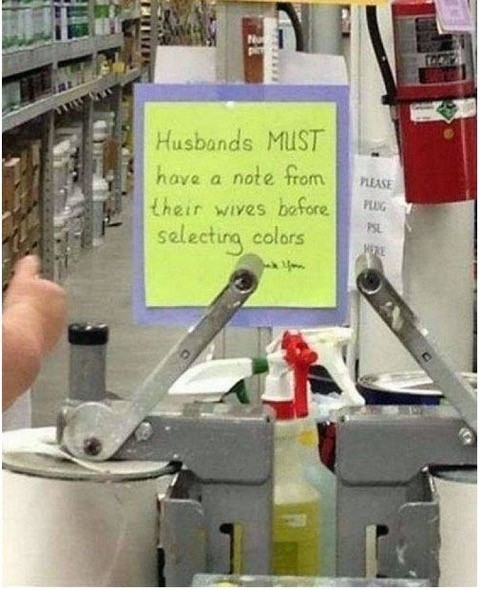
Seen in the paint section of the hardware store


Winston Churchill quotes:
• You will never reach your destination if you stop and throw stones at every dog that barks.
• Fear is a reaction. Courage is a decision.
• A nation that forgets its past has no future.
• Success consists of going from failure to failure without loss of enthusiasm.
• A good speech should be like a woman’s skirt: long enough to cover the subject and short enough to create interest.
• A pessimist sees the difficulty in every opportunity; an optimist sees the opportunity in every difficulty.
• One man with conviction will overwhelm a hundred who have only opinions.
• I’d rather argue against a hundred idiots than have one agree with me.
• An appeaser is one who feeds a crocodile, hoping he will eat him last.
• Life is fraught with opportunities to keep your mouth shut.

A Blessed Death

On December 13, 2024, I lost my dearest treasure. So this blog is very personal. Here is the eulogy I wrote for the memorial service on December 28.

Each life is sacred to God. Thus, it is fitting that we meet today to celebrate the life and faith of Barbara Ann Hurd (Breneman). She was born during the Great Depression to a strong Mennonite family living on a dairy farm near Lancaster, Pennsylvania. Farming life taught her the virtue of hard work, a virtue she demonstrated throughout her life and inflicted on her husband and children.

In 1967 Barbara began her work with Latin America Mission when she taught school in Costa Rica. We met each other there and, after a few months, became engaged on a remote airstrip in Venezuela where I was flying for Mission Aviation Fellowship. Later, we adopted our three children from Costa Rica and Colombia.

Barbara never complained about where we lived. In Venezuela she would stare up at the cockroach-eating geckos on our ceiling who would lose occasionally lose their grip and land on our supper table. As I was flying over the Venezuelan jungle, she stayed home alone with Princessa, our German Shepherd, checking my progress with our short-wave radio. When our water supply failed, she took our laundry down to the Orinoco River to wash it and beat it out on the rocks.

When we moved to Colombia she comforted me after an airplane crash, nursed me through a bout of Typhoid fever and, when we were evicted, found us a new home.

During my years at Penn State, Barbara never complained about the poverty of grad school. She worked as an overnight nurse’s aide. She planted a productive garden in rocky soil. She sewed and patched clothes. Our 100-year-old house had no furnace so we bought a free-standing woodstove and Barbara helped me build a 30-foot-high cement-block chimney for it.  On trash days, Barbara would lead the whole family out to scavenge the garbage cans and dumpsters. She made her own tortillas, except once, when she brought some hard taco shells home from a local garage sale. She linked us up with the local Christian and Missionary Alliance Church and directed their program for seniors. She took the lead in forming some of our life-long friendships.

We moved to Minnesota in 1982 where I taught at Bethel University. She painted and wallpapered our two-story colonial house and turned it into a home. We would drive at night up University Ave. to Main St. to gather what she called “used carrots,” discarded in a field by the green grocer. I would shine the headlights out over the field and she would dash out to fill a large bag with carrots while our kids would all bend down so their friends would not see them. She made ice cream with cream from a nearby Amish farm, churning it with ice that we harvested from our yard and crushed in a burlap bag. She frequently hosted students and faculty and linked us into a strong, loving network of friends. Barbara entered into the life of each church we attended and served them well—Sunday School superintendent at Good Shepherd Church and 28 years as a volunteer counselor in the North Heights counseling clinic.

In 1988 we uprooted our whole family to live for a year in Costa Rica where I taught in a missiological school. When I was caught in the eye of hurricane Joana in Bluefields, Nicaragua, she volunteered at a local shelter and awaited word from me. Several years later, she joined me for five months in northern England when I was a visiting fellow at Durham University. We explored Holy Island together, along with other wonders of the Celtic Christian world.

Barbara suffered through the many stories we told at her expense. For instance, the healing service where she said, “I wanted to go down for healing but if I got healed, I would never know what was causing it.” Like Mary Poppins, she was an Almost Perfect Person. We would joke that Lent was the hardest season of the year for her since she never could think of any sins to confess.

Barbara was the beating heart of our home. Always loyal to her husband. A sacrificial wife and mother, she fiercely fostered our social, emotional and spiritual development.

Her life motto was “To know Christ and to make him known.” She forgave people who hurt her, including her husband, and poured her life into her kids and grandkids. In the larger community, her charity was natural and unpretentious.

We lived Barbara’s last days in sacred time. In our own bed, I would hold her hand and speak my gratitude to her. Her condition waxed and waned and in the low times she would say, “I just want to go and be with Jesus.” Barbara was embarrassed at all the care we had to give her—the last words she spoke were “thank you.” She trusted in Christ and his death on her behalf and confidently looked forward to a resurrection when she would dwell in the house of her Lord forever. She died without regrets, with no unconfessed sin and with no unfinished business. It was a blessed death for her and a gift to all of us.

Barbara, I bow before your example, your faith and your service. You have distributed your rich gifts to many and now I release you to our Lord. May eternal light shine upon you.

James Hurd and family

.

WINGSPREAD Ezine for October, 2024

Please forward and share this Ezine with others. Thank you.

  • Writer’s Corner
  • Blessed Unbeliever 
  • This month’s story
  • This month’s puzzler
  • WINGSPREAD Ezine subscription information
  • Wisdom

Tip for writers: Never use a metaphor you’ve heard before. If possible, invent your own.

Task for you: When you are reading, select a paragraph you love very much. Then write your own paragraph for your own purposes copying the ideas and structures in your model paragraph. In this way you benefit from the skills of other writers.

Book of the month: Dorothy Sayers, Gaudy Night. Originally published in 1936, this novel imagines a women’s college at Oxford University immersed in sinister doings. Harriet Vane, an alumna, is pressed into service to solve the crime. Sayers conducts us on a marvelous tour of Oxford and of the inner workings of the female mind, both student and professor. One of Sayers’ best. Other of her novels: The Nine Tailors, Whose Body?, Murder Must Advertise and Clouds of Witness.

Sean McIntosh left his Fundamentalist childhood and walked the road toward becoming an atheist—while attending Torrey Bible Institute. Spoiler alert: it didn’t work out very well. Blessed Unbeliever (paper or Kindle version) can be found at Wipf and Stock Publishers, Amazon https://a.co/d/9su5F3o or wherever good books are sold.

Doc: Now, let’s test your memory of elementary school. How do you spell Mississippi?

Me: The state or the river?

Doc: (pause) Never mind . . . Look, I want you to look at this clock face and I’ll tell you a time to draw on it. Could you draw the hands to indicate 10 minutes after 11?

Me: Would that be daylight time or standard time?

Doc: Well, it doesn’t really make any difference.

Me: AM or PM?

Doc: (pause) Either one.

Me: (I write the numbers: 11:10).

Doc: That’s correct, but I actually wanted you to draw the clock hands.

Me: But I only use a digital watch. . . .

To read more, click here:  https://jimhurd.com/2024/10/25/the-annual-physical/

Leave a comment on the website and share with others. Thanks.

Imagine, if you will…

There is a yacht tied to a dock in a harbor at dead low tide. 

So, the tide begins to come in at two thirds of a foot per hour. It is a steady rate.  So if you were in the harbor and you were measuring the rate of the tide, after a half hour, it would have come in a third of a foot.

The porthole on the side of the yacht is nine feet above the surface of the water.

How many minutes will it be before that distance is reduced from nine feet to seven and a half feet?

Good luck.
 

(Answer will appear in next month’s WINGSPREAD newsletter.)

Answer to last month’s puzzler: 

You remember the boy who wanted to carry his fishing pole aboard the bus, but was rejected because it was more than the allowable four feet long. How did the boy legally get on the bus with the five-foot fishing rod without breaking it or altering it and how did he do it legally?

Here is the answer. 

He had a brilliant idea. He went back into the store and he asked them for an empty box that was 3 feet by 4 feet. And then, he put the fishing rod in the diagonal of the 3 by 4 foot box, which is exactly 5 feet. 

So he was able to get on the bus with his 5 foot fishing rod, set in the diagonal of the 3 by 4 foot box!

Click here https://jimhurd.com/home/  to subscribe to this WINGSPREAD ezine, sent direct to your email inbox, every month. You will receive a free article for subscribing. Please share this URL with interested friends, “like” it on Facebook, retweet on Twitter, etc.

If you wish to unsubscribe from this Wingspread Ezine, send an email to hurd@usfamily.net and put in the subject line: “unsubscribe.” (I won’t feel bad, promise!) Thanks.

Social Media acronyms

  • ICYMI  (in case you missed it)
  • IMHO (in my humble opinion)
  • LOL, LMAO, LMFAO (variants of laughing, including
    crude ones)
  • ROFL (rolling on the floor laughing)
  • IJBOL (I just burst out laughing)
  • FOMO (fear of missing out)
  • GOAT (greatest of all time)
  • YOLO (you only live once)
  • GIF (a short video format)

Social media-speak (How many do you know?)

  • Sycophant
  • Doomscrolling
  • Catfishing
  • Hacking
  • Clickbait
  • Frenemies
  • Ghosting
  • Phishing
  • Troll
  • Blogosphere
  • Meme
  • Crowdsourcing
  • Viral post
  • Mash-up
  • Avatar
  • Argot

WINGSPREAD Ezine for September, 2024

Please forward and share this Ezine with others. Thank you.

Contents

  • Writer’s Corner
  • Blessed Unbeliever 
  • This month’s story
  • This month’s puzzler
  • WINGSPREAD Ezine subscription information
  • Wisdom

Tip for writers: Ideally, the first paragraph of your story should do the following: 1. Introduce the main character(s), characters whom readers are willing to invest time getting to know, strong characters. 2. Give some idea of the world of the story: location, time period. 3. Hint at the main conflict or challenge. 4. Establish the tone of the story. 5. Fill the first paragraph with not only narrative or description; fill it with action.

Favorite metaphors: cow-flecked hills, moon with upturned horns, poster child for the human condition.

Book of the month: Isaac Azimov’s Foundation Series, 1950s. At some time in the distant future ships traveling faster than light ply the starry field of our Milky Way, knitting together several billion solar systems and quintillions of people The First Empire is destroyed and now it’s up to Hari Sheldon and the Foundation to construct a new empire. Nuclear blasters, mind control, a dangerous mutant—all this and more in a cosmic drama that unfolds across several millennia and the vast reaches of the galaxy.

Blessed Unbeliever (paper or Kindle version) can be found at Wipf and Stock Publishers, Amazon https://a.co/d/9su5F3o or wherever good books are sold.

September, 1946. Mother took my hand as we walked the dirt along Mr. Wheeler’s avocado orchard, turned to walk the three blocks of Culver Street, then crossed the playground toward Center Street school. I raised my eyes to view the enormous three-story wooden cube with its green-shingled hip roof and windows that stared out with unblinking eyes. I was excited about the classroom work but worried about meeting new kids. Mother pointed to a cave-like opening under the entrance stairs. “That’s the boys’ bathroom. The girls’ is on the other side; never go in there.” She said goodbye as I climbed the wooden steps to where Mrs. Brennan extended her carefully-tended white hand. She wore her greying hair up in a bun and her blue dress reached to her calves. I glanced behind me to see my mother disappearing across the playground. . . To read more, click here.  

Leave a comment on the website and share with others. Thanks.

An 11-year-old boy is standing at a bus stop in a very small town waiting for the #12 bus and holding his just-purchased fishing pole.

The bus finally arrives, but as the little boy begins to step up onto the bus, the bus driver stops him. 

“You can’t get on here with that fishing rod,” the bus driver says.

“Why not?” the little boy asks.

“There’s a new city ordinance that prohibits anything—packages, bags or anything at all—being carried on the bus that’s longer than four feet. And that fishing rod is longer than four feet. I’m sorry.”

“Well, how am I supposed to get home?” the little boy asks.

“That’s your problem, kid. That fishing rod is five feet long, so you can’t ride the bus.Sorry,” says the bus driver.

So, the kid figures he will have to return the fishing rod, get his money back, so he can get home on the bus. He goes to the store, and the clerk tells him, “No refunds. Sorry kid. You’re stuck with it.”

So he’s stuck with the fishing rod and no way to get home because he can’t take a cab because it’s too expensive.

He walks back into the store again, realizing he can’t return it. He stands thinking for a second. 

Five minutes later, he’s on the bus legally, riding home with the fishing rod, without altering it, breaking it, sawing it in half, or collapsing it. 

He does nothing whatsoever to alter the fishing rod.

How does he do it?

(Answer will appear in next month’s WINGSPREAD newsletter.)

Answer to last month’s puzzler: 

 You recall Julie’s dad had five daughters: June, July, August and September. What was the fifth daughter’s name? The fifth daughter? Julie! (Please don’t unsubscribe; the puzzler will be harder next time.)

Subscribe free to this Ezine  

Click here https://jimhurd.com/home/  to subscribe to this WINGSPREAD ezine, sent direct to your email inbox, every month. You will receive a free article for subscribing. Please share this URL with interested friends, “like” it on Facebook, retweet on Twitter, etc.

If you wish to unsubscribe from this Wingspread Ezine, send an email to hurd@usfamily.net and put in the subject line: “unsubscribe.” (I won’t feel bad, promise!) Thanks.

Disappeared words

Well, I hope you are Hunky Dory when you read this and chuckle. Here are some old expressions that have become obsolete because of the inexorable march of technology. These phrases included: Don’t touch that dial; Carbon copy; You sound like a broken record; and Hung out to dry.

Eeyoring (being glum, despondent)

Mergatroyd ? Do you remember that word? Would you believe the spell-checker did not recognize the word? “Heavens to Mergatroyd!”

The other day a not so elderly (I say 75) lady said something to her son about driving a Jalopy; and he looked at her quizzically and said, “What the heck is a Jalopy?” He had never heard of the word “jalopy!” She knew she was old . . . but not that old.

Back in the olden days we had a lot of moxie . We’d put on our best bib and tucker, to straighten up and fly right.

Heavens to Betsy!

Gee whillikers!

Jumping Jehoshaphat!

Holy Moley!

We were in like Flynn and living the life of Riley, and even a regular guy couldn’t accuse us of being a knucklehead, a nincompoop or a pill. Not for all the tea in China!

Back in the olden days, life used to be swell, but when’s the last time anything was swell? Swell has gone the way of beehives, pageboys and the D.A.; of spats, knickers, fedoras, poodle skirts, saddle shoes, and pedal pushers.

Oh, my aching back! Kilroy was here, but he isn’t anymore.

We wake up from what surely has been just a short nap, and before we can say, “Well, I’ll be a monkey’s uncle!” Or, “This is a fine kettle of fish!” We discover that the words we grew up with, the words that seemed omnipresent as oxygen, have vanished with scarcely a notice from our tongues and our pens and our keyboards.

Poof, go the words of our youth, the words we’ve left behind. We blink, and they’re gone. Where have all those great phrases gone?

Long gone: Pshaw, The milkman did it. Hey! It’s your nickel. Don’t forget to pull the chain. Knee high to a grasshopper.

Well, Fiddlesticks! Going like sixty. I’ll see you in the funny papers. Don’t take any wooden nickels. Wake up and smell the roses.

It turns out there are more of these lost words and expressions than Carter has liver pills.

This can be disturbing stuff! (Carter’s Little Liver Pills are gone too!)

Leaves us to wonder where Superman will find a phone booth.

See ya later, alligator! Okey Dokey .

From the heart

  • Some people are kind, polite, and sweet-spirited
    Until you try to sit in their pews. 
  • Many folks want to serve God,
    But only as advisers.
  • The good Lord didn’t create anything without a purpose,
    But mosquitoes come close.  
  • Opportunity may knock once,
    But temptation bangs on the front door forever. 
  • We’re called to be witnesses, not lawyers or judges.
  • I don’t know why some people change churches;
    What difference does it make which one you stay home from?
  • Be ye fishers of men. You catch ’em – He’ll clean ’em.
  • Coincidence is when God chooses to remain anonymous.
  • God grades on the cross, not the curve.
  • He who angers you, controls you!
  • What more could we want
    than to be a healing presence
    in each other’s life?

The prophetic tasks of the church are to tell the truth in a society that lives in illusion, grieve in a society that practices denial, and express hope in a society that lives in despair.
                                                                                                Walter Brueggemann

I will go out and carve a tunnel of hope from a mountain of despair.
                                                                                                Martin Luther King Jr.

The World of Center Street Elementary

September, 1946. Mother took my hand as we walked the dirt along Mr. Wheeler’s avocado orchard, turned to walk the three blocks of Culver Street, then crossed the playground toward Center Street school. I raised my eyes to view the enormous three-story wooden cube with its green-shingled hip roof and windows that stared out with unblinking eyes. I was excited about the classroom work but worried about meeting new kids. Mother pointed to a cave-like opening under the entrance stairs. “That’s the boys’ bathroom. The girls’ is on the other side; never go in there.”

She said goodbye as I climbed the wooden steps to where Mrs. Brennan extended her carefully-tended white hand. She wore her greying hair up in a bun and her blue dress reached to her calves. I glanced behind me to see my mother disappearing across the playground. As we entered, I smelled the waxed hardwood floor and turned to gawk at the carved wooden staircase rising toward second floor.

When the noon buzzer rang, Mrs. Brennan told us, “You may eat downstairs in the lunchroom or outside under the playground shelter.” Students walked to the cloakroom and grabbed lunches out of their cubbyholes but I left the building and wandered around the playground hungry, wondering why my mother hadn’t packed me a lunch.

Principal Ebersole saw me. “Are you in kindergarten?”

“Yes.”

“Why are you still here? Kindergarten ends at noon.”

“Mrs. Brennan never told us to go home.”

“Mrs. Brennan? She’s the first-grade teacher. You should have been in Mrs. Baker’s class.”

“No one told me . . .”

Mother came to pick me up.

The next morning, my neighbor Jerry and I were walking to school along Culver when we passed a dark, stuccoed house with tall grass, scraggly bushes and the window shades pulled down. “A witch lives there,” Jerry told me. We started running.

A block farther on, we looked down Harwood Street and saw the tiny store that sold Bazooka gum, M&Ms, and candy cigarettes. We walked over, searching our pockets for change. I opened the little paper packet Mom had sent with me and used the money to buy M&Ms for Jerry and me. We arrived at Kindergarten all sweet and chocolatey.

After a few weeks of walking down Culver Street we got braver and shortcut through our orange orchard smelling the fragrant blossoms so we could cut through Joe’s Lumberyard—a chaotic assortment of broken chairs, metal tables, old doors, window frames with peeling paint, derelict staircases, ceiling trusses, broken strips of siding, toilet stools, bathtubs, kitchen sinks and faucets, piles of used lumber—all strewn helter-skelter with little rabbit runs winding between. It looked like a ghost town hit by a tornado.

Stray cats haunted the woodpiles, along with the occasional rabbit. Once we saw a coyote. And then there was Sam the Tramp who guarded the lumberyard with his snarly dog Butch. Unshaven, with his long dishwater-gray hair hanging to his earlobes, he wore torn brown pants too big for him, scuffed shoes with holes in the leather and a ripped straw hat, appearing as a person destiny had a serious grudge against. He slept in a tiny tarpaper shack that stood amidst the lumber and debris. He didn’t talk; he just sat in front of his shack on an old chair with missing spindles and stared at us until we took off running. “I think he’s a serial killer,” Jerry told me.

. Mrs. Baker, serious as a Puritan preacher, sat soberly with every inch of her body erect in her desk chair. When she rose to illustrate something, her fingernails would scratch the blackboard. And yet she had a great heart for her students. Her classroom had plastered walls reaching high to the ceilings, large windows that allowed the sun to beat in onto the hardwood floor and no air conditioning. Chains supported big hanging light fixtures that glowed beige. A sandbox stood in one corner. The letters of the alphabet in block letters and cursive ran along the top of the blackboards. We sat at cast-iron-legged wooden desks on which some past students had carved their initials. A hole was cut in the top that previously held an ink jar, the purpose of which, my dad told me, was for dipping the pigtails of the girl in front of you. A pencil sharpener hung on the wall near the blackboard. Once when I blew in it to clean out the shavings, pulverized lead flew out all over my face

We always began by reciting the Pledge of Allegiance but it was years before I learned what “republic” and “indivisible” meant. I liked learning about the pilgrims and singing patriotic songs—“God Bless America,” “America the Beautiful.” Then  a song about leading the tow-mules sixteen miles along the Erie Canal and finally, “Las Chiapanecas,” about the Mexican girls who danced twirling their full skirts. I don’t remember any opening prayers. I learned to form letters and to add and subtract. Being left-handed, I would pull my pencil across the page and slant the letters to the right. The teacher gave up trying to change me. When mid-morning came, we marched down to the lunchroom where we drank our little cartons of milk, free if your family was low-income.

Then we returned to class to read from Dick and Jane—a beautiful picture story book about little kids and their dog, Spot. “Look, Dick, look.” “See Spot run.” “Jump, Spot, jump.” Dick and Jane lived in an all-white neighborhood with no dirt or trash or crime, yet still patrolled by big, friendly, blue-suited policemen. Next, we had show-and-tell time when kids would stand in front of the class and tell stories about themselves. Some of these may have been true. Once Harold told his story with his fly open. Nobody said anything.

The next year I was sitting in Mrs. Brennan’s first grade class as the hands of the big Seth Thomas wall clock nibbled away at the morning until the piercing buzzer signaled lunchtime. We carried our lunches outside to eat under wooden shelters that shielded us from the sun. The kids who ate bologna and cheese sandwiches made fun of my mom’s sandwiches of mayonnaise and avocado, made with avocados from our own orchard. Once when Darlene walked by, a boy yelled, “I wish I had that swing in my back yard!” I didn’t know what he meant..

Out on the playground, the LA basin smogged our throats. But sometimes, hot, dry, fifty-mile-per-hour Santana winds would roll in from the east through the Banning pass. The wind blew all the smog out to sea, leaving the air so clean it quivered. The trees swung their leaves like nets and shed some of their smaller branches. Inhaling the smell of blowing dust, we tried out the merry-go-round, swings, a sagging, netless basketball hoop and the exercise bars. The merry-go-round was a marvel of perpetual motion that seemed to spin forever, making your head dizzy. But if it spun too fast, the bearings would grind and it would throw kids off. The tall swings had canvas seats held by long chains. The fifth graders told us they could pump the swings so hard they looped-the-loop. I had nightmares about looping, then crashing down on the high crossbar. I spent hours shooting baskets at the solitary, sad and sagging iron hoop.

Kids would jump and grab the parallel bars with gritty, sweaty hands, then do the dead man’s drop. You got swinging by your knees, then released at the top of the swing and tried to land on your feet. When I  tried it I landed on my backside and knocked my breath away. The girls would hang upside down on these bars with their dresses falling down over their heads, yelling at the staring boys, “Get your eyes full!” The Center Street girls fascinated me. They seemed a different species, walking around the gravely playground in their white dresses with the little starched collars, white bows in their hair.

We played kickball on the dirt diamond. When it was my turn to kick, Gary Bradley sauntered over, pushed me down and took my place. I started crying. I tried to avoid him but later, in middle school, he beat me up again. Gary—poster child for the human condition, terrifying pustule of ego with bulbous eyes, puffy face and wearing an attitude tough as nails, grated on people like tinfoil on a filling. He gave me my first bloody nose. Then Sherman, an unerupted volcano with an IQ below the range of his body temperature, would push boys down onto the gravel. I avoided him until the day Mom invited him to go to church with us. Awkward. I assumed. Jesus’ command to “love your enemies” did not include Gary or Sherman,

We met Okie and Arkie kids whose parents had fled to California from the Midwest of the 1930s to escape the terrible dustbowl droughts. They took over the jobs the locals did not want and began replacing the Mexican orange pickers in the orchards. The girls in their faded dresses looked as if their mothers had forgotten to comb their hair. The boys wore longer, disheveled hair, overalls instead of jeans, and they talked funny. Big belt buckles. You didn’t want to sit next to them. They smelled perspired and If they sniffed something, they would lean over and smell your crotch.

Most Mexicans lived on the other side of Glassell and went to Killefer School. In the 1940s, Orange Unified was one of the first districts to integrate so later, in first grade, we got Richard Herrera. Brown-skinned with straight black hair, he wore a tiny crucifix hanging from a gold chain. His English was pretty good. We became friends.

Every Wednesday, the higher grades got to practice jumping onto a fire escape slide that spiraled down from the third floor. During Cub Scout nights, some of us would sneak up to the dark third floor and feel our way over to the fire escape. One after another we launched, sailing down the slick slide. We found the exit doors locked, so we had to climb back up the slide, slipping and sliding. One night the principal caught us. It was totally worth it.

At the end of my fifth grade year, Center Street finally closed her doors. That day, anyone could slide down the fire escape—even the principal! But soon they bulldozed the school to the ground. When graduation day came we filed by the principal to receive our diplomas. Afterwards the teachers assembled the students to do the Bunny Hop. But Silver Acres Church was fundamentalist and Brother Cantrell preached hard against dancing. So instead of dancing, Kevin and I sat in the hallway at a table playing chess. Kevin was happy but I felt like a nerd. That summer Jerry and I were walking through Joe’s junkyard when we saw an abandoned metal helix lying on its side, forlorn and forsaken. We stared at the twisted metal of the derelict fire escape.

After graduation I thought my bullying troubles were over. Until I moved on to the anteroom of Hades—Orange Intermediate School. Another world to conquer!

WINGSPREAD Ezine for August, 2024

Please forward and share this E-zine with others. Thank you.

  • Writer’s Corner
  • Blessed Unbeliever 
  • This month’s story
  • This month’s puzzler
  • WINGSPREAD Ezine subscription information
  • Wisdom

Tip for writers:. A good (but hard) rule to follow is to never use a metaphor you’ve seen before. One of my favorites by Mark Twain: “Why do you sit there looking like an envelope without any address on it?”

Task for you: Send me an original metaphor. I’ll publish them in the next WINGSPREAD.

Try using some of these words in your writing:

  • Hurkle-durkling          Staying in bed awake after the alarm goes off
  • Outré               Unusual or startling
  • Smellmaxxing Think tween and teen boys buying $300 cologne
  • Polycule          A molecule or “pod” of consensual non-monogamous people
  • Deepfake         Manipulated image, video or audio of people doing or saying things they never did or said
  • Bespoke          Made for a particular client
  • Belch up          Something nasty reappears
  • Scabrous         Indecent, salacious
  • Anodyne         Harmless; inoffensive
  • vertiginous     Causing vertigo
  • Perseverate    Repeat or prolong an action
  • Oeuvre             A painter’s or composer’s body of work
  • Limerence      Obsession with another person, oftentimes who does not know you
  • Swatting          A fake call to 911 to send emergency vehicles to an address
  • Couture           High-fashion designer clothes
  • Rizz                 Romantic appeal or charm

BLESSED UNBELIEVER novel

Blessed Unbeliever (paper or Kindle version) can be found at Wipf and Stock Publishers, Amazon https://a.co/d/9su5F3o or wherever good books are sold.

Man (sic) cannot name himself.
He waits for God or Satan
To tell him who he is.
                                    Unknown

Americans are experiencing a crisis of identity. I asked a middle school counselor why people came to see her. “Anxiety!” she said, “feeling they can’t measure up.” At this crucial age students compare themselves to others, especially to the images on social media that tell them two things. 1. There are Beautiful People in the world. 2. You are not one of them. . . .

Leave a comment on the website and share with others. Thanks.

 Julie’s dad had five daughters: June, July, August and September. What was the fifth daughter’s name? (Apologies to the expert puzzlers who find this puzzler too easy!)

(Answer will appear in next month’s WINGSPREAD newsletter.)

Answer to last month’s puzzler: 

So how can Sherlock Holmes be 32 the day before yesterday, but will turn 35 next year?
Here is the answer:

Watson and Holmes are sitting by the fire on January 1st when this conversation was happening. 
The day before yesterday, Sherlock was 32.
Yesterday, December 31, was his birthday and he turned 33.
So this year he will turn 34 on December 31st, and next year, he’ll turn 35. 

Trick question, but a good one!

Subscribe free to this Ezine  

Click here https://jimhurd.com/home/  to subscribe to this WINGSPREAD ezine, sent direct to your email inbox, every month. You will receive a free article for subscribing. Please share this URL with interested friends, “like” it on Facebook, retweet on Twitter, etc.

If you wish to unsubscribe from this Wingspread Ezine, send an email to hurd@usfamily.net and put in the subject line: “unsubscribe.” (I won’t feel bad, promise!) Thanks.

I’m so single right now that when I stood on a cliff and shouted “I love you,” my echo replied, “I just want to be friends.”

Red Skelton’s secret to the perfect marriage

  1. Two times a week we go to a nice restaurant, have a little beverage, good food and companionship. She goes on Tuesdays, I go on Fridays.
  2. We also sleep in separate beds. Hers is in California and mine is in Texas.
  3. I asked my wife where she wanted to go for our anniversary. “Somewhere I haven’t been in a long time!” she said. But when I suggested the kitchen she got all mad . . .
  4. We always hold hands. If I let go, she shops.
  5. My wife told me the car wasn’t running well because there was water in the carburetor. I asked where the car was. She told me, “In the lake.”
  6. Remember: Marriage is the number one cause of divorce.
  7. I married Miss Right. I just didn’t know her first name was ‘Always’.
  8. I haven’t spoken to my wife in 18 months. I don’t like to interrupt her.
  9. The last fight was my fault though. My wife asked, “What’s on the TV?” I said, “Dust!”
  • American author Dorothy Parker once wrote: “If you have any young friends who aspire to become writers, the second-greatest favor you can do them is to present them with a copy of The Elements of Style. The first-greatest, of course, is to shoot them now, while they’re happy.”
  • People often mistake me for an adult because of my age.
  • A truck loaded with thousands of copies of Roget’s Thesaurus crashed yesterday losing its entire load. Witnesses were stunned, startled, aghast, taken aback, stupefied, confused, shocked, rattled, paralyzed, dazed, bewildered, mixed up, surprised, awed, dumbfounded, nonplussed, flabbergasted, astounded, amazed, confounded, astonished, overwhelmed, horrified, numbed, speechless, and perplexed.

Identity Crisis

Man (sic) cannot name himself.
He waits for God or Satan
To tell him who he is.
                                    Unknown

Americans are experiencing a crisis of identity. I asked a middle school counselor why people came to see her. “Anxiety!” she said, “feeling they can’t measure up.” At this crucial age students compare themselves to others, especially to the images on social media that tell them two things. 1. There are Beautiful People in the world. 2. You are not one of them.

Identity matters. An ambiguous or negative identity can provoke depression, anger, social isolation and even homicide or suicide. For example, National Institutes of Mental Health reports that gender dysphoria (confusion about one’s gender) creates a profound confusion about identity and is reflected in higher suicide rates. Among transgender adults in the U.S., 81% have thought of suicide, 42% have tried it, and 56% have engaged in non-suicidal self-injury over their lifetimes.

My identity imposed by others?

People receive their identity from others. The child receives their identity from parents: gender, race and membership in a social or religious group (e.g., male white Protestant)..

Even more than our adopted daughters, our son struggled with his racial identity after we adopted him in Colombia. When he was eight, I told him that my great-grandfather Alex was born in Dublin. He asked me wide-eyed: “Dad—Are we Irish?”

Amish communities socialize their children to see themselves as a member of the Amish community. They erect barriers, physical and social, that limit the child’s contact with alternative possibilities. This illustrates the social nature of identity and the power of intentional socialization.

Most parents “gender” their children, e.g., encourage and strengthen the child’s gender identity. Children usually accept these imposed identities. How far should parents go to reinforce a child’s identity, or how enthusiastically should they support their wish to change? A suicidal girl in high school transitioned from female to male gender. His suicidal thoughts subsided. His father exclaimed, “I finally have the boy I wished for!”

Personally constructing an identity

People learn to reinforce their identities through clothing, grooming or behavior. The New York Times reported a recent event where 24 NBA rookies, before they were drafted, met to show off their clothes and discuss their decisions about how to represent themselves.

No one is condemned to accept their socially-imposed identity. But what happens when a person transgresses, challenges the identity given to them? They might start “talking black,” swearing, dressing differently, cosplaying (dressing and acting like a fictional or famous character). Sometimes transgression is temporary but sometimes it becomes permanent.

Amish young people sometimes attempt to leave their church, community and culture. People sometimes try to renounce their families. When young people go to college they may form new friend groups along with new opinions and new identities.

We all exhibit layered, hierarchical identities, some more salient than others. People may get caught displaying one identity in one group but codeswitching when in another group. Years ago I was on a train with a group of marines headed home after Pendleton Marine bootcamp. They were earnestly trying to clean up their foul “Marine language” before showing up at Mom and Dad’s door. Their new marine identity clashed with their identity in their family.

Standing out or fitting in? Instead of trying to fit in, some people may strive to stand out. An elementary school principal told me that when the fifth-grade kids were asked to form a boys’ line and a girls’ line, two students stood apart. They were trying out “nonbinary” (refusal to identify as either gender). I asked the principal if “nonbinary” would become their permanent identity. “Probably not,” he said. “They’re just trying it out.”

My adopted son identified as African-American all through school and beyond. But after he turned 40, he sent off his DNA sample to figure out his genetic history. It came back with a little African but substantial “Spanish” ancestry. So he changed and began to identify as Latino. He feels more comfortable with this new identity and is trying to grow into it. I joke with him that he should start wearing Converse tennis shoes and squinting a little!  

“I am who I say I am.” And yet when does my freedom impinge upon others? People may try to adopt a new identity but their family or social group may refuse to accept the change. So they must give up the attempt to change or seek a new social group. Suppose I am white but I try to identify as Latino or black on a college application. Or try to present myself as having Tourette’s syndrome without being diagnosed. These experimental identities carry economic and legal implications and ultimately may not be accepted by others.

Performing gender identity

Is gender identity personally constructed? A young child gradually learns their gender identity and learns how to perform that identity. When I was a young boy I was desperate to fit the image of a male—I would try to cross my legs like a man rather than like a woman. Elvira de Bruyn was a Belgian cycling champion who excelled in women’s cycling races in the 1930s. However in 1937 he declared he wished to live the rest of his life as a man.

What is “female” and what is “male” behavior, anyway? These identities are not all arbitrary, not all culturally imposed. Richard Dawkins argues that in any species, being male or female demands certain behaviors, especially those behaviors most closely connected to reproduction. This is because natural selection rewards certain behavioral strategies in males, and different strategies in females, by imparting reproductive success (offspring). A male has an unlimited supply of sperm, but a female has a limited number of valuable eggs. Thus, for instance, a male may seek a variety of sexual partners and change partners more often while a female may seek fewer partners and focus more on quality and caretaking. Thus, although males and females each show a wide spectrum of behaviors, we are warranted in identifying as typical those “male” and “female” behaviors that are key to reproductive success.

Here are a few terms related to sexual preference and gender orientation.

  • Sexual identity: Innate identity based on genitalia, DNA and secondary sex characteristics
  • Intersexual: ambiguous genitalia
  • Bisexual: sexually attracted to both male and female persons
  • Gay, lesbian, homosexual: same-sex attracted
  • Queer: non-conforming to majority ideas of sex or gender
  • Cisgender: My gender conforms to my biological sex characteristics
  • Transvestite: dressing as the opposite gender
  • Transgender: adopting a gender that does not conform to one’s biological or birth sex. Transgender people may seek speech therapy to feminize or masculinize their voices, trying to conform to their new gender.
  • Cosplay: dressing up as a famous character, real or fictional. For instance, children of both genders may wear an “Elsa” dress when cosplaying the Disney character.
  • Nonbinary: not exclusively identifying with male or female gender. Switching between male and female roles or even trying to avoid stereotypic male or female behaviors.
  • Two-spirit: Refers to individuals in some native American cultures who demonstrate aspects of both male and female genders
  • LGBTQIAI2S+  Lesbian, gay, bisexual, transsexual, queer, inquiring, asexual, intersex, two-spirit, plus “other.” This is a catch-all term for non-traditional gender and sexual roles.

Legal protection of identity

Can I force others to honor my chosen identity(ies)? Identity politics argues for the rights of individuals to assert their membership in a group: ethnic, religious, sexual, etc. Many states have “hate crime” laws to prosecute offenders targeting certain ethnic, racial or religious groups. These laws compel the many to respect the rights of the few. Just last month, California banned schools from forcing teachers to notify parents when students request different names or pronouns. (In protest, Elon Musk said he would move the headquarters of his companies X and SpaceX from California to Texas.)

In Tennessee, four transgender women plaintiffs petitioned the court to change their sex on their birth certificates to conform to their current gender identity. Just recently the 6th U.S. Circuit Court of Appeals upheld a 2023 district court ruling that found that the state of Tennessee can legally prohibit changing a child’s sex on their birth certificate. Across the states, laws about identity are constantly changing—encouraging or restricting people’s attempts to assert their identity.

And bathrooms. Some schools have responded to the “bathroom issue” by creating unisex bathrooms. For instance, Blaine High School has generic bathrooms (no doors, wide entrances, a row of sinks on one side and individual stalls on the other). This prevents transgendered men from walking into single-sex women’s bathrooms (because there are none).

And yet even the law does not and should not compel acceptance of certain identities: criminal, abusive, pedophile (or the euphemism “minor-attracted person,” MAP ). An 18-year-old person cannot identify as a 22-year-old so they can buy alcohol. The law prevents an individual from impersonating a doctor or an officer of the law. It is illegal to gain employment using falsified credentials.

Religious groups have successfully litigated against some identity laws. For instance, Christian colleges are not yet compelled to hire individuals who identify as gay or transgender. These colleges argue that this hiring would violate their religious beliefs about the sacredness of heterosexual sex and biblical teaching asserting two distinct biblical genders.

Discovering a healthy identity

How can I name myself, be true to myself? If the epigraph at the head of this essay is true, we ultimately need to find our identity in the transcendent— an identity primordial, unchanging, holistic, certain.

For Christians, the Bible encourages us to embrace a new identity. I “cannot name myself” but I can embrace and grow into the person God says I am. St. Paul talks about the old person and the new person. To become a Christ-follower means to embrace a new identity—child of God and brother/sister to Christ. This identity is neither imposed by our social group nor fabricated by the individual. It is a gift from God and is immune to the tides and storms that threaten to overwhelm. With a plethora of identities swirling around us we must choose who to trust. For Christians, our identity is rooted in trusting how God defines us.