Tag Archives: writing

WINGSPREAD for March, 2024

Please forward and share this Ezine with others. Thank you.

  • Writer’s Corner
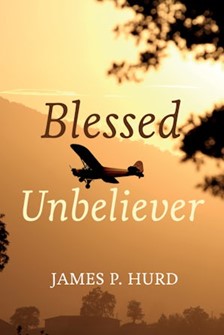
  • Blessed Unbeliever  available
  • New story: “Pitch Perfect”
  • This month’s puzzler
  • Wingspread Ezine subscription information
  • Wisdom

This month’s writing quote: “If it sounds like writing, I rewrite it.” Elmore Leonard

Tip for writers: Begin your story in media res. You do not have to “begin at the beginning.” Try starting your story just before or just after the peak of the action. Example: “I’m not dead! But I have no idea what happened.” This hooks the reader. Then, go back and start at the beginning.

Word of the month: OBLIQUE DIALOGUE. Good dialogue makes a good story. It should sound natural, though. Just statement-response, statement-response gets stilted and boring; it doesn’t sound natural. Oblique dialogue means that the response is oblique; not just a simple response. For example—Kathy: “I wonder when Mom will get home.” Bill: “I worry about her being gone so much.”   Another—Kathy: “Do you think this dress makes me look fat?”  Bill (a wise husband): “I think you have great taste in clothes.” Notice he doesn’t directly answer the question.

Question for you:  How to overcome writer’s block?

  • Get a list of “prompts” and write briefly on several of them.
  • Take a piece you’ve written and try to condense into just 100 words.
  • Ask “what if?” For instance, what if a character is carrying a dark secret? What if she were born in a different town?
  • Mine your own life for people and events that you can use to transform your writing.
  • Freewrite. Just start writing. The only rule is do not stop.

BLESSED UNBELIEVER novel

Blessed Unbeliever (paper or Kindle version) can be found at Wipf and Stock Publishers, Amazon https://a.co/d/9su5F3o or wherever good books are sold.

A normal smoggy day at Chino airport. I’d just taken off with my student, Stan, whom I was checking out in the Taylorcraft.

The takeoff was normal, but after we leveled off, our increasing speed tended to force the nose up.

“Trim the nose down, Stan.”

“I am trimming down.”

“Trim down more.”

“I am!”

“Give me the controls.”

I grabbed the dual control wheel and it just about hit me in the face! The airplane was trying mightily to pitch up. . . .

To read more, click here  https://jimhurd.com/2024/03/09/pitch-perfect/

Leave a comment on the website and share with others. Thanks.

(Thanks to Car Talk puzzler archives.)
A friend of mine who works at a bank was doing her accounting duties. She noticed that there was a balloon payment coming up and she said, “Well, that’s interesting. Balloon. b.a.l.l.o.o.n. There are two sets of double letters in that word. Hmm.”

And so she thought to herself, is there a word in the English language that has three sets of double letters in a row? And as I was working on this one, I came across a word that has two H’s in it, back to back. 

So the puzzler has two parts. What word has three sets of double letters in it? And what word has a double H?

Now, there may be 2500 answers to this one, I know. Just have fun with it. 

(Answer will appear in next month’s WINGSPREAD newsletter.)

Answer to last month’s puzzler: 

Recall Uncle Enzo had 11 antique cars and his will specified: one-half of them should go to his oldest son, one-fourth to his middle son and sixth of them to his youngest son. How will they divide them up?

Then Uncle Vinny shows up with his car and he says, “Look, I will lend you my car.” So, once he lends them his car, they have 12 cars.

So, now with 12 cars, 6 of them go to the oldest son. That would be half. A fourth of the cars, or 3 cars, go to the middle son, and a sixth of the cars, or 2 cars, go to the youngest son. That leaves only one car.

Then, Vinny takes his car back. The split has happened the way Uncle Enzo wanted it to, because 6, 3 and 2 make 11. 

Fractions are fun, right?
Subscribe free to this Ezine  

Click here https://jimhurd.com/home/  to subscribe free to this WINGSPREAD ezine, sent direct to your email inbox, every month. You will receive an article for subscribing. Please share this URL with interested friends, “like” it on Facebook, retweet on Twitter, etc.

If you wish to unsubscribe from this Wingspread Ezine, send an email to hurd@usfamily.net and put in the subject line: “Unsubscribe.” (I won’t feel bad, promise!) Thanks.

Wordplay — thoughts on modern era marketing signage

Signage for an Electrician’s truck: Let us remove your shorts

Signage for a curtain delivery truck: Blind man driving

Signage for a Podiatrist’s office: Time wounds all heels

Signage for a Septic Tank Truck: Yesterday’s Meals on Wheels

Signage for an Optometrist’s Office: If you don’t see what you’re looking for, you’ve come to the right place.

Signage for a Plumber’s truck: We repair what your husband fixed. Don’t sleep with a drip. Call your plumber.

Signage for a Tire Repair Shop: Invite us to your next blowout

Signage for a Maternity Room door: Push. Push. Push.”

Signage for a Car Dealership: The best way to get back on your feet—miss a car payment.

Signage for a Muffler Shop: No appointment necessary. We hear you coming.

Signage for a Veterinarian’s waiting room: Be back in 5 minutes. Sit! Stay!

Signage for a Shoe repair store: We will heel you and save your sole, we will even dye for you.

Signage for an Electric Company: We would be delighted if you send in your payment on time. However, if you don’t, YOU will be de-lighted.

Signage for a Restaurant: Don’t stand there and be hungry; come on in and get fed up.

Signage for a Funeral Home:: Drive carefully. We’ll wait.

Signage for a Propane Filling Station: Thank Heaven for little grills.

Signage for a Radiator Shop: Best place in town to take a leak.

And—last but not least—Signage for another Septic Tank Truck: Caution—This Truck is full of Political Promises.

When I fed the poor they called me a saint. When I asked why they were poor, they called me a Communist.                —Bishop Dom Helder Camara of Recife, Brazil
Wingspread Ezine for February, 2024

Please forward and share this E-zine with others. Thank you.

Contents

  • Writer’s Corner
  • Blessed Unbeliever
  • New story
  • This month’s puzzler
  • Wingspread Ezine subscription information
  • Wisdom

Tip for writers: Rabbit trails. Wonderful paragraphs, or even chapters, that interrupt the narrative but may enrich the story. (E.g., in Les Miserables Victor Hugo interrupts the narrative by inserting four chapters of deep, miasmic description of the extensive sewer system under Paris.) How does a writer get away with this—the modern reader may lose interest if the author abandons the narrative. Some answers: 1. Break up these interruptions into smaller bits. 2. Insert some narrative into the diversion. 3. Never put a diversion in the first chapter of the book. 4. Include a protagonist or main character in the diversion. 5. Explain to the reader the purpose of the diversion. 6. Know that some readers may skip over a rabbit trail to get on with the dominant narrative. Charles Darwin, in his own family’s reading together, called this skipping “skipibus.” It’s alright; you have my permission.

Word of the month:  REVENANT: One that returns after long absence or after death. E.g., “He thought I was dead; I was a revenant from his distant past.”

Book of the month: LES MISERABLES. Victor Hugo. 1862. Translated by Charles Wilbour. Modern Library: New York. 1200 pages. A vast narrative set in Paris and its environs in the early 1800s. Fleeing from police inspector Javert, the convicted thief Jean Valjean robs a kind bishop who has sheltered him, but the bishop refuses to turn him over to the authorities. Valjean resolves to amend his life. He adopts little Cossette, daughter of a prostitute. Javert pursues them but at the insurrection barricades, Valjean saves Javert’s life. When Cossette falls in love with Marius Valjean hates him for stealing him away from her. And yet, Valjean saves Marius’ life, delivers him to precious Cossette, and as his own life ends, endows the happy couple with great wealth.

Question for you:  How do you personally overcome writer’s block? I’ll put some of your responses in the next Wingspread.

Blessed Unbeliever (paper or Kindle version) can be found at Wipf and Stock Publishers, Amazon https://a.co/d/9su5F3o or wherever good books are sold.

It’s too late for me, so you ask Grandpa Anderson what it was like building his tarpaper shack on the South Dakota prairie. Or ask him how he survived the death of his two young boys (your uncles), Jamie and Calvin. Grandpa and Grandma won’t be around forever, and after they’re gone you’ll long to be able to ask them questions. Ask them now. . . . To read more, click here  https://jimhurd.com/2024/02/06/a-letter-to-my-fourteen-year-old-self-you-are-not-weird/

Leave a comment on the website and share with others. Thanks.

(Thanks to “Car Talk Archives”) Many years ago, we had an uncle named Enzo. We only vaguely remember him. We were very young. Anyway, he went back to Italy. But before he went, he had 11 antique cars here. Each of them had a value of about 500 bucks. This was a while ago. 

So, when our Uncle Enzo died, he left a very interesting will. His will said that his 11 cars be divided among his three sons. But he wanted the oldest son to get more of his estate, due to his age. 

Half of the cars would go to the eldest son. One fourth of the cars to the middle son. And one sixth of the cars to the youngest son. 

So after the reading of the will, everyone was puzzled. Because there are 11 cars, and 11 is a prime number, it cannot be divided in halves, fourths or sixths. 

So just as everyone is scratching their heads not knowing what to do, our Uncle Vinny shows up in his 1962 Chevy Bel Air and says, “Don’t worry. I know what to do. I can help with my car.”

And the puzzler is, how do they do it?

Good luck.
 

Answer to last month’s puzzler: 

“Crusty” the mechanic had a little test to check out how good a car’s engine was. So, what was Crusty doing under the hood?

This little test is something he could do with his eyes closed. He didn’t even have to look at the engine. In fact, he often did this with his eyes closed so as not to be distracted by anything else. 

What he was doing was disconnecting the coil wire so the engine would crank, but it wouldn’t start. It was a kind of compression test. So he was listening for how the engine would crank and whether or not it would crank evenly. So as every piston came up on its compression stroke, he would hear the cadence of the engine. Cool, huh?

Subscribe free to this Ezine  

Click here https://jimhurd.com/home/  to subscribe to this WINGSPREAD ezine, sent direct to your email inbox, every month. You will receive a free article for subscribing. Please share this URL with interested friends, “like” it on Facebook, retweet on Twitter, etc.

If you wish to unsubscribe from this Wingspread Ezine, send an email to hurd@usfamily.net and put in the subject line: “unsubscribe.” (I won’t feel bad, promise!) Thanks.

Joyce Johnson said: Artists are nourished more by each other than by fame or by the public. To give one’s work to the world is an experience of peculiar emptiness. The work goes away from the artist into a void, like a message stuck into a bottle and flung into the sea.

He who has a “why” can bear any “how.” Nietzsche

The more often a man feels without acting, the less he will be able ever to act, and, in the long run, the less he will able to feel.   C.S. Lewis

The difficulty of literature is not to write, but to write what you mean. Robert Louis Stevenson

He was too cowardly to do what he knew to be right, as he had been too cowardly to avoid doing what he knew to be wrong.                  Charles Dickens

WINGSPREAD for October, 2023

A warm welcome to this month’s Ezine, offered to fellow travelers and especially to fellow writers. Enjoy. (Please forward and share this E-zine with others. Thank you.)

  • Writer’s Corner
  • New story
  • This month’s puzzler
  • Blessed Unbeliever now available
  • Wingspread Ezine subscription information
  • Wisdom

Tip for writers: First, write for yourself. Are you satisfied? Trust yourself to tell the story you wish to tell with your own voice.

Word of the month: METAWRITING. Writing about your writing. Especially in nonfiction (and rarely in fiction), we have the Preface. Here, you tell the reader what you’re trying to do, how you are going to do it and why. Metawriting also may give you insight when you revise your writing.

Question for you: How do you know when you’re done writing a book? When you’re satisfied? When your editor/publisher is satisfied? You’re tired of the thing? Deadline? Cannot improve on it?

Are you serious about wanting to write? If so, try writing just a few lines each day (or each week) using the following prompts. Guaranteed to get the creative juices flowing.

Our writing must never be only goal-oriented—directed toward a published product. We must write for practice, for opening our creativity and (dare I say it?) just for fun.

Day 1: Write a story with no dialogue
Day 2: Take something usual and have it do something unusual
Day 3: Write a story that incorporates the color red
Day 4: Select a kitchen item; write from its perspective
Day 5: Write a story about a couple
Day 6: Write something in the absurdist style

Day 7: Write a discovery
Day 8: Write a one-sentence story
Day 9: Write about a surprise gone wrong
Day 10: Write about an animal
Day 11: Write about a holiday
Day 12: Write about a food you (or your character) hate
Day 13: Write about the weather

Day 14: Write about non-romantic love
Day 15: Write about someone who needed to take a deep breath
Day 16: Think about something boring; make it interesting
Day 17: Write a how-to in the second person
Day 18: Write someone’s online dating profile
Day 19: Write about an argument
Day 20: Write about an unopened letter

Day 21: Write about something that scares you
Day 22: Write in a form you normally wouldn’t
Day 23: Write something based on a random word
Day 24: Create a new myth
Day 25: Write about a cryptid (a mythological animal)
Day 26: Write about a piece of clothing
Day 27: Write something that makes you laugh
Day 28: Write a story with only dialogue

**Note: I know everybody understands the things I wonder about. So you could consider these a plaintive plea for sympathy and insight.

Why do some birds find their way from New York to Chile while I get lost three blocks from my home? (True story.) I’ve had trouble navigating all my life— missing exits on the freeway, getting lost on cross-country flights, even walking out of a downtown store and turning north instead of south. What’s up? Am I just not paying attention? Is it genetic?

At our apartment in Oak Crest we have a football-field-sized main hallway, 50 yards down each wing. I walk home down the hallway and burst unannounced into Larry and Julie’s apartment. “Hi, Larry and Julie! No, nothing; just dropping by.” Their door is the last door on the right in the east wing. My apartment door is the last door on the right in the west wing. Not only have I done this three times but I don’t know why, or how to avoid doing it next time. . . .

To read more, click here:  https://jimhurd.com/2023/10/04/navigating/

 Leave a comment on the website and share the site with others. Thanks.

(Adapted from Car Talk Puzzler archives)

There is in the English language, a seven-letter word that contains nine words without rearranging any of the letters.  So using pieces of the original word, without changing the placement of the letters, you can form nine words. What is the word?

So the original word has seven letters, but there are nine words buried in this seven-letter word. 

For example, the word ‘garbage’. This word contains these three words:

1. Garb

2. Bag

3. Age

And the word we are looking for is a seven-letter word that has nine words buried in it, including itself. There might even be more . . .

(Answer will appear in next month’s WINGSPREAD newsletter.)

Answer to last month’s puzzler: 

This one was very simple. Which of the following words does not belong, and why?

  • Mother
  • Father
  • Cousin
  • Uncle
  • Brother
  • Aunt

And the answer is: the word cousin does not belong. And why? Because it is the only word that does not describe the gender of the family member. Cousin can be either male or female. (Alternative answer: “Aunt” is the only one-syllable word.)

BLESSED UNBELIEVER novel

Blessed Unbeliever (paper or Kindle version) can be found at Wipf and Stock Publishers, Amazon https://a.co/d/9su5F3o or wherever good books are sold.

Subscribe free to this Ezine  

Click here https://jimhurd.com/home/  to subscribe to this WINGSPREAD Ezine, sent direct to your email inbox every month. You will receive a free article for subscribing. Please share this URL with interested friends, “like” it on Facebook, retweet on Twitter, etc.

If you wish to unsubscribe from this Wingspread Ezine, send an email to hurd@usfamily.net and put in the subject line: “unsubscribe.” (I won’t feel bad, promise!) Thanks.

BRITISH HUMOR IS DIFFERENT
These are classified ads, which were actually placed in U.K. Newspapers:   
FREE YORKSHIRE TERRIER.  
8 years old,
Hateful little bastard.
Bites!     
FREE PUPPIES
  
1/2 Cocker Spaniel, 1/2 sneaky neighbor’s dog.     
FREE PUPPIES.

Mother is a Kennel Club registered German Shepherd.
Father is a Super Dog, able to leap tall fences in a single bound.  
COWS, CALVES: NEVER BRED.
Also 1 gay bull for sale.  
JOINING NUDIST COLONY!
Must sell washer and dryer £100.    
WEDDING DRESS FOR  SALE .  
Worn once by mistake.
Call Stephanie.  
FOR  SALE BY OWNER.
Complete set of Encyclopedia Britannica, 45 volumes.
Excellent condition, £200 or best offer. No longer needed, got married, wife knows everything.     

Whoopsie

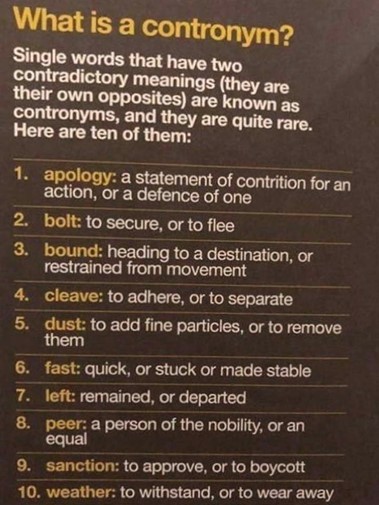
Oxymorons

Like other kinds of figurative language, oxymorons (or oxymora) are often found in literature. As shown by this list of awfully good examples, oxymorons are also part of our everyday speech. You’ll find common figures of speech, plus references to works of classic and pop culture.

  • absent presence (Sidney 1591)
  • alone together
  • awful good
  • beggarly riches (Donne 1624)
  • bittersweet
  • brisk vacancy (Ashbery 1975)
  • cheerful pessimist
  • civil war
  • clearly misunderstood
  • comfortable misery (Koontz 2001)
  • conspicuous absence
  • cool passion
  • crash landing
  • cruel kindness
  • darkness visible (Milton 1667)
  • deafening silence
  • deceptively honest
  • definite maybe
  • deliberate speed
  • devout atheist
  • dull roar
  • eloquent silence
  • even odds
  • exact estimate
  • extinct life
  • falsely true (Tennyson 1862)
  • festive tranquility
  • found missing
  • freezer burn
  • friendly takeover
  • genuine imitation
  • good grief
  • growing smaller
  • guest host
  • historical present
  • humane slaughter
  • icy hot
  • idiot savant
  • ill health
  • impossible solution
  • intense apathy
  • joyful sadness
  • jumbo shrimp
  • larger half
  • lascivious grace (Shakespeare 1609)
  • lead balloon
  • liquid marble (Jonson 1601)
  • living dead
  • living end
  • living sacrifices
  • loosely sealed
  • loud whisper
  • loyal opposition
  • magic realism
  • melancholy merriment (Byron 1819)
  • militant pacifist
  • minor miracle
  • negative growth
  • negative income
  • old news
  • one-man band
  • only choice
  • openly deceptive
  • open secret
  • original copy
  • overbearingly modest
  • paper tablecloth
  • paper towel
  • peaceful conquest
  • plastic glasses
  • plastic silverware
  • poor health
  • pretty ugly
  • properly ridiculous
  • random order
  • recorded live
  • resident alien
  • sad smile
  • same difference
  • scalding coolness (Hemingway 1940)
  • seriously funny
  • shrewd dumbness
  • silent scream
  • small crowd
  • soft rock
  • “The Sound of Silence” (Simon 1965)
  • static flow
  • steel wool
  • student teacher
  • “sweet sorrow” (Shakespeare 1595)
  • terribly good
  • theoretical experience
  • transparent night (Whitman 1865)
  • true fiction
  • unbiased opinion
  • unconscious awareness
  • upward fall
  • wise fool
  • working vacation