Grey towers of Durham,
Yet well I love thy mixed and massive piles,
Half church of God, half castle ‘gainst the Scot,
And long to roam these venerable aisles,
With records stored of deeds long since forgot.
―From Sir Walter Scott,
etched on the Prebends Bridge, Durham
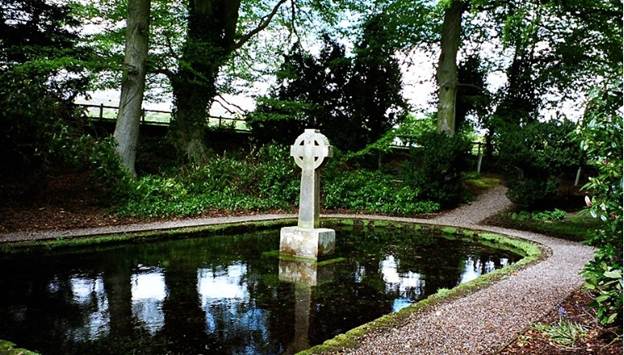
Just a small spring, oval-shaped and rimmed with stones. And yet when Rachel’s husband was dying of cancer, they would visit this spring and walk around its rim. Both were self-described agnostics, yet Holystone Spring became for them a sacred place.
Rachel, admin in the Department of Anthropology at Durham University where I was a visiting fellow, suggests to Barbara and me that we take a Saturday ramble to the spring. For her, this little pool provides peace amidst her grief, and she is kind enough to introduce us.
She drives us along winding roads through pasturelands of sheep and cattle bounded by dry stone fences. She points to a cave near a river. “That’s where Cuthbert, a seventh-century Celtic monk, used to live and pray.” We eventually leave the paved road and drive through a cattle gate and across a field to stop near a small wood. This is not a tourist spot―we see no one else. Exiting the car, we walk to a stone fence and open a gate. Walking into the wood, we enter a circle of seven large beech trees and come to a small, oval pool that holds the waters of Holystone Spring. I dip my hand into the cool, clear waters. On the margins grow bright yellow monkeyflowers, watercress and celandine that flourish in this cool shade. A Celtic stone cross rises out of the waters, placed here in Victorian times to honor early Celtic missionaries. On the edge of the spring stands a gray stone statue of Bishop Paulinus that was carved in the fifteenth century. Legends tell of him baptizing thousands of Northumbrians here in this place where Roman cavalrymen used to water their horses.
We circle the spring in silence, enjoying the coolness of the wood, seeing the sun’s sparkle on the still waters, examining the cross and statue, honoring the memory of Rachel’s husband and respecting this place holy to her and to the thousands of pilgrims who have visited over the centuries.
In the early twelfth century Holystone became the home of a priory of Augustinian canonesses. They took charge of the famous spring and christened it “Lady’s Well,” after the Virgin Mary. But in 1541, Henry VIII abolished their monastery (along with many others all over England) and ordered their buildings razed during what became known as the “Dissolution of Monasteries.” All that remains today is an excavated site that reveals the thick, ancient walls.
So can we call Holystone Spring a “sacred site?” It is a place where pilgrims come to meditate, a place of great spiritual importance over the centuries. Ironic that it lies here hidden, a silent witness to the men and women whose lives were changed here forever.
As we depart, I smile, thinking back to my fundamentalist childhood in California. I treasure the Bible knowledge I gained, the orientation toward Christ and the gospel, the moral guidance. And yet we had no holy objects, no “saints,” no pilgrimages, no treasured studies of church history, no sacraments and no sacred places (we used to play chess on the communion table). Fundamentalism was evangelizing and missionizing, Bible- and doctrine-based, accompanied by strict lifestyle prohibitions (no smoking, drinking, dancing or going to movies). I treasure that early formation, but if I had only one day to live, and could choose one place in all the world to visit, I would choose Holystone Spring.

